
What you’ll learn in this article…
- W. P. Carey Full-Time MBA tuition starts at $63,000 for Arizona residents.
- Online and evening MBA applicants can skip the GMAT entirely.
- Arizona operations managers earn roughly $131,030, reinforcing strong MBA ROI.
Arizona State University's W. P. Carey School of Business ranks among the top 50 MBA programs nationally, but the real decision for most applicants comes down to format: a two-year full-time immersion, a 21-month evening track for working professionals, or a fully online degree that never requires a campus visit. All three carry AACSB accreditation and a STEM MBA designation, credentials that matter for international students seeking OPT extensions and for anyone betting on data-driven management roles.
Total program costs range from roughly $45,000 for the online option to more than $90,000 for out-of-state full-time students. GMAT waiver policies differ sharply by format, with some requiring no GMAT. And post-graduation salaries in Arizona's major metros now exceed $130,000 for operations managers.
ASU W. P. Carey MBA Program Overview: Formats, Rankings, and Accreditation
What formats does the W. P. Carey MBA offer, and how does the program stack up in national rankings? Arizona State University's W. P. Carey MBA offers three distinct MBA pathways, each built for a different stage of career and life. All three carry AACSB accreditation, the gold standard held by fewer than 6 percent of business schools worldwide, and the full-time program holds STEM designation3, a detail that matters enormously for international applicants.
Three MBA Formats at a Glance
- Full-Time MBA (21 months): A traditional, immersive program based at ASU's Tempe campus. Students complete coursework over four semesters plus a summer. Because certain concentrations fall under STEM-designated CIP codes3, F-1 visa holders who choose those tracks qualify for a 36-month OPT extension, nearly tripling the standard post-graduation work authorization window.
- Evening/Fast-Track MBA: Designed for working professionals in the Phoenix metro area, this format compresses the curriculum into roughly 21 to 24 months of evening classes. Students maintain full-time employment while progressing through the same core coursework.
- Online MBA: Consistently ranked in the top 10 nationally by U.S. News, the online program offers maximum scheduling flexibility. Coursework is delivered asynchronously with periodic live sessions, and most students complete the degree in about two years depending on course load.
Where W. P. Carey Ranks
The full-time MBA earned the No. 29 spot in the 2026 U.S. News Best Business Schools ranking, placing it No. 12 among public universities.1 In the Financial Times global MBA ranking, the program sits at No. 53 worldwide, with particularly strong showings in faculty research (No. 27) and career services (No. 22).1 The part-time format ranks No. 27 in U.S. News, making it the highest-ranked among Arizona MBA programs.1 Meanwhile, the online MBA holds a No. 8 position for online MBAs overall and a No. 3 ranking for online graduate business programs, with specialty rankings in the top six for general management, business analytics, finance, and marketing.1
Class Profile Snapshot
The full-time cohort is intentionally small, among the three smallest in the U.S. News top 30, which translates into close faculty interaction and tight peer networks. Students enter with an average of about five years of professional experience.3 The school does not publicly disclose a single median GMAT score or GPA figure for its incoming class, so applicants should expect a holistic review rather than a hard cutoff. Detailed admissions criteria, including test-optional pathways, are covered in the sections that follow.
From an outcomes standpoint, the full-time program reports a two-year average employment rate of 83.7 percent at graduation, climbing to 96.2 percent within three months2, figures that signal strong employer demand for W. P. Carey graduates.
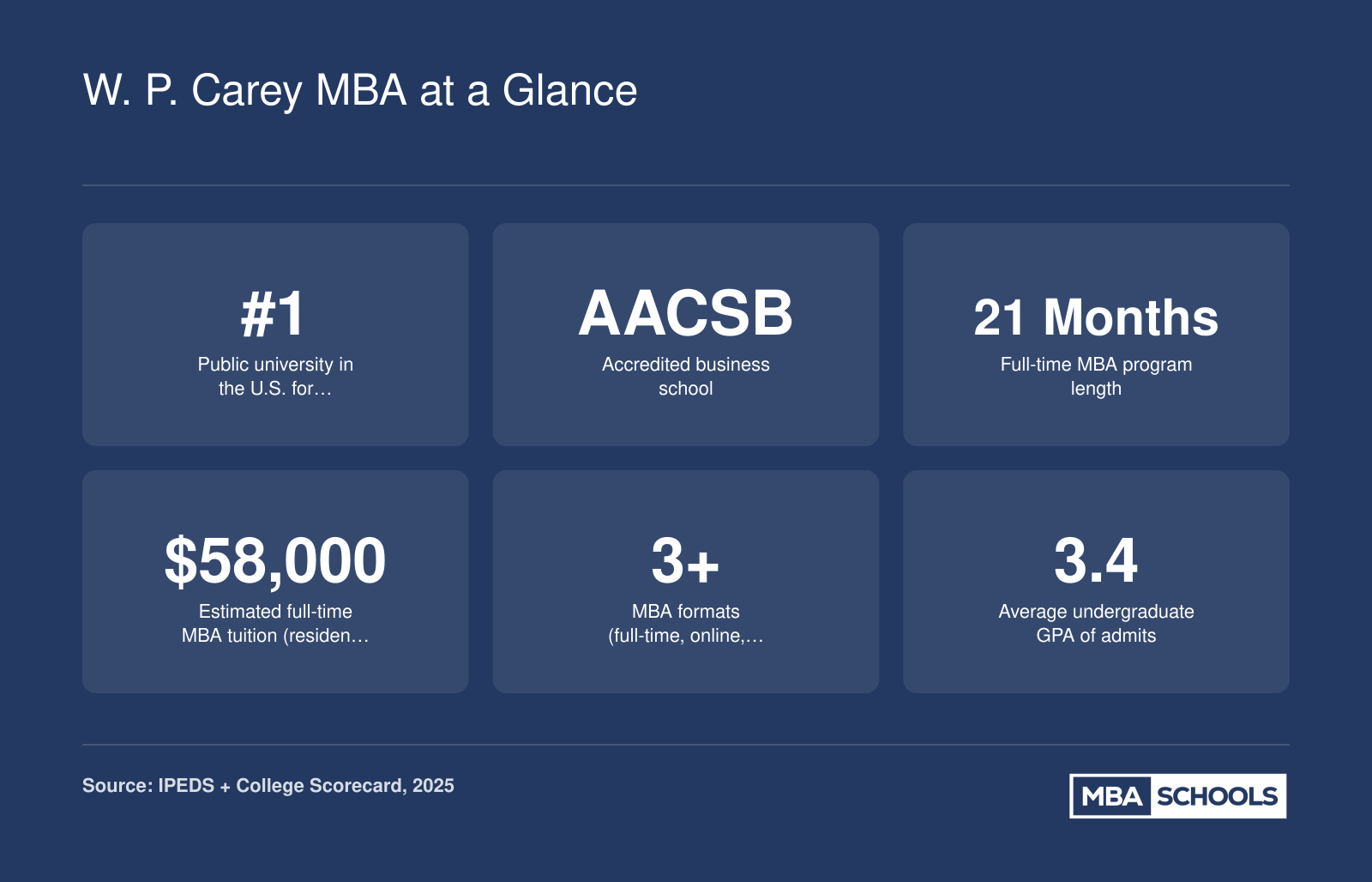
W. P. Carey MBA at a Glance
The W. P. Carey School of Business at Arizona State University offers multiple MBA formats designed for working professionals and full-time students alike. Here are the key figures prospective applicants should know.
Admissions Requirements and Application Deadlines for 2026–2027
A competitive W. P. Carey Full-Time MBA applicant typically brings a median GMAT score of 670 and a 3.0 minimum GPA.1 Across all three formats , full-time, fast-track/evening, and online , the school assembles a class of professionals with strong academic foundations and clear career direction. Below, we unpack the required materials, MBA application deadlines, and points of difference between programs.
Required Application Materials
MBA requirements are closely aligned for all W. P. Carey MBA paths. You will need to submit:
- Online application: $70 fee for domestic applicants, $115 for international.2
- Official transcripts: From every regionally accredited institution attended. ASU graduates do not need to provide ASU transcripts. A minimum 3.0 GPA in the last 60 credit hours of the first bachelor's degree, or a 3.0 cumulative in a relevant master's program, is expected.3
- Resume: A current professional resume with month and year dates for each role. The admissions team looks for progressive responsibility and leadership potential.
- Essays: Short-answer responses to prompts provided in the application. Personal statements are not accepted; focus your answers on career goals, fit with W. P. Carey, and personal contributions you would bring to the cohort.
- Letters of recommendation: One to two letters. At least one should come from a professional recommender who can speak to your work performance, leadership, and readiness for graduate study.5
- GMAT or GRE scores: Required unless you qualify for and receive a waiver (covered in a subsequent section). The median GMAT for the full-time program is 670; the median GRE is 312.2
- English proficiency (international applicants): TOEFL iBT minimum of 80-90, IELTS 6.5, Duolingo 110, or PTE accepted, regardless of residency status.
- Interview: By invitation only. Invitations are extended after an initial application review.6
Deadlines for 2026, 2027 by Format
Full-Time MBA
ASU operates a four-round cycle with a rolling admission window thereafter: - Round 1: October 15, 2025 (decision by December 12, 2025) - Round 2: December 1, 2025 (decision by February 6, 2026) - Round 3: February 1, 2026 (international final and priority consideration; decision by April 10, 2026) - Round 4: April 1, 2026 (decision by June 5, 2026) - Rolling: Applications accepted until July 15, 2026, space permitting.2
Fast-Track/Evening MBA
ASU has not published dedicated fast-track deadline tables for the 2026, 2027 cycle. Independent sources suggest a three-date pattern similar to earlier years: October 1, December 1, and February 1. Because the evening program is cohort-based and fills throughout the year, we recommend contacting the admissions office directly or checking the W. P. Carey website for the most current dates. Most successful fast-track candidates bring at least 2-3 years of professional experience, though the school does not list a strict minimum.
Online MBA
The online application mirrors the full-time process and currently shows at least two firm deadlines: December 1, 2025 (Round II) and February 1, 2026 (Round III, which serves as the international final). Earlier rounds may exist but were not visible at the time of writing. The program admits students several times per year; check ASU Online for any additional start terms.
Acceptance Rate and Selectivity
ASU does not publish an official MBA acceptance rate. Third-party estimates vary widely , from roughly 18% based on self-reported profile data to around 45% in more recent summaries,1 depending on the methodology and the year examined. In practice, the W. P. Carey full-time program draws a solid middle-tier applicant pool. While it is less selective than top-20 schools, its median GMAT of 670 places it ahead of many large public universities. Prospective students should view the numbers as directional rather than definitive and focus on presenting a strong overall application.
Format-Specific Differences
- Full-time: Demands no minimum work experience, but the typical admitted student has several years. International applicants must plan around Round 3 as the final deadline for visa processing.
- Fast-track/evening: Designed for working professionals; evening classes meet on the Tempe campus. While no formal work minimum is enforced, the cohort leans heavily toward those with significant professional experience. Application components are the same, but deadlines may differ from the full-time roster.
- Online: Offers the most flexibility and uses the same core requirements. The program does not currently list prerequisite courses beyond a bachelor's degree and the standard GPA expectation, though competency in quantitative areas is implicitly expected. Deadlines are fewer, so early submission is advisable.
GMAT and GRE Waiver Options by MBA Format
The move toward test-optional admissions has reshaped MBA applications, and ASU W. P. Carey's approach splits sharply by program format: full-time candidates still navigate a test-required baseline with a petition-based waiver, while part-time and online applicants face no test requirement at all.
Full-Time MBA: GMAT or GRE Required, Waiver by Petition
For the full-time program, submission of a GMAT or GRE score is the default.1 ASU does not publish automatic waiver triggers based on years of experience or a specific GPA cutoff. Instead, candidates who believe their profile demonstrates readiness without a test must request a GMAT waiver through the optional essay portion of the application.1 The admissions committee reviews each petition individually, assessing factors like professional experience, quantitative academic performance, and possession of an advanced degree. While the program prefers at least two years of full-time work experience3 and matriculating students average around five years,2 no fixed threshold guarantees approval. Strong experience in analytical roles, a high undergraduate GPA in quantitative coursework, or a prior master's degree are typical grounds for a successful petition, but the decision remains fully discretionary.
Evening/Fast-Track MBA and Online MBAs: No Test Required
The evening (Fast-Track) MBA and the Online MBA have removed the GMAT/GRE requirement entirely. For the evening program, applicants are not required to submit any test scores, making a waiver process unnecessary. The program does indicate a preference for five or more years of professional experience, but that is an admissions guideline rather than a test-related criterion. The Online MBA similarly operates under a test-free admission model, though applicants may optionally submit scores if they wish.4 To qualify, online applicants need a bachelor's or master's degree from a regionally accredited institution and a minimum cumulative GPA of 3.00 in the last 60 credit hours of their undergraduate work, or a 3.00 in a relevant graduate program.5 These GPA thresholds are baseline admission requirements, not waiver conditions.
Executive Assessment Not Accepted Across These Formats
For the MBA formats covered here, ASU W. P. Carey does not accept the Executive Assessment as a substitute for the GMAT or GRE. Candidates considering the full-time MBA must plan to submit either a GMAT or GRE score unless they secure a case-by-case waiver, while evening and online applicants can bypass standardized testing altogether.
Questions to Ask Yourself
ASU MBA Tuition, Fees, and Financial Aid by Format
$63,000 represents the minimum estimated total program cost for Arizona residents pursuing the W. P. Carey Full-Time MBA, while out-of-state students face a significantly higher investment. Understanding the complete financial picture across all three MBA formats helps you budget accurately and identify funding opportunities that can substantially reduce your net cost.
Full-Time MBA Costs by Residency
The 21-month Full-Time MBA carries different price points depending on where you live. For 2025-2026, Arizona residents pay approximately $63,000 in total program tuition and fees. Non-residents should expect around $112,000, while international students face the highest cost at roughly $119,000. These figures include required school fees of approximately $1,013 annually.1
Beyond tuition, plan for estimated living expenses of about $28,199 per year3. Admitted students must submit a $1,000 non-refundable enrollment deposit, which is later credited toward tuition, and a separate $500 matriculation fee also applies.1
Evening and Online MBA Pricing
The Evening MBA offers a more uniform pricing structure. Annual tuition runs approximately $28,626 regardless of residency status, making it an attractive option for out-of-state professionals who can commute to campus periodically.3
The Online MBA's online MBA cost is a flat $74,000 total program cost for all students2, whether Arizona residents, domestic non-residents, or international learners. This consistent pricing eliminates the residency penalty that affects full-time students. A $1,000 non-refundable enrollment deposit is required upon acceptance, with no separate matriculation fee reported for this format.2
Scholarships and Merit-Based Awards
W. P. Carey offers substantial financial aid, with many students receiving MBA scholarship support. Merit-based awards are available for high-achieving candidates, and international students may qualify for named scholarships. Graduate assistantships provide stipends and potential tuition waivers, typically requiring weekly work supporting faculty or departmental operations.
Federal Aid and Military Benefits
Prospective students should complete the FAFSA to determine eligibility for federal financial aid. Graduate students commonly use Direct Unsubsidized Loans and Graduate PLUS Loans to cover remaining costs after scholarships.
Veterans and active-duty military personnel may apply Post-9/11 GI Bill benefits or Yellow Ribbon Program funding toward their MBA. ASU participates in employer tuition reimbursement partnerships, allowing working professionals to coordinate company-sponsored education benefits with their enrollment.
W. P. Carey does not publish a single median scholarship figure across all recipients, so prospective applicants should contact the admissions office directly for personalized estimates based on their profile and chosen format.
Related Articles
Online MBA Vs. Full-Time Vs. Fast-Track: Choosing the Right ASU Format
Selecting the right ASU W. P. Carey MBA format means matching your career stage, schedule flexibility, and budget , all critical factors to consider when choosing an MBA program , to one of three distinct paths: the in-person Full-Time MBA, the fully remote Online MBA, and the part-time Evening MBA (previously branded as the Fast-Track). Each format delivers the same core W. P. Carey curriculum and AACSB-accredited quality, but they serve very different professional rhythms.
Comparing the Three Formats at a Glance
- Duration: Full-Time: 21 months, Online: 24 months, Evening: 21 months.
- Total program cost: Full-Time approximately $58,000, $100,000 (resident vs. nonresident); Online flat rate roughly $74,000; Evening around $34,000, $40,000.
- Average work experience: Full-Time students typically bring 5 years; Online and Evening cohorts average 7 years.
- GMAT/GRE requirement: Full-Time requires a test score (class average around 680); Online and Evening operate under a no-GMAT/GRE policy for most applicants.
- Delivery format: Full-Time is daytime, in-person, cohort-based at the Tempe campus; Online is entirely remote, part-time with no on-campus obligations; Evening meets one or two weeknights on campus, with some online course options.
- Start dates: Full-Time admits once per year in August; Online offers intakes in August, September, January, February, and May; Evening accepts students in August and January.1
Full-Time MBA: Immersive and Cohort-Driven
The 21-month Full-Time MBA is built for professionals ready to step away from the workforce and fully immerse themselves in a daytime, cohort-based program. With a small class size of roughly 90, 100 students, the experience emphasizes deep collaboration, leadership development, and access to on-campus recruiting pipelines. Career outcomes mirror those of other top full-time programs, with graduates moving into consulting, finance, technology, supply chain, and marketing. The total investment ranges from about $58,000 for Arizona residents to over $100,000 for nonresidents, plus living expenses.1 A competitive GMAT score is still a cornerstone of the admissions process, with admitted students averaging around 680.
Online MBA: Structured Flexibility for Working Professionals
The W. P. Carey Online MBA is designed for mid-career professionals who need to continue working full-time while earning their degree; for many, weighing online MBA vs. in-person MBA dynamics is key. The 24-month, part-time structure comprises 51 credit hours at a flat tuition rate of roughly $74,000 for all students, regardless of residency. There are no mandatory campus visits, and the same faculty who teach on-campus deliver the courses, ensuring curriculum parity with the residential programs. The average student brings 7 years of work experience and advances into leadership roles in finance, consulting, and operations , outcomes that closely overlap with the Full-Time MBA. With five start terms per year and a no-GMAT application path, the Online MBA maximizes scheduling flexibility without diluting academic rigor.2
Evening MBA (Formerly Fast-Track): Part-Time Campus Learning
The Evening MBA , first introduced as an accelerated “Fast-Track” option, though that specific accelerated path is no longer offered , remains a STEM-designated, part-time program for working professionals. Classes meet on the Tempe campus one or two evenings per week, with some coursework available online. The program typically takes 21 months and costs around $34,000, $40,000 for students who proceed without a break. Designed for holders of a prior business-related master’s degree and at least two years of work experience, it particularly suits those targeting general management or leadership promotions. Unlike the Full-Time MBA, the Evening MBA does not require a GMAT or GRE score, making it an accessible choice for experienced candidates who value face-to-face interaction while maintaining a full-time job.1
Concentrations and Curriculum Structure
The Full-Time MBA and the Online MBA at W. P. Carey take different paths to specialization, each with a unique set of MBA concentrations and curricular requirements. While the on-campus program allows for deep immersion and a wide range of electives, the online format is structured for flexibility, letting students build expertise three electives at a time. The following sections detail the specific tracks and structure for each delivery mode.
Full-Time MBA: 60 Credits with Nine Concentrations
The on-campus Full-Time MBA spans 21 months and requires 60 total credits.1 The MBA curriculum is intentionally lean: just 1.5 credits in LES 582 Ethical Issues for Managers. The remaining 55.5 credits are dedicated to electives and concentration coursework, capped by a 3-credit capstone (MGT 589 Strategic Management). A required summer internship between years provides hands-on applied experience.2 Nine concentrations are offered:
- Artificial Intelligence
- Business Analytics
- Consulting
- Entrepreneurship
- Finance
- Information Management
- Marketing
- Real Estate
- Supply Chain Management
Each concentration has its own specific course mix, blending required courses and electives. For example, the Business Analytics track includes six courses with one elective, while Supply Chain Management involves eight required courses.3 Three concentrations, Consulting, Real Estate, and Information Management, are exclusive to the full-time program and are not available online.
Online MBA: 18 Courses and Stackable Specializations
The Online MBA is structured as a 51-credit program delivered one course at a time. It consists of a core curriculum plus electives; to earn a concentration, students must complete three electives in a single area. The online format offers eight concentrations:
- Artificial Intelligence
- Business Data Analytics
- Entrepreneurship
- Finance
- International Business
- Leadership and Management
- Marketing
- Supply Chain Management
International Business and Leadership and Management are exclusive to the online delivery mode, while Consulting, Real Estate, and Information Management are only available on campus. Unlike the full-time program, the online curriculum does not include a documented capstone or internship requirement in the available sources.4
Distinctive Curricular Features and the Fast-Track Gap
The full-time program’s required summer internship and strategic management capstone provide structured experiential learning that the online format does not explicitly replicate. Online students instead progress through a sequential, flexible framework that accommodates working professionals. For the Fast-Track/Accelerated on-campus MBA, published 2026 curriculum details, including credit hours, concentration lists, and experiential requirements, are not available. Prospective students should contact the school directly for the most current information on that format.
Career Outcomes and Salary After Graduation
For most applicants, the honest tension in choosing an MBA is whether an MBA is worth it: does the salary bump justify two years of forgone income? The W. P. Carey full-time MBA gives you a concrete answer: strong six-figure starting pay and a placement curve that catches up quickly if you are not employed on day one.
Class of 2025 Employment Snapshot
According to W. P. Carey's most recent employment report, 72% of the Class of 2025 had accepted offers by graduation, and 90% were employed within three months.1 The gap between those two numbers is worth reading closely: it signals a market where roughly one in five graduates finishes their job search over the summer rather than in the spring. That is normal for MBA cohorts, but if you are debt-financing the degree, plan cash flow for a possible three-month runway after commencement.
Compensation for the same class:
- Average base salary: $121,1161
- Average signing bonus: $22,8191
- Total first-year cash comp (base + signing): roughly $144,000 on average1
Where Graduates Land
Recent full-time hires have gone to a range of best companies for MBA graduates like Amazon, Applied Materials, Deloitte, Intel, Microsoft, and Walmart, with additional volume at American Airlines, American Express, Chevron, Dell, EY, PwC, Raytheon, and W. L. Gore.1 The mix reflects Phoenix's regional economy (semiconductors, aerospace, logistics) layered on top of national tech and consulting recruiters.
The Class of 2024 industry breakdown gives the clearest picture of where W. P. Carey MBAs actually work2:
- Technology: 26%
- Retail: 15%
- Consulting: 11%
- Transportation and logistics: 9%
- Manufacturing: 6%
- Accounting: 5%
- Health care products and services: 3%
- Energy: 3%
- Consumer packaged goods, real estate, non-profit, and other: 2% each
The school does not publish a reliable current breakdown by job function (consulting, marketing, operations, finance), so we are not going to guess at those percentages. If function-level placement matters to your decision, ask the admissions office for the most recent internal figures before you deposit.
How That Compares to the Broader Labor Market
Context matters. The Bureau of Labor Statistics reports a national median annual wage of $101,190 for management analysts and $102,950 for general and operations managers, the two most common MBA career paths. W. P. Carey's average MBA salary of $121,116 sits roughly 18 to 20% above those medians before signing bonus, and comfortably above the 75th percentile for management analysts ($133,140) once the bonus is included. In short: the degree is pricing graduates near the top quartile of the occupations they compete in, right out of school.
MBA Salaries in Arizona by Metro Area
Salary potential varies significantly across Arizona's metro areas, with Phoenix commanding the highest compensation for MBA-typical roles. The figures below reflect 2024 annual wages reported by the Bureau of Labor Statistics for occupations commonly held by MBA graduates. For ASU W. P. Carey alumni, the Phoenix metro area is the most relevant benchmark, given the university's Tempe campus location and the concentration of employer demand in the region.
| Metro Area | Role | Total Employment | 25th Percentile | Median Salary | 75th Percentile | Mean Salary |
|---|---|---|---|---|---|---|
| Phoenix, Mesa, Chandler | General and Operations Managers | 73,000 | $62,780 | $94,130 | $141,450 | $122,850 |
| Phoenix, Mesa, Chandler | Management Analysts | 14,540 | $66,720 | $90,810 | $125,640 | $122,710 |
| Phoenix, Mesa, Chandler | Sales Managers | 10,700 | $98,240 | $131,410 | $181,340 | $160,610 |
| Phoenix, Mesa, Chandler | Administrative Services Managers | 4,780 | $80,080 | $101,020 | $135,460 | $115,490 |
| Phoenix, Mesa, Chandler | Chief Executives | 2,160 | $101,530 | $164,980 | N/A | $227,990 |
| Tucson | General and Operations Managers | 11,190 | $58,780 | $79,080 | $127,900 | $119,270 |
| Tucson | Sales Managers | 1,060 | $79,800 | $122,670 | $172,230 | $141,250 |
| Tucson | Management Analysts | 1,350 | $62,780 | $81,030 | $108,760 | $89,790 |
| Tucson | Administrative Services Managers | 780 | $76,190 | $93,890 | $127,980 | $104,710 |
| Tucson | Chief Executives | 310 | $101,500 | $151,550 | $227,590 | $192,330 |
| Prescott Valley, Prescott | General and Operations Managers | 2,650 | $56,410 | $74,770 | $112,350 | $96,150 |
| Prescott Valley, Prescott | Sales Managers | 170 | $86,310 | $123,360 | $165,780 | $138,880 |
| Flagstaff | General and Operations Managers | 2,120 | $58,240 | $76,220 | $110,350 | $97,710 |
| Flagstaff | Management Analysts | 190 | $63,960 | $88,650 | $108,910 | $91,310 |
| Yuma | General and Operations Managers | 1,710 | $51,030 | $74,830 | $113,170 | $93,420 |
| Yuma | Sales Managers | 190 | $80,200 | $108,130 | $150,880 | $126,310 |
| Lake Havasu City, Kingman | General and Operations Managers | 1,930 | $51,030 | $72,730 | $106,270 | $90,290 |
| Sierra Vista, Douglas | General and Operations Managers | 1,040 | $53,500 | $75,880 | $110,450 | $98,410 |
Is the ASU MBA Worth It? An ROI Breakdown
Deciding whether an MBA program justifies the investment requires a clear-eyed look at total cost, expected earnings, and the less tangible factors that influence long-term value, in short, how to calculate MBA ROI. Here is how the W. P. Carey MBA stacks up.
A Simple Cost-Versus-Salary Calculation
Using the tuition figures outlined earlier in this guide, the total estimated cost of the full-time MBA for an Arizona resident falls roughly in the $60,000 to $70,000 range over two years. Out-of-state and international students should plan for a higher figure, potentially exceeding $90,000 once fees and living expenses are included. Compare that investment against the median starting salary reported by W. P. Carey graduates, which in recent cohorts has landed near $80,000 to $95,000, and the math begins to work in the program's favor within a few years of graduation. If pre-MBA earnings averaged around $55,000 to $65,000, the annual salary premium alone can recoup tuition costs in roughly three to four years for in-state students, and five to six years for out-of-state students, a favorable mba payback period, before accounting for signing bonuses and long-term salary growth.
Opportunity Cost Across Formats
The full-time format carries the steepest opportunity cost because students step away from full-time employment for roughly 21 months. That lost income, often $100,000 or more for mid-career professionals, effectively doubles the real price of the degree. The evening and online formats largely eliminate this problem. Students in those programs continue earning while they study, which can make the net cost of the MBA significantly lower even if tuition is comparable. For professionals who cannot afford to leave the workforce, the online or evening track frequently delivers a stronger short-term ROI.
STEM Designation and International Student ROI
The full-time W. P. Carey MBA carries a STEM designation in business analytics, which unlocks a 36-month Optional Practical Training extension for international graduates. That extra time in the U.S. labor market is a powerful ROI multiplier: three years of domestic work experience at post-MBA salaries can generate hundreds of thousands of dollars in additional lifetime earnings compared to a 12-month OPT window. For international applicants weighing STEM-designated programs, this feature meaningfully strengthens the long-term financial case for ASU.
So, Is Arizona State University Good for an MBA?
The balanced answer is yes, with context. W. P. Carey holds AACSB accreditation, the gold standard for business schools worldwide. The program regularly appears in major rankings from U.S. News, Financial Times, and Poets & Quants, typically placing in the top 30 to 50 among U.S. MBA programs depending on the format. Career placement rates have been solid, and the Phoenix metro area offers a growing job market in technology, healthcare, and financial services.
Where ASU may not compete as aggressively is against elite top-15 programs that open doors to the most selective consulting and investment banking pipelines. If your career goals center on McKinsey or Goldman Sachs, the calculus is different. But for professionals targeting general management, supply chain leadership, tech, or regional opportunities in the Southwest, the W. P. Carey MBA offers a strong return on a comparatively moderate investment, especially through the online or evening formats that let you keep earning while you learn.
Frequently Asked Questions About the ASU MBA
Below are answers to the questions prospective students ask most often about the W. P. Carey MBA at Arizona State University. Costs, timelines, and policies reflect the most recent data available as of 2026, though you should always confirm details directly with the admissions office.