

What you’ll learn in this article…
- An MBA builds broad leadership skills across functions, while an MS develops deep expertise in a single discipline.
- The Bureau of Labor Statistics reported a median annual salary of $122,090 for management occupations in 2024.
- MBA programs typically favor candidates with several years of professional experience; most MS programs welcome recent graduates.
- Salary outcomes depend more on the specific role and industry you target than on the degree title itself.
Both the MBA and the Master of Science sit under the graduate business umbrella, yet they deliver fundamentally different value propositions. Dr. Karen L. Koza, an MBA instructor at Southern New Hampshire University, frames the distinction clearly: the MBA builds range, while an MS builds depth.1 One prepares you to lead across functions and industries; the other sharpens your expertise in a single discipline such as finance, data analytics, or supply chain management.
That difference cascades through every dimension of the degree experience, from curriculum structure to admissions criteria to long-term career trajectory. MBA programs require foundational courses in marketing, operations, and strategy, while MS programs drill into econometrics, statistical modeling, or financial engineering. Admissions expectations diverge as well: MBA programs prioritize professional experience and leadership potential, while many MS tracks admit students directly from undergraduate programs. For a broader comparison of how these credentials stack up, our MBA vs. master's degree guide covers the key distinctions in detail. Cost structures, salary trajectories, and even the industries most likely to recruit you depend on which path you choose.
The Bureau of Labor Statistics reports that the median annual salary for all management occupations stood at $122,090 in 2024, underscoring the earning potential of roles MBA graduates typically pursue.1 Yet specialists with an MS often command comparable or higher pay in technical fields, particularly in technology and quantitative finance.
MBA Vs. MS at a Glance: Key Differences
Before diving into the details, this side-by-side snapshot captures the core distinctions between an MBA and a Master of Science in a business discipline. As Dr. Karen L. Koza, an MBA instructor at Southern New Hampshire University, puts it: "The MBA develops a broader business leader, while the MS builds specialized functional expertise." Neither degree is inherently superior. Dr. Michelle Caron, associate dean of business at SNHU, emphasizes that "whether you have management experience or aspiring to become a manager, you can achieve your personal, professional and financial goals with either of these degrees." The right choice depends on your career trajectory and whether you need breadth or depth.
| Dimension | MBA | MS (Business Discipline) |
|---|---|---|
| Degree Focus | Broad leadership across core business functions (finance, marketing, operations, strategy) | Deep specialization in a single functional area (e.g., finance, data analytics, accounting) |
| Typical Duration | 1 to 3 years, depending on format (full time, part time, or accelerated) | 1 to 2 years in most programs |
| Curriculum Structure | Cross-functional core courses with elective concentrations; heavy use of case studies, team projects, and experiential learning | Discipline-specific coursework with technical or research components; may include a capstone or thesis |
| Ideal Candidate Profile | Working professionals with roughly 3 to 5 years of experience seeking leadership or general management roles | Early-career professionals or recent graduates with 0 to 3 years of experience seeking functional expertise |
| Career Orientation | General management, consulting, entrepreneurship, C-suite leadership, and cross-industry career pivots | Specialist roles such as financial analyst, data scientist, supply chain manager, or domain-specific consultant |
| Typical Total Cost (U.S.) | Approximately $100,000 to $220,000 at leading programs | Approximately $40,000 to $100,000, varying by institution and field |
| Median Starting Salary (U.S., 2025) | Around $125,000 for graduates of business programs | Roughly $80,000 to $100,000, depending on specialization |
| Admissions Emphasis | Leadership potential, diverse professional background, GMAT or GRE (increasingly optional), essays, and recommendations | Academic preparation in the target discipline, GMAT or GRE scores, and relevant coursework or certifications |
Curriculum and Learning Approach: Breadth Vs. Depth
Deciding between an MBA and an MS often comes down to a fundamental question: do you want to learn a little about every part of the business, or do you want to know everything about one part of it? This is the breadth-versus-depth tradeoff, and it shapes the curriculum, teaching methods, and even the day-to-day experience of each program. As Dr. Karen L. Koza, an MBA instructor at Southern New Hampshire University (SNHU), explains, "The MBA develops a broader business leader, while the MS builds specialized functional expertise." Her framing captures the core curricular difference that prospective students need to understand before committing to either degree.
The MBA Curriculum: A 360-Degree View of the Organization
An MBA program curriculum is designed to build a generalist management perspective. Core courses typically span all major business functions: finance, marketing, operations, strategy, organizational behavior, and leadership. This cross-functional exposure ensures that graduates can speak the language of every department and make decisions that balance competing priorities. After completing the core, many MBA programs offer concentrations or elective tracks, such as consulting, entrepreneurship, or healthcare management, that add a layer of specialization without sacrificing the broad foundation. For a closer look at how those elective tracks differ, our MBA concentrations guide breaks down the most popular options and their salary outcomes. The end goal is a leader who can step into a variety of roles and industries, not a technician tied to a single function.
The MS Curriculum: A Vertical Deep-Dive
In contrast, an MS program immerses you in one discipline from day one. An MS in Finance, for example, might require courses in advanced corporate finance, derivatives pricing, portfolio theory, and quantitative methods, with little to no exposure to marketing or operations. An MS in Marketing could be built around consumer behavior, marketing analytics, brand strategy, and digital marketing, while omitting finance entirely. This vertical structure is ideal for students who already know the area they want to specialize in and seek deep technical mastery. Many MS programs also require a research-based capstone or thesis, further emphasizing depth over breadth.
How You Learn: Pedagogy and Classroom Style
The teaching methods mirror the degree goals. MBA classrooms rely heavily on the case method: students analyze real-world business dilemmas, debate solutions in teams, and are graded on participation and leadership. Experiential learning through consulting projects, simulations, and global immersions is common. The emphasis is on collaboration, communication, and applying broad frameworks. MS programs, by contrast, lean on lectures, quantitative problem sets, and independent research. Students may spend more time in front of spreadsheets, coding in statistical software, or writing a thesis. The environment is more academic and technically rigorous, preparing graduates for roles that demand advanced subject-matter knowledge.
The Accounting Example: One Course vs. Six
A simple way to grasp the difference is to look at a single discipline. In a typical MBA program, a student might take one required financial accounting course, a survey designed to teach managers how to interpret financial statements, not how to be an accountant. An MS in Accounting, on the other hand, often includes six or more accounting courses covering auditing, tax, advanced financial reporting, and forensic accounting, along with preparation for the CPA exam. The MBA student gains literacy; the MS student gains proficiency. This pattern repeats across other fields: one marketing course versus a full slate of brand strategy and analytics, one operations course versus a deep sequence in supply chain optimization. Understanding this curricular divide helps you decide not just what you want to study, but how you want to work after graduation.
Questions to Ask Yourself
Admissions Requirements Compared: GMAT, GRE, Work Experience, and More
Full-time MBA and Master of Science programs stand on opposite sides of the admissions landscape: MBAs court professionals with years of leadership experience, while most MS programs welcome recent graduates stepping directly from undergraduate studies. That divide shapes every element of the application, from standardized test expectations to the weight placed on career accomplishments versus academic aptitude.
GMAT and GRE Expectations
Top-tier MBA programs continue to demand competitive GMAT or GRE scores, though the new GMAT Focus Edition has shifted benchmarks. For the class entering in 2025-26, Stanford GSB reported a mean GMAT Focus score of 689, while Columbia Business School averaged 690 and Kellogg posted a median of 687. Harvard Business School's median sat at 685, and Chicago Booth averaged 670. On the legacy GMAT scale, Stanford's mean was 738. GRE takers face similarly high bars: Stanford's mean total was 328, Yale School of Management's median was 330, and both Harvard and Kellogg recorded medians of 326. Candidates preparing for these benchmarks can start with a free GMAT practice test to gauge readiness.
Master of Science programs often set lower quantitative thresholds or waive exams entirely for candidates with strong STEM backgrounds. Top MS in Finance programs typically accept legacy GMAT scores in the 640-700 range, while MS in Business Analytics programs look for GRE quantitative scores between 163 and 168.2 MS in Management programs generally cluster between 600 and 690 on the legacy GMAT.2 Many MS programs also permit test waivers for applicants holding undergraduate degrees in quantitative disciplines or meeting minimum GPA cutoffs in prerequisite coursework.
Work Experience Norms
MBA programs almost universally expect meaningful professional experience. Top full-time programs enroll students with three to eight years of work history, with the median around four to five years.2 MBA admissions committees look for progression, leadership scope, and cross-functional exposure over sheer tenure. MS programs, by contrast, frequently admit candidates straight from college or with one to two years of work experience. This distinction reflects the MBA's emphasis on integrating academic frameworks with real-world management challenges, while MS curricula focus on developing technical or functional expertise that can be absorbed without prior organizational context.
Prerequisite Coursework
MS programs routinely require foundational coursework aligned with the discipline. MS in Finance applicants often need calculus and intermediate accounting; MS in Analytics programs expect statistics, linear algebra, and proficiency in programming languages such as Python or R. MBA programs, designed for generalists, rarely impose course prerequisites. Most offer pre-term math and accounting boot camps for students whose undergraduate prerequisites for MBA coursework lies outside business.
Application Components and Evaluation Criteria
MBA applications place heavy weight on leadership essays, manager recommendations, and behavioral interviews that probe teamwork, conflict resolution, and strategic thinking. Admissions readers assess whether candidates can contribute to case discussions and peer learning. MS applications, meanwhile, scrutinize quantitative aptitude and academic transcripts more closely. Essays may focus on research interests or technical career goals rather than leadership narratives, and interviews (when required) often test problem-solving skills or technical knowledge.
Is an MBA Worth It Without Work Experience?
For top-ranked MBA programs, the answer remains no. Schools value the diversity of perspectives and the depth of case-study debate that experienced professionals bring. Applicants with fewer than two years of work history struggle to compete. However, accelerated MBA tracks and early-career programs (such as deferred-admission MBA pathways) allow high-performing undergraduates to secure a future seat while gaining work experience before matriculation. For candidates seeking immediate graduate education, an MS degree is almost always the better fit.
Related Articles
Cost, Financial Aid, and ROI by Program Type
How much does an MBA cost compared to a master's in science, and which one gives you a better return on investment?
Typical Tuition: MBA vs. MS
At the top end, full-time MBA programs carry substantial price tags. Among the top-20 U.S. schools, the average total program cost stands at $171,250 for the 2025, 2026 academic year. For example, The Wharton School's MBA totals $184,560, Columbia Business School comes in at $182,344, and Harvard Business School, while comparatively lower, still requires $157,400. These figures include tuition, fees, and living expenses for a two-year residential program.
Specialized business master's degrees, such as an MS in Finance or MS in Business Analytics, generally cost less. Typical tuition ranges from $30,000 to $120,000 total, depending on the institution and program length. Public universities and shorter one-year tracks can drive costs toward the lower end of that spectrum.
Online and On-Campus Cost Differences
Both online MBAs and online MS programs often reduce the sticker price by 30, 60% compared to their on-campus counterparts. Online formats remove campus fees, relocation costs, and commuting expenses. Many online MBA programs from respected schools hover between $25,000 and $80,000 in total tuition, while online MS programs can start as low as $15,000 for an entire degree. The trade-off is you lose the in-person networking and on-campus recruiting that can accelerate career transitions. For a deeper look at whether employers value the online format, see our analysis of what employers think about online MBA degrees.
Financial Aid Options
Financial aid landscapes differ by degree type. Top MBA programs frequently award merit-based fellowships that cover a significant portion of tuition, and employer sponsorship is widespread, particularly for part-time or executive MBAs. Many large companies view MBA funding as a talent retention tool.
MS students often rely on graduate assistantships, teaching or research roles that provide tuition waivers and small stipends. Additionally, MS degrees in quantitative or technical fields commonly receive STEM designation, unlocking access to federal STEM scholarships and extended work authorization for international graduates. Programs with a STEM MBA designation can offer similar benefits on the MBA side. Borrowing through federal loans is available for both paths, but the assistance structures shape the net cost.
ROI: It Depends on Your Field and Career Stage
There is no universal winner in return on investment. An MBA's ROI is typically measured by the post-degree salary lift into management consulting, investment banking, or corporate leadership, fields where six-figure starting salaries can quickly offset six-figure debt. For Master of Science programs, the payoff is discipline-dependent: an MS in Data Science can command a high starting salary at a tech firm, while an MS in Nonprofit Management may take longer to recoup costs. The Bureau of Labor Statistics median of $122,090 for management occupations highlights the earnings potential linked to leadership roles, but the degree alone is not a guarantee. ROI hinges on your pre-degree background, the network you build, and the industry you enter, not just the credential you hold.
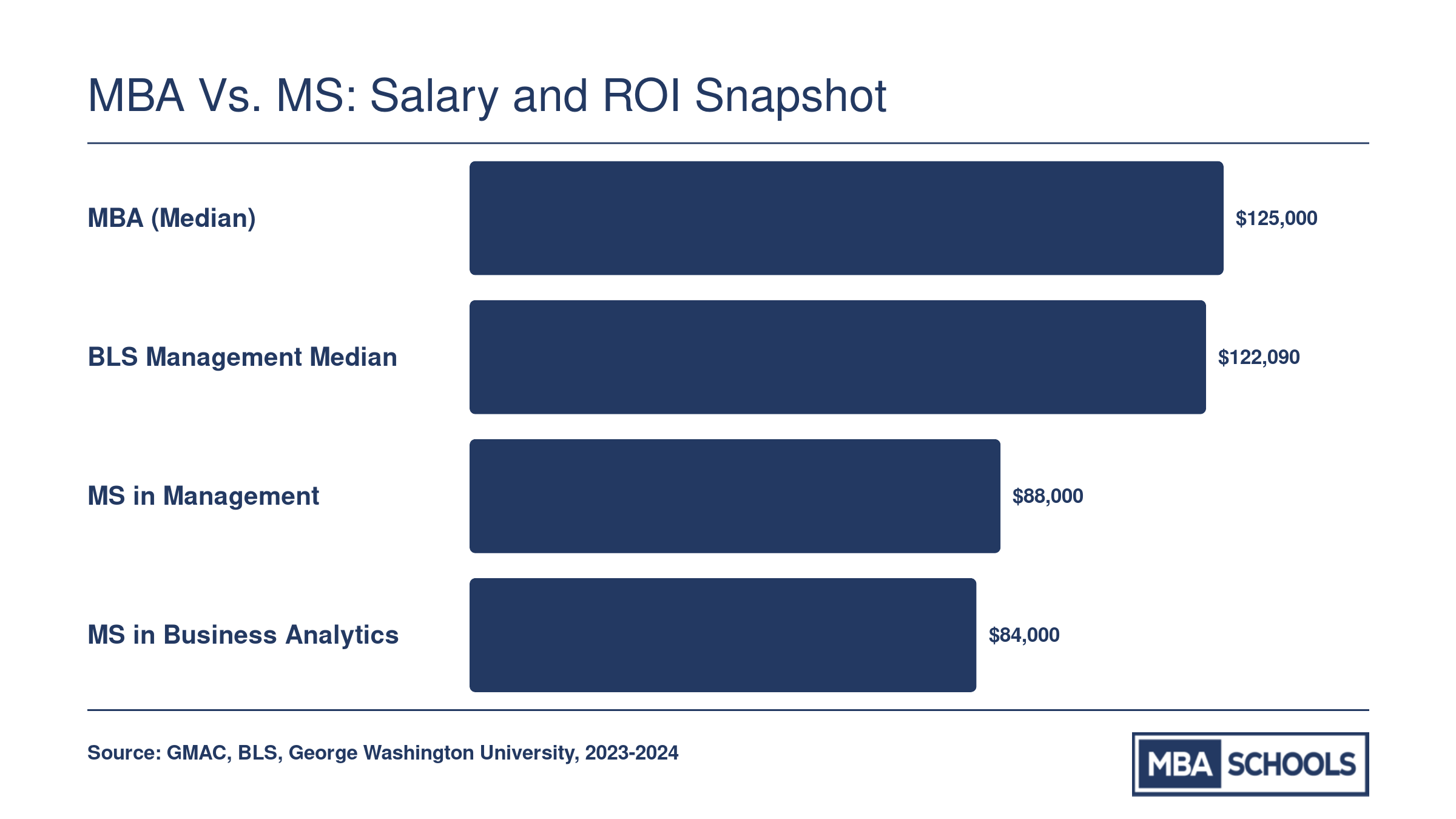
MBA Vs. MS: Salary and ROI Snapshot
Starting salaries vary significantly across master's degree types, driven more by role, industry, and location than by the degree name alone. The figures below compare median and mean starting salaries for MBA graduates against common MS specializations, alongside the Bureau of Labor Statistics median for all management occupations.
Career Paths and Salary Outcomes: Which Degree Pays More?
The salary question often dominates degree comparisons, yet the honest answer depends less on which credential you earn and more on the role you pursue, the industry you enter, and how effectively you leverage your education. Both MBA and MS graduates command competitive salaries in business fields, but the paths to those earnings look different.
How to Research Salary Outcomes
Rather than relying on broad claims, prospective students can access several reliable sources to estimate earning potential for each degree type:
- Bureau of Labor Statistics (BLS.gov): The BLS publishes median wages by occupation, which you can cross-reference with typical degree requirements. For example, management roles often list an MBA as preferred, while data science positions may specify an MS in a quantitative field. The BLS reported a median annual salary of $122,090 for all management occupations in 2024, illustrating the earning potential for leadership roles that MBA graduates frequently target.1
- School-specific career placement reports: Many business schools publish detailed employment outcomes, including median starting salaries by function, industry, and prior experience level. These reports offer the most direct comparison when evaluating specific programs.
- LinkedIn Salary and alumni tools: Filtering by degree type, industry, and years of experience provides real-time salary ranges based on self-reported data from professionals in your target field.
- Professional association surveys: Organizations like GMAC publish comprehensive employment data for MBA graduates, while groups like INFORMS (for analytics professionals) and the CFA Institute (for finance) offer specialized salary breakdowns for MS holders in those disciplines.
Salary Patterns by Degree Type
MBA graduates typically pursue generalist management roles where compensation reflects leadership responsibility and organizational scope. These positions span industries from consulting and finance to healthcare and technology, with salaries varying significantly by sector and geography. For a deeper look at compensation benchmarks across functions, explore our guide to MBA career paths and salaries.
MS graduates often enter specialist positions where compensation correlates with technical expertise and market demand for specific skills. Fields like data science, financial engineering, and business analytics can offer highly competitive starting salaries, sometimes matching or exceeding MBA entry points, particularly in technology hubs.
The Real Determinant: Role, Not Degree
Dr. Karen L. Koza, an MBA instructor at Southern New Hampshire University, emphasizes that "the MBA develops a broader business leader, while the MS builds specialized functional expertise."1 This distinction shapes career trajectories more than it predetermines salary ceilings. A product manager with an MBA and a machine learning engineer with an MS might earn comparable salaries, but their paths reflect different applications of graduate education.
If you are leaning toward the MBA path, understanding how to choose an MBA specialization can help you target roles with the strongest salary outcomes in your preferred industry. Ultimately, earnings depend on how well your degree aligns with your target role and how effectively you position yourself for advancement. Neither degree guarantees higher compensation; both open doors to well-compensated careers when matched thoughtfully with professional goals.
MBA Vs. MS for Career Changers: Which Degree Opens More Doors?
Generalist credential versus specialized diploma: the distinction dictates which master's degree better facilitates a career pivot. For most professionals seeking to switch industries or functions, the MBA remains the stronger vehicle. According to GMAC alumni survey data, 39% of business school graduates switched industries after completing their degree, while 52% changed functional roles. Notably, one-third changed both industry and function simultaneously, underscoring the MBA's power as a reinvention tool. A separate survey indicates that 57% of MBA and MS holders successfully executed a career change in 2022, though the MBA's recruiting infrastructure and employer brand recognition give it a distinct edge in competitive transitions.2
Why the MBA Opens More Doors for Industry Switchers
MBA programs are purpose-built for career transitions. They offer structured recruiting pipelines, including on-campus interviews, industry-specific career treks, and alumni networks that span consulting, finance, technology, and beyond. Employers mirror this orientation: 79% of surveyed recruiters actively hired MBA graduates in 2017, compared to just 31% for master's in management holders and 29% for master's in accounting candidates.3 The MBA's generalist curriculum teaches cross-functional business literacy, making graduates credible candidates in unfamiliar sectors. MBA internships embedded in full-time programs function as extended interviews, allowing career changers to prove competence in a new field before graduation. Among prospective switchers, 77% target consulting roles, while 58% aim for product and services industries, 54% eye consulting firms, and 50% pursue technology companies.4
When an MS Degree Wins: Pivoting Into Technical Functions
The MS becomes the superior choice when the career change requires deep technical credibility that an MBA cannot confer. A finance professional moving into data science, or a liberal-arts graduate entering quantitative finance, often needs rigorous training in programming, statistical modeling, or domain-specific tools. Employers in these fields may view a general MBA as insufficient preparation, whereas a Master of Science in Analytics, Finance, or Computer Science signals specialized competence. The MS also appeals to career changers who already possess business acumen and need only functional depth to complete the transition.
Decision Heuristic: Match the Degree to the Pivot
Use this framework: if you are switching industries but staying within a similar function (for example, marketing in retail to marketing in tech), the MBA's network and brand open more doors. If you are pivoting into a technical role (data analyst, quantitative researcher, machine learning engineer), the MS provides the hard skills and credibility employers demand. If you are changing both industry and function into a non-technical domain, consider how to choose the right MBA program for your goals, because the MBA's versatility and recruiting apparatus typically deliver better outcomes.
Choosing by Industry: Finance, Tech, Consulting, and Beyond
Not every industry values the MBA and MS equally, and even within a single field the preferred degree can shift depending on the specific role. The table below maps five high-demand industries to the roles each degree typically unlocks, along with a short rationale. As Dr. Karen L. Koza of SNHU has noted, the MBA builds range while the MS builds depth, and this distinction plays out clearly when you look at hiring patterns across sectors.
| Industry/Field | MBA Best For | MS Best For | Recommended Degree | Rationale |
|---|---|---|---|---|
| Finance | Investment banking, corporate finance, private equity, general management in financial services | Quantitative trading, risk modeling, derivatives pricing, financial engineering | MBA for client-facing and leadership roles; MS in Financial Engineering or related field for quantitative roles | Investment banks and PE firms recruit heavily from MBA programs for deal teams and leadership pipelines. Quant desks and risk groups, however, prioritize the deep technical training an MS provides. |
| Technology | Product management, business development, strategy and operations, general management rotational programs | Machine learning engineering, data engineering, software architecture, applied AI research | MBA for product and business strategy roles; MS in Computer Science or Analytics for engineering roles | Tech companies value the cross-functional leadership skills MBA graduates bring to product and go-to-market roles. Engineering and data science teams look for the specialized depth an MS delivers. |
| Consulting | Management consulting, strategy consulting, organizational transformation, C-suite advisory | Data analytics consulting, actuarial consulting, specialized operations research | MBA for generalist strategy and management consulting; MS for technical or analytics-focused consulting | Top strategy firms (McKinsey, BCG, Bain) are among the largest MBA employers. Niche analytics and operations consultancies often prefer candidates with a targeted MS. |
| Healthcare Management | Hospital administration, health system strategy, pharmaceutical commercialization, payer operations leadership | Health informatics, biostatistics, clinical data science, epidemiological research | MBA or MBA/MHA for administrative leadership; MS in Health Informatics or Biostatistics for research and data roles | Healthcare organizations need leaders who can manage budgets, teams, and regulatory complexity, which aligns with the MBA curriculum. Technical and research positions require the specialized methodology an MS covers. |
| Marketing | Brand management, chief marketing officer track, integrated marketing strategy, consumer insights leadership | Marketing analytics, customer data science, pricing optimization, A/B testing and experimentation | MBA for brand and strategy leadership; MS in Marketing Analytics or Data Science for quantitative marketing roles | MBA programs emphasize strategic thinking, cross-channel leadership, and general management skills prized in senior marketing roles. An MS equips candidates for the increasingly data-driven side of the discipline. |
Online Vs. On-Campus: Which Format Works for Each Degree?
The line between online and on-campus delivery has blurred as top business schools invest heavily in digital platforms, making format choice a strategic career decision rather than a logistical one. For MBA and MS candidates, the decision often hinges on networking needs, learning style, and career stage, not just flexibility.
Understanding the Growth and Perception Shift
Online MBAs and specialized MS programs have expanded rapidly, with many established universities now offering fully remote tracks that mirror their on-campus curricula. Employer perception has evolved as well. Recruiters at major corporations increasingly recognize that online degrees from accredited institutions carry the same weight as their in-person counterparts, especially when the program name does not differentiate between formats.
- Enrollment trends: Recent enrollment data from graduate management education surveys show that demand for online and hybrid formats continues to climb, driven by working professionals who cannot relocate or pause their careers. This is true for both broad MBA programs and focused MS degrees in fields like finance, business analytics, and marketing.
- Quality indicators: Accreditation remains the gold standard. Programs with AACSB accreditation or recognition from EQUIS and AMBA undergo the same rigorous review regardless of delivery mode. Transcripts and diplomas rarely note whether coursework was completed online, which preserves a level playing field.
Which Format Fits Each Degree?
The MBA's emphasis on peer learning and cohort-based leadership development makes the format decision particularly nuanced. On-campus experiences provide spontaneous networking, team-based projects in real time, and access to career services and recruiting events that can be harder to replicate digitally. For career changers or those aiming for elite consulting and banking roles, in-person immersion often offers a competitive edge.
MS programs, with their narrower technical focus, translate more naturally to online delivery. Courses that concentrate on quantitative modeling, data analytics, or supply chain operations rely less on informal networking and more on individual competency building. Consequently, many specialized MS degrees are available entirely online, often at a lower tuition point.
- Hybrid options: A growing number of schools offer blended MBAs that combine short on-campus residencies with online coursework, giving students the best of both worlds. This format can be especially attractive for mid-career professionals who need networking but cannot leave their jobs for two years.
- Self-assessment: Before choosing, prospective students should honestly assess their learning preferences. Do you thrive in structured classroom discussions, or are you self-directed and disciplined enough to engage asynchronously? The answer may override any trend data.
Verifying Outcomes: What to Look For
To compare online versus on-campus results, start with official resources. The Bureau of Labor Statistics provides broad occupational outlook data, but school-specific career reports, often called Graduate Employment Reports or Career Outcomes, are more granular. These documents, typically found on university websites, may break down employment rates, average salaries, and industry placement by program format.
Industry research from organizations like the Graduate Management Admission Council (GMAC) and the Association to Advance Collegiate Schools of Business (AACSB) also offers periodic studies on enrollment and outcome trends. While these reports do not always separate online from on-campus data, they can validate the rising credibility and ROI of distance learning. When evaluating any report, pay close attention to response rates and methodologies; a high response rate and transparent survey process signal more reliable figures.
Ultimately, the right format for an MBA or MS depends on your career goals, personal circumstances, and the specific program's ability to deliver the experiences you value most. Both pathways can lead to competitive management roles, provided the degree comes from an accredited, well-regarded institution.
Frequently Asked Questions About MBA Vs. MS Degrees
Choosing between an MBA and an MS raises many practical questions about cost, career fit, and long-term value. Below are answers to the most common questions prospective students ask when weighing these two degrees.