
What you’ll learn in this article…
- Some MBA programs discount tuition by up to $48,000, per a Forbes Advisor report.
- Stacking school scholarships with employer reimbursement can cut your net cost by over 50 percent.
- Online MBAs in 2026 total between $55,000 and $120,000, often with deeper discounts than on-campus programs.
- Negotiate aid using competing offers and documented achievements to secure more funding.
Business schools are now discounting MBA tuition by as much as $48,000, according to a June 2026 Forbes Advisor analysis, a level of price-cutting largely unseen in the degree's history. The shift reflects a demand-side reckoning: full-time MBA applications have softened, and the rise of shorter, specialized business credentials has eroded the traditional two-year program's monopoly on career advancement.
For working professionals eyeing an MBA, the math has changed. Schools that once held firm on sticker price are now competing on affordability through scholarships, fellowships, and direct discounts, often without requiring a separate negotiation. The result is a rare buyer's market where the net cost of an elite degree can slide far below published tuition, and understanding MBA career paths and salaries can help you judge whether the investment pays off once you factor in every available discount.
Why MBA Programs Are Discounting Tuition Right Now
The MBA market has entered a buyer's era, and tuition discounting is the most visible signal of that shift.
A Demand-Side Squeeze: Fewer Applicants, More Alternatives
After reaching a peak during the pandemic, global interest in full-time MBA programs softened. Data from the Graduate Management Admission Council (GMAC) shows that applications fell by 3 percent in 2022,1 and while 56 percent of programs reported increases again by 2024, enrollment in many U.S. schools remains below pre-2020 levels. The headwinds are structural: a strong labor market that pulls potential students toward immediate earnings, faster and cheaper alternative credentials such as data analytics certificates and artificial intelligence MBA programs, and a generation of candidates who question the return on a six-figure degree.
The skepticism is particularly acute in the United States. As one analysis noted, global MBA demand overall has rebounded, but American two-year programs are steadily losing market share to European and Asian schools that offer shorter, more affordable formats. So while full-time two-year MBA applications ticked up 4 percent in 2025 per GMAC,3 that modest recovery masks a long-term erosion of the applicant pool that schools can no longer ignore.
How Business Schools Are Responding: Resets and Promotions
Faced with soft demand, schools are pursuing two distinct strategies. The first is a permanent tuition reset, a deliberate, one-time cut to the published sticker price that signals a long-term commitment to affordability. A handful of institutions have lowered annual MBA tuition by $10,000 or more, effectively repricing their programs to reflect market realities.
More common, however, are limited-time promotional discounts packaged as automatic scholarships, early-decision incentives, or enhanced merit awards. These can shave $30,000 to $48,000 off the total price, but they are typically tied to application deadlines, test scores, or specific applicant profiles. The key distinction: a reset changes the baseline cost for everyone; a promotional discount is selective and may disappear next year. Most applicants are encountering the latter, generous financial aid offers that appear as tuition reductions on the award letter.
The Shift in Bargaining Power: Applicants Now Hold the Leverage
Five years ago, admitted MBA candidates rarely negotiated financial aid. Today, that calculus has flipped. With schools competing more fiercely for a shrinking pool of qualified applicants, the balance of power has shifted toward the student. According to a 2025 GMAC survey, 30 percent of prospective MBA students now expect grants and scholarships to cover a significant portion of their costs,1 and admissions offices are listening.
This leverage plays out in negotiations. Applicants who hold multiple offers, especially from peer schools, can often secure additional discounts by simply asking. Whether an MBA is worth it in 2026 depends heavily on net price, and the current climate invites a real conversation about value, fit, and cost.
Are These Discounts Here to Stay?
Whether current tuition reductions are temporary or permanent depends on how deeply demand has changed. Programs that have built discounting into their operations, through lower sticker prices or stackable scholarships, are signaling a structural shift. Others, facing acute enrollment dips, may be using steep but short-lived discounts to fill a single class.
What's certain is that the era of unquestioned year-over-year tuition hikes is not returning soon. As alternative education pathways continue to multiply and employer attitudes toward credentials evolve, business schools will need to demonstrate clear ROI, and in many cases that means a lower net price. For applicants, this translates into a rare window of affordability in a historically expensive degree market.
Schools Currently Offering MBA Tuition Discounts (2025–2026)
Identifying the specific MBA programs that offer tuition discounts in 2025, 2026 requires a strategic approach, as promotional pricing is rarely advertised in a centralized way. Most discounts take the form of scholarships, fellowships, or enrollment incentives that effectively lower the net cost, so applicants must know where to look and how to verify the details.
Understanding MBA Discount Structures
MBA tuition discounts can take many forms: flat-dollar reductions off the total program cost, percentage cuts on per-credit rates, early-enrollment incentives, or targeted scholarships that function as de facto discounts. Some programs frame these as "partnership pricing" with employers or associations, while others brand them as "fellowships" or "merit-based awards." The key point is that these reductions are often not labeled "discounts" on a school's website, so you need to read between the lines on financial aid pages, tuition schedules, and promotional materials.
Starting with Official School Financial Aid Pages
The most direct source of information is a school's own financial aid or tuition page. Look for sections titled "scholarships," "tuition reduction," "special pricing," or "affordability initiatives." For example, schools such as Purdue Global, UC Irvine Merage, and Johns Hopkins Carey health care management MBA often post time-sensitive offers or fellowship programs that can significantly lower the total cost. Bookmark these pages and check back periodically, as offers may be updated for new application cycles. Also look for net price calculators, which many schools provide to help applicants estimate personalized costs after grants and discounts.
Monitoring Professional Associations and Industry News
Organizations like AACSB and GMAC frequently compile reports on tuition trends and school promotions. These sources can give you a broader view of which schools are actively marketing discounts and what kinds of offers are becoming common. While they may not list every individual program, they can point you toward schools that are more aggressive with pricing in the current market.
Using Government Data to Anchor Expectations
The U.S. Bureau of Labor Statistics (BLS) publishes general education cost indices and information on price changes. Cross-referencing these trends with a school's advertised tuition can help you gauge whether a stated discount is substantial relative to the market. For example, if average graduate tuition is rising by a certain percentage, a program that holds its rate steady or offers a $10,000 reduction may be more competitive than it appears. School-specific net price calculators, updated annually, can also provide a more accurate picture of what students actually pay.
Contacting Admissions Directly for Unpublished Offers
Not all discounts are publicly posted. Admissions offices sometimes have limited-time promotions, pilot pricing for new program formats (like hybrid or online tracks), or unpublicized fellowship funds that they can tap for strong candidates. Staying organized throughout this process is easier when you follow a clear MBA financial aid timeline so you never miss a scholarship deadline. Frame your inquiry as part of your due diligence as a prospective student, not as negotiating a price. Admissions staff are often willing to share details if they feel you are a serious applicant.
Questions to Ask Yourself
Scholarships vs. Tuition Cuts: What MBA Applicants Get Wrong
What's the real difference between an MBA scholarship and a tuition discount? It's a question many applicants overlook, but confusing the two can lead to miscalculations that blow a budget. Let's untangle the terms so you know exactly what kind of money you're getting and what's at stake.
Tuition Discounts Are Across-the-Board Price Cuts
A tuition discount is a reduction in the advertised price that applies to every student, often without any application. Think of it as a new, lower sticker price. Schools are increasingly resetting base tuition to attract candidates. These cuts are guaranteed, non-competitive, and typically do not require maintenance of a GPA or enrollment status. If a school cuts tuition by $10,000 for all incoming MBA students, you see that lower number on your bill no matter what.
Scholarships Are Competitive, Individual Awards
MBA scholarships are selective financial aid, by contrast. They are awarded based on merit, need, or specific criteria like industry background. Most require an application, and many demand a minimum GPA to renew. Lose that GPA or switch to part-time, and the scholarship might vanish. Unlike a discount, a scholarship isn't baked into the published tuition , it shows up as a separate credit on your account, and you may need to reapply annually.
Why Confusing the Two Wrecks Your Financial Plan
Mixing up these two can distort your net cost calculation. With a tuition discount, your out-of-pocket expense is predictable from day one. With a scholarship, you're banking on continued eligibility. Some applicants see a "scholarship for all" and mistakenly believe it's conditional, causing them to budget conservatively. Others assume a merit scholarship is guaranteed, only to lose it later. The confusion flows both ways.
- Price tag: Discounts lower the published tuition; scholarships are credited after tuition is billed.
- Application: Discounts are automatic; scholarships often require essays and interviews.
- Renewal: Discounts are permanent for your cohort; scholarships may need annual renewal and can be lost.
- Negotiability: Discounts are rarely negotiable because they're set for all; scholarships can sometimes be increased with competing offers.
Seeing Through 'Scholarship for All' Branding
A growing number of schools are repackaging broad tuition reductions as "universal scholarships" to make them sound more generous. If every admitted student automatically receives the same amount with no application, it's a discount, not a scholarship. Don't let the label fool you. When you're comparing programs, ask directly: Is this a fixed price cut for everyone, or an individual award with conditions? That clarity will anchor your financial plan in reality.
Related Articles
How to Negotiate Your MBA Financial Aid Package
The difference between a polite inquiry and a demand is often the difference between thousands of extra dollars and a closed door. Negotiating your MBA financial aid package is expected, but it must be approached with preparation and professionalism.
When to Start the Conversation
The best window opens the moment you hold your admission letter and closes before the enrollment deposit deadline. Once you have paid the deposit or started classes, your leverage drops sharply. Admissions teams allocate scholarship budgets in rounds, and funds set aside for accepted candidates are finite. Reach out soon after receiving your award, ideally within one to two weeks, to demonstrate genuine enthusiasm while there is still room to adjust.
In 2026, rising competition among business schools has pushed many to expand scholarship pools.1 This means prospects can and should expect to negotiate for more money. However, there is no published success-rate survey for MBA aid negotiations,2 so treat this as a high-upside conversation rather than a guaranteed outcome. When it works, the incremental bump typically falls between $5,000 and $25,000.2 Some candidates have secured as much as $48,000 in total discounts by combining institutional aid with other reductions, but individual results vary.
Whom to Contact and Why
The channel matters as much as the message. Merit-based scholarships are managed by the Admissions Office, so your negotiation letter should go there. Need-based aid, including federal loans and work-study, resides with the Financial Aid Office. If your award blends both, start with admissions for any merit reconsideration and loop in financial aid for need-based adjustments. Keep the tone collegial: you are not demanding a match but asking whether additional funding might be available given your profile and circumstances.
Building Your Leverage
Two levers carry the most weight: a competing offer from a higher-ranked or peer school, and a recent accomplishment since you applied.4 If you have an admit and scholarship from another program, mention it plainly without stating a precise dollar amount.5 Say you prefer their school but the financial difference is material. Schools are prepared to move for candidates they want badly,2 and a competing offer gives them a concrete reason to do so. If you are still mapping your options, reviewing the MBA financial aid checklist can help you track deadlines and ensure you have everything ready before reaching out.
Changed financial circumstances, such as a job loss, a medical expense, or a shift in family obligations, are also valid grounds to request a review. Do not fabricate any of these; admissions officers see enough applications to spot dishonesty. Emphasize recent professional wins or higher test scores if you have them, reinforcing why you are worth the extra investment.4 Waitlisted candidates with eventual admits can still negotiate, though initial funding may be more limited; it never hurts to ask.2
What to Avoid
Avoid ultimatums, even implicitly. Saying "I will not attend unless you match this offer" can backfire. Likewise, never lie about a competing offer; schools occasionally verify through informal networks. Do not wait until after you have enrolled, because by then the budget is allocated elsewhere and your request will likely be dismissed. Finally, do not send multiple rounds of negotiation letters; one well-timed, professional appeal is the norm.5 Follow up only if you receive a genuine new piece of leverage.
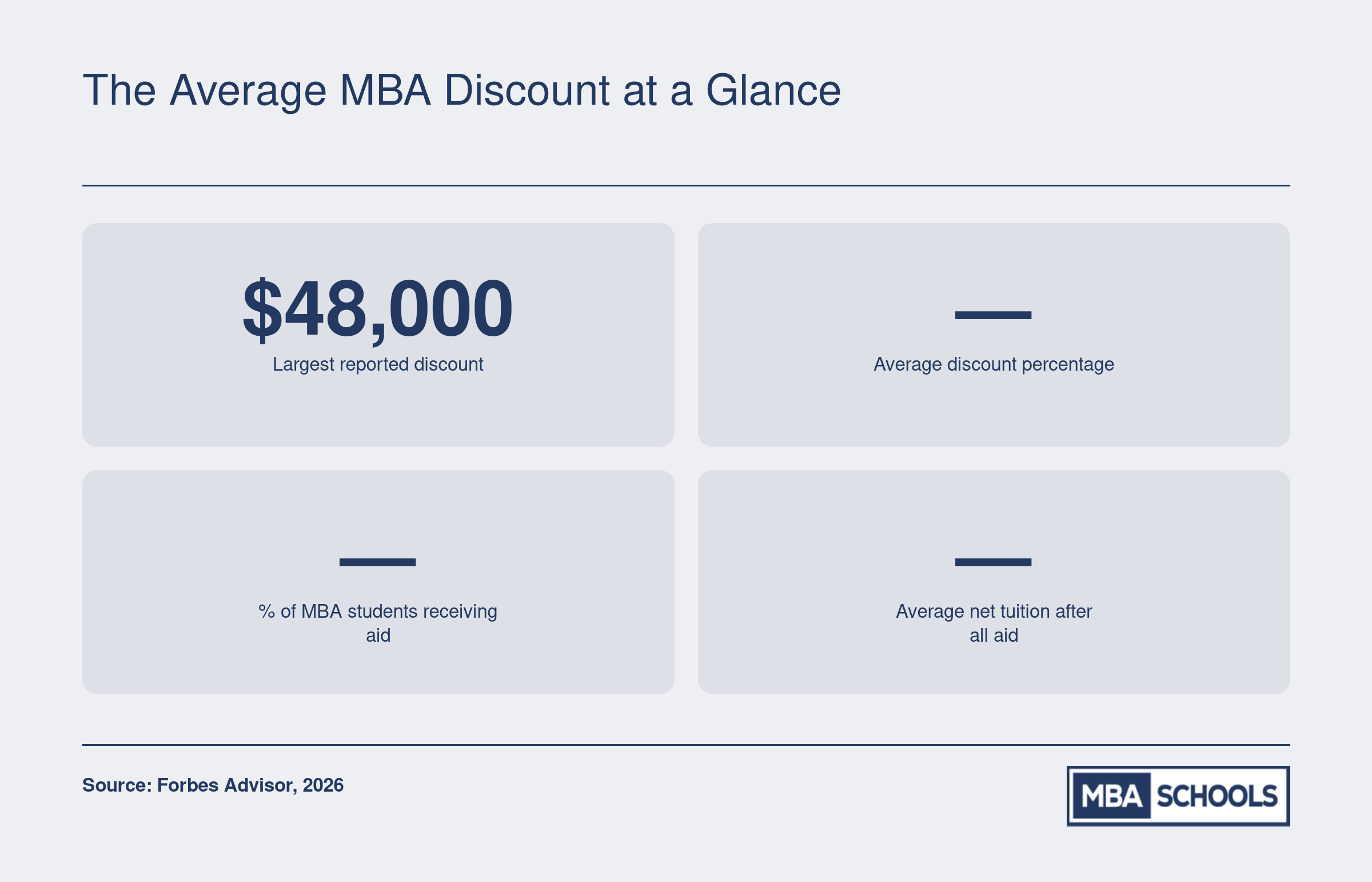
The Average MBA Discount at a Glance
While comprehensive data on MBA discount rates isn't centrally tracked, a Forbes Advisor report identified current tuition reductions that can reach as high as $48,000 at select programs. The grid below highlights what we know and what remains opaque about the financial aid landscape for MBA students.
Stacking Discounts: Combining School Aid with Employer Sponsorship
Combining employer tuition reimbursement with a school scholarship, a practice known as aid stacking, can dramatically lower your MBA cost, but policies vary widely. Before you accept an offer, you need to understand exactly how a business school treats outside financial support. Some programs allow you to keep every dollar, while others reduce your institutional aid to offset what your company contributes.
How Schools Treat Employer Reimbursement: Three Common Scenarios
Schools generally follow one of three stacking models. In the first, full stacking is permitted as long as your total resources do not exceed the cost of attendance.1 Many elite full-time MBA programs fall into this category: a moderate annual reimbursement of $5,250 or $8,000 rarely triggers a scholarship reduction because your combination of grants, loans, and employer aid remains well below the total budget. Only when outside awards push you past tuition plus mandatory fees does the school subtract the overage.
The second model is a partial offset, often found in part-time and mid-tier programs. Here, institutional scholarships are "last-dollar," meaning the school fills the gap after your employer contribution is accounted for. If your company pays $10,000, the school may reduce a previously offered scholarship by exactly that $10,000, leaving your net cost unchanged. Direct-billed corporate sponsorship, where your employer pays the school directly, is almost always counted against institutional funds first, effectively erasing any merit aid you might have been granted.1
The third model is the most rigid: a dollar-for-dollar reduction. This is typical for formal, full-tuition MBA sponsorship programs like Deloitte's Graduate School Assistance Program (GSAP).3 When an employer covers the entire tuition, the school eliminates all institutional merit aid because you no longer demonstrate financial need from the school's perspective. Even partial sponsorships can trigger significant cuts if the school treats all external resources as equivalent.1
The IRS Section 127 Wildcard: Tax-Free Employer Education Assistance
The IRS allows employers to provide up to $5,250 per year in tax-free educational assistance under Section 127. This is the most common reimbursement structure and the one most likely to disrupt your aid package. Because these funds are reported to the school as a resource, they can affect need-based grants and some scholarships. However, a reimbursement paid directly to you after you complete a course is often treated as a personal resource, not an institutional resource, making it less likely to reduce your aid. If your employer pays the school directly (a practice known as direct billing), the school treats it as a clear resource that will offset other aid first.1
Questions to Ask Before You Commit
Contact the financial aid office before you deposit and ask these specific questions: - Does the school allow stacking of employer reimbursement with institutional scholarships up to the cost of attendance, or is there a dollar-for-dollar reduction? - How does the school classify different types of employer support, such as direct billing vs. reimbursement, partial vs. full sponsorship? - If my reimbursement increases after matriculation (for example, due to a promotion), will that trigger a mid-program aid adjustment? - Does the school treat tax-free Section 127 assistance differently from other employer contributions?
Understanding these policies upfront can help you negotiate or choose a program where your total net cost is genuinely lower, not just shifted between funding sources. For a broader look at employer tuition reimbursement for MBAs, including which companies offer the most generous benefits, it pays to research your options before you apply.
What Companies Will Help Pay for Your MBA?
Paying for an MBA entirely out of pocket can feel like a second mortgage. But a growing number of working professionals are discovering that their employer, not their bank account, covers a large share of the bill. MBA tuition reimbursement programs have become a strategic tool for talent retention, and they can slash your net cost long before you submit a single loan application.
The Tax-Free Foundation: IRS Section 127
Before looking at specific employer caps, it helps to understand the federal tax advantage that underpins most programs. Under IRS Section 127, employers can provide up to $5,250 per year in educational assistance entirely tax-free to the employee. Anything above that amount is generally treated as taxable income, unless the education qualifies as a working condition fringe benefit. Many companies choose to exceed the tax-free ceiling, so $10,000 or $25,000 annual benefits are not uncommon, but the portion above $5,250 will appear on your W-2. Knowing this threshold helps you estimate your true after-tax benefit when comparing offers.
Leading Employers That Cover MBA Costs
Based on public policy disclosures for the 2025-2026 cycle, these companies represent a range of industries and benefit levels:1
- Boeing: Pre-approved job-related courses at approved institutions, with a cap of $25,000 per year.
- Deloitte: For regular employees with at least one year of tenure, up to $10,000 annually; courses must be pre-approved and passed.
- Intel: Up to $50,000 lifetime, but you must commit to two years of service; leaving within one year triggers full repayment.
- Microsoft: $10,000 per year covering tuition, books, and fees for degree programs.
- Qualcomm: $10,125 per year for graduate degrees, also covering tuition, books, and fees.
- Bank of America: $7,500 annually for job-related coursework.
- Verizon: $8,000 per year for both undergraduate and graduate degrees.
- UPS: $5,250 per year with a lifetime cap of $25,000; eligible from your hire date.
- Wells Fargo: $5,000 per year for regular or fixed-term employees.
- Allstate: $5,250 per year after one year of employment, with pre-approval and repayment conditions.
- Apple: The standard $5,250 per year for full-time employees enrolled in accredited programs, with pre-approval.2
These figures are subject to change, and large consulting firms, investment banks, and tech platforms like Amazon, Google, and McKinsey also operate well-regarded tuition assistance programs, though their precise caps often sit behind internal portals. For a deeper look at companies that pay for MBA programs across industries, a dedicated guide can help you compare sponsorship structures side by side.
What Conditions Typically Apply?
Beyond the dollar caps, every program comes with strings attached. The most common conditions include pre-approval from a manager or HR liaison, maintaining a minimum grade point average, and selecting an accredited institution. Some employers, like Intel, tie the benefit to a multi-year retention clause. Others, like Allstate, require repayment if you leave shortly after completing a course. Many programs restrict funding to courses directly related to your current role, which can rule out a full-time, career-switching MBA unless you negotiate.
How to Confirm Your Employer's Policy
Because policies shift annually with budgets and strategic priorities, the safest move is to retrieve the current employee handbook or contact your HR benefits team directly. Ask specifically about the educational assistance plan document, which should outline annual limits, lifetime caps, eligible degree levels, and any service commitments. If you are evaluating a job offer, treat the tuition benefit as part of total compensation and negotiate its inclusion in writing.
Calculating Your Net MBA Cost After All Discounts
Reducing tuition is a decisive step, yet the full financial picture of an MBA extends far beyond the published price. Sticker shock fades only when you account for every offset and every hidden drain. The exercise below turns abstract savings into a concrete net out-of-pocket number you can own.
A Step-by-Step Net Cost Calculation
Start with the full published tuition for your target program. Suppose the sticker is $80,000 for a two-year residential MBA. Apply the school's tuition discount, as many programs now reduce sticker by 20, 30% for well-qualified candidates. In this example, a 25% discount cuts $20,000. Next, layer on merit scholarships, which often stack with discounts. Assume a $15,000 scholarship awarded directly by the school. Now factor in employer reimbursement. Under current IRS rules, the first $5,250 per year is tax-free; any excess is taxable as income. If your employer provides $10,000 per year, the tax-free portion is $5,250, and the remaining $4,750 is taxed at your marginal rate. Treated simply, that yields an after-tax benefit of about $8,000 per year, or $16,000 over two years. Finally, if you qualify, the Lifetime Learning Credit can subtract up to $2,000 per tax return per year. The running tally: $80,000 , $20,000 , $15,000 , $16,000 , $4,000 = $25,000 in net tuition. That is a $55,000 reduction from the sticker price.
The Hidden Costs: Living Expenses and Opportunity Cost
Tuition is only one line on the ledger. Living costs, including housing, food, insurance, and books, easily add $25,000, $35,000 per year. If you attend full-time, you also forgo your salary. For someone earning $80,000 pre-MBA, two years of lost income total $160,000 before taxes. These figures do not shrink when tuition is discounted, so the true out-of-pocket investment equals net tuition plus living expenses, and the full economic cost includes forgone earnings.
Your Personal Cost Checklist
Adapt this simple framework to your own situation: - Sticker tuition , the program's published price - Less: tuition discount , any percentage reduction offered by the school - Less: merit scholarships , direct aid from the program or external sources - Less: employer reimbursement (after tax) , only the net benefit after accounting for taxability - Less: education tax credits , such as the Lifetime Learning Credit - Equals: net tuition - Add: estimated living costs , to arrive at total cash outlay - Add: forgone salary (pre-tax) , for the full economic cost
ROI With a Discounted Degree
A lower net tuition accelerates the payback. With $25,000 in net tuition, a post-MBA salary jump from $80,000 to $140,000 yields a tuition breakeven in about half a year from the incremental income alone. At full $80,000 tuition, the same salary bump might take three to four years to recoup solely from the raise. To stress-test your own numbers, it helps to calculate MBA ROI with scholarships and aid before committing to a program. Cutting your upfront cost does more than ease near-term cash flow; it magnifies the lifetime value of the degree.
Online vs. On-Campus: Where MBA Discounts Are Deepest
Total economic cost for an online MBA in 2026 lands between $55,000 and $120,000,1 while a traditional full-time on-campus program can easily surpass $300,000 when factoring in tuition, fees, and lost income.1 That gap is widening as online programs discount more aggressively, often 20% to 50% off sticker price, to attract career-minded professionals who cannot afford to pause their earnings.
Where Discounts Run Deepest
Online MBA programs have pushed harder into tuition reduction because they face fiercer competition and enjoy lower delivery costs. A fully online curriculum avoids campus overhead, so schools can pass savings directly to students. Discounts on online MBAs commonly cut $15,000 to $30,000 off the published rate, while residential programs typically negotiate smaller merit-based scholarships. Net tuition after discounts often brings an online degree below $50,000, whereas on-campus net cost still averages $120,000 or more after aid.
Total Cost of Attendance: The Bigger Picture
Tuition discounts alone do not capture the full financial picture. On-campus students must budget for relocation, campus fees, and two years of forgone salary, adding $150,000 or more to the true cost. Online learners can often keep their jobs, avoid moving, and continue building retirement savings. Even with a smaller percentage salary bump after graduation (20-40% vs. 40-80% for full-time programs),1 the online MBA's lower total outlay frequently delivers a quicker return on investment. Calculating MBA ROI with scholarships and aid can help you compare formats side by side before committing.
Employer Sponsorship and Part-Time Advantage
Online programs naturally align with online MBA employer tuition reimbursement because they fit alongside full-time work. Many companies cap annual assistance at $5,250 under IRS rules; stacking that over a three-year part-time online MBA can erase a significant portion of the bill. On-campus formats typically require resigning, which eliminates reimbursement eligibility at most firms. Part-time online students also maintain industry continuity, making them eligible for promotion-based salary increases even before graduation.
Negotiation Leverage and Program Value
An offer from a competing online program gives applicants strong negotiating power because online enrollments are so price-sensitive. On-campus candidates may still extract more aid by highlighting unique profiles, but the structural cost advantage of online models means those discounts are already baked in. For career switchers, the on-campus premium is often justified by deeper networking and stronger employer perception at mid-tier schools,2 but for professionals staying in their field, an online MBA with a heavy discount delivers the best value.3
Common Questions About MBA Tuition Discounts
MBA applicants often overlook the substantial discounts that can slash the cost of a top program. Below are clear, straightforward answers to the most pressing questions about securing your share of tuition savings.