
What you’ll learn in this article…
- GMAC’s 2026 survey of 600+ recruiters ranks AI training 14th among desired MBA skills but top in five years.
- Employers now prioritize communication, problem-solving, and data interpretation; AI fluency has become a baseline expectation.
- AI-focused MBA grads see faster salary growth in tech, consulting, finance, healthcare, and retail.
- Recruiters test applied AI skills like workflow automation and predictive modeling, not just conceptual knowledge.
In 2026, AI-specific training ranked 14th out of 22 desired MBA skills in GMAC’s survey of over 600 recruiters.1 Projected five years forward, the same hiring managers vault it to first place.
That gap frames a new expectation: AI fluency is becoming as fundamental as spreadsheet skills. Employers still prioritize communication, problem-solving, and adaptability in the near term, but they already test for applied AI capabilities through case studies and technical interviews.
An MBA without AI capability now looks incomplete, and graduates must pair machine-learning literacy with leadership on a tightening timeline.
The New Baseline: Why AI Fluency Is Now an MBA Requirement
AI fluency is no longer a speculative elective in MBA programs, it has become a baseline expectation for graduates entering a job market that is rapidly reorganizing around data-driven decision-making. In 2026, employers are not simply looking for MBAs who can prompt a chatbot; they want professionals who can integrate artificial intelligence into strategic thinking, operational analysis, and leadership communication. The Graduate Management Admission Council’s 2026 survey of more than 600 corporate hiring managers and staffing firm recruiters across dozens of countries clarifies this shift: while traditional skills still dominate near-term hiring criteria, a dramatic reordering is underway.1
Current Employer Priorities: A Snapshot from 2026
The GMAC data reveals that in 2026, the top four skills employers seek among business school master’s graduates are communication, problem-solving, adaptability, and data analysis/interpretation. AI-specific training, by contrast, ranked in the bottom third of 22 skills assessed, a marginal improvement from its similarly low placement in 2025. This might suggest that AI remains a niche competency, but the numbers tell a more nuanced story. Employers are still hiring for the human capabilities that drive team performance and client relationships, yet they are simultaneously signaling a future state where those very skills will be amplified, or even replaced, by AI-enabled professionals.
The Five-Year Outlook: AI’s Leap to the Top
When the same employers were asked which skills they will prioritize five years from now, AI-specific training vaulted to the top of the list.1 This leap is not incremental; it repositions AI from an afterthought to a primary differentiator. Andrew Walker, GMAC’s industry communications director, noted that the premium on core skills like communication and problem-solving is nothing new, but the sudden elevation of AI reflects a collective realization: business problems are becoming too complex for intuition alone, and the MBAs who will lead in 2031 are those who can marry judgment with machine intelligence right now.
Bridging the Gap: Why This Matters for MBA Students
The gap between today’s hiring priorities and tomorrow’s expectations creates a strategic opening. An MBA candidate who graduates with demonstrated AI fluency, not just coursework, but applied projects and tool proficiency, enters a market where most peers are still being evaluated on traditional metrics. This early-mover advantage is already visible: companies are creating dedicated roles for AI-savvy MBAs in strategy, product management, and operations, offering premium compensation to those who can bridge the technical and the commercial. For business schools, the implication is clear: curricula must embed AI training into finance, marketing, and leadership courses without diluting the soft skills that employers currently demand. The programs that treat AI as a standalone module rather than an integrated foundation will produce graduates who are equipped for yesterday’s job descriptions, not next year’s.
The AI Skills Employers Actually Demand (And How They Test for Them)
A structural shift is underway: as noted in our guide on working with mba recruiters, MBA recruiters no longer ask whether you can 'talk AI'; they demand evidence you can apply it to real business decisions.
The AI Toolkit Employers Expect
The tools showing up in MBA job descriptions span four practical domains. Python is the dominant programming language, listed as required or a strong plus for data manipulation and building simple predictive models. SQL follows closely, used to access relational databases and construct the KPI views that drive management dashboards.1 On the visualization side, Tableau and Power BI are baseline expectations: candidates must demonstrate they can build clear, interactive dashboards for revenue, funnel, or operations metrics without relying on a data team.2
Generative AI platforms, surveyed in AI tools for business in 2026, form the newest layer. Employers expect fluency with ChatGPT or GPT-4 for drafting slide decks, memos, and strategy documents, interpreting data, and even prototyping code snippets.3 Microsoft Copilot is quickly becoming essential inside Excel for variance analysis and generating slide outlines, while Google Gemini is valued for analyzing data in Sheets and summarizing lengthy documents.3 Claude often appears in roles requiring deep report analysis or code review.3 The theme is consistent: companies are hiring managers who can use these tools to accelerate decision-making, not engineers who build them from scratch.
How Recruiters Test for AI Aptitude
Employers evaluate AI skills through a multi-stage funnel that mirrors real work. AI-enhanced case interviews, a format covered in mba interview tips, are now common: candidates are given a business problem and a generative AI tool. They are assessed not just on the outcome but on their prompt engineering, how they iterate, and their ability to critique the AI’s output for errors or bias.
Technical tests are also prevalent, often a Python mini-project lasting 30 to 90 minutes. A typical challenge involves cleaning a messy dataset, performing exploratory analysis, and presenting a short recommendation. Portfolio reviews, usually two to three projects, allow candidates to showcase end-to-end work: building a churn prediction model, automating a reporting pipeline, or designing an AI strategy for a hypothetical product launch.
Structured interviews on AI ethics have also entered the rotation. Recruiters probe understanding of algorithmic bias, hallucination risks, data privacy constraints, and emerging regulatory frameworks.4
From Classroom to Recruiter: Building a Portfolio
The test tasks that land offers are rarely theoretical. An AI Business Strategist candidate might be asked to design a three-year AI roadmap for a retail bank, outlining use cases, data requirements, and change management steps. A Generative AI Product Manager interviewee could face a prompt like: “Our chatbot’s engagement dropped after a model update. Define three improvements and outline the A/B tests you’d run.” These exercises reward business judgment over pure technical depth.
Portfolio projects that stand out mirror this blend. A predictive model built with scikit-learn is fine, but one that includes a cost-benefit analysis for deploying it into a customer service workflow is far more compelling. Employers want evidence you can translate between business stakeholders and data science teams.
Certifications as a Screening Shortcut
Many firms use certifications as quick filters to manage application volume. Common ones include AWS Certified Machine Learning - Specialty, Google Data Analytics Professional Certificate, and the Microsoft Azure AI Engineer Associate. While no credential replaces hands-on ability, these signals help your resume survive initial keyword scans and can be completed alongside an MBA. They are especially valuable for career switchers who need to demonstrate baseline AI familiarity before an interview.
The net message for MBA candidates is clear: you don’t need to code a transformer from scratch, but you must be ready to lead with data, provoke an AI’s output, and defend your recommendations through the lens of both business and ethics.
In 2026, hiring managers ranked AI-specific training 14th out of 22 desired skills for MBA graduates, according to GMAC's annual survey. But when asked which skill would be most important in five years, they vaulted it to first place, a dramatic reversal that underscores how quickly AI is reshaping business education priorities.
AI MBA Vs. Traditional MBA: Hiring and Salary Outcomes
The distinction between a traditional MBA and an AI-focused MBA has become more pronounced in the job market. While general management roles continue to offer strong MBA career paths, graduates with demonstrated AI competencies often find themselves in a different conversation with recruiters, which often means accelerated hiring and premium salary packages. Employers are not simply looking for candidates who understand AI concepts; they want MBAs who can translate data-driven insights into strategic business decisions.
Based on industry surveys and career outcomes reported by leading business schools, AI specialization can shift both the types of roles offered and the compensation bands attached to them. Traditional MBA graduates typically land in consulting, finance, and general management, whereas AI-enabled MBAs are increasingly recruited into product management, tech strategy, and analytics leadership roles where the intersection of business and technology is critical.
The Compensation Premium for AI-Enabled MBAs
While precise salary figures vary by industry, location, and prior experience, a clear pattern has emerged: roles that explicitly require AI or machine learning fluency often command higher starting offers. Employers recognize that candidates who can bridge the gap between data science teams and executive strategy are rare, and they are willing to pay accordingly. In competitive sectors like technology, financial services, and healthcare, base MBA salaries for AI-literate MBA graduates can outpace those of their traditional counterparts by a meaningful margin, sometimes reaching into the top quartile of their class placement reports.
This premium is not uniform across all functions. For example, a product manager role at a tech firm that expects the hire to work closely with AI engineering teams will typically carry a higher salary than a brand management role in consumer packaged goods. The value-add is the ability to make faster, more informed decisions and to lead cross-functional initiatives that leverage machine learning outputs.
Industry Demand and Placement Rates
Corporate recruiters consistently report that they seek MBAs who can navigate data-rich environments. The annual GMAC Corporate Recruiters Survey highlights that, while soft skills like communication and problem-solving remain essential, technical AI proficiency is rapidly climbing the list of desired attributes. This translates into higher interview invitation rates for candidates who showcase relevant AI projects, certifications, or coursework on their resumes.
Business school career offices have noted that students pursuing AI concentrations or dual degrees with data science often receive multiple offers earlier in the recruiting cycle. These graduates are also more likely to be placed in strategic roles rather than rotational programs, as employers are eager to deploy their specialized skills immediately.
What MBA Employment Reports Reveal
Many top business schools now break out employment statistics by specialization. For those that offer AI or analytics tracks, the data generally shows strong placement rates and competitive compensation. Even programs that do not formally label a track as "AI" often highlight that graduates who took relevant electives in machine learning, data analytics, or digital transformation secure roles in high-demand sectors. The consistent message from these reports is that AI literacy enhances marketability without closing doors to traditional MBA functions.
Long-Term Career Trajectories
Beyond the initial job offer, AI-enabled MBAs may benefit from faster career progression. As organizations embed AI into core operations, leaders who understand both the technical and business implications are positioned for earlier advancement into senior management. While a traditional MBA provides a broad foundation, the addition of AI skills can act as a catalyst, accelerating the path to roles such as Chief Strategy Officer or VP of Innovation where technology strategy is integral.
In summary, while a traditional MBA remains a valuable credential, the data and trends suggest that AI-enabled graduates often enjoy a measurable edge in hiring outcomes and salary potential. This edge is not universal, but for those targeting industries undergoing digital transformation, the investment in AI coursework can yield significant returns.
Questions to Ask Yourself
Related Articles
Top Industries and Companies Hiring AI-Enabled MBAs in 2026
AI fluency has shifted from a nice-to-have to a table-stakes requirement across major MBA hiring sectors in 2026.1 Demand spans technology, consulting, finance, healthcare, and retail, each valuing a unique mix of AI capabilities and traditional business skills.
Technology: AI Fluency as a Core Competency
Amazon, Microsoft, AWS, Oracle, and AI-native firms like Clara AI and Keysight Technologies are embedding AI into every product and service line.2 These employers need MBAs who can translate emerging AI capabilities into market-ready solutions.
- Key employers: Amazon, Microsoft, AWS, Oracle, Clara AI, Keysight Technologies
- Common titles: AI Product Manager, Head of Product, AI Strategist, Martech & AI Architect
- Critical skills: AI fluency, machine learning concepts, prompt engineering, product strategy, cross-functional leadership
Consulting: Translating AI into Business Impact
Leading management consultancies are placing AI at the center of their digital transformation practices.3 They seek MBAs who can quantify AI’s business value and communicate strategic recommendations effectively.
- Key employers: Leading management consultancies and digital transformation practices
- Common titles: AI Strategy Consultant, Digital Transformation Consultant, Business Analyst, AI Transformation Lead
- Critical skills: Quantifying business impact, AI fluency, responsible AI use, communication, translating AI outputs into client strategy
Finance: Data Literacy Meets Strategic Thinking
Financial institutions like Capital One are integrating AI into risk assessment, forecasting, and customer analytics.1 MBAs in this sector must bridge data science and high-stakes decision-making.
- Key employers: Capital One and other major banks and investment firms
- Common titles: Principal Data Scientist, Manager Data Science, Financial Analyst, AI Strategy Manager
- Critical skills: Data literacy, machine learning basics, interpreting model outputs, risk and forecasting analysis, quantitative reasoning
Healthcare: Driving Efficiency with AI
Healthcare organizations are adopting AI for operational improvement and clinical decision support.2 MBAs lead initiatives that navigate regulatory complexity while delivering measurable productivity gains.
- Common titles: Product Manager, Operations Manager, AI Program Manager, Healthcare Strategy Manager
- Critical skills: AI for productivity and decision support, healthcare workflow understanding, data interpretation, responsible AI use, stakeholder communication
Retail: Personalization and Predictive Analytics
E-commerce and retail giants rely on AI to personalize customer journeys and optimize pricing. MBAs in this sector combine analytical rigor with a deep understanding of consumer behavior.
- Common titles: Product Manager, Pricing Manager, Growth Manager, AI Business Analyst
- Critical skills: AI-powered personalization, pricing optimization, experimentation, data-driven decision-making, customer insight translation
Across all industries, employers surveyed by GMAC agree on a foundational skill set for AI-enabled MBAs: familiarity with Python or SQL, machine learning literacy, and the enduring strengths of business strategy, communication, and leadership.2 While soft skills like adaptability and problem-solving dominate current hiring criteria, AI proficiency is the skillset poised to define career growth over the next five years.
Right now, employers want communication and adaptability from MBAs. In five years, they'll demand AI fluency above all else.
AI-Resilient Careers: Which MBA Jobs Are Safe From AI?
In the MBA job market, AI is simultaneously creating new executive roles and automating routine analytical tasks. Understanding this divide is critical for graduates aiming to future-proof their careers and target the best jobs for MBA graduates.
The Divide: Automation vs. Augmentation
Routine data processing, report generation, and simple financial modeling are increasingly handled by AI. Roles centered solely on these tasks face obsolescence. However, positions requiring nuanced decision-making, cross-functional leadership, and creative problem-solving are not just safe; they become more valuable when AI handles the grunt work. Management occupations represent a massive segment where AI augmentation is reshaping rather than erasing demand. Employers now seek MBAs who can leverage AI to inform strategy, not just execute predefined analyses.
AI-Augmented Roles Driving MBA Hiring
A new wave of hybrid positions blends business acumen with AI expertise.1 Among the most resilient are:
- AI Product Manager: Owns the vision for AI-driven products, translating between technical teams and business stakeholders to deliver market-ready solutions.
- AI Strategy Consultant: Advises enterprises on integrating AI into operations, competitive positioning, and long-term planning; human judgment is irreplaceable when assessing organizational readiness and change management.
- AI Ethics Officer (or Governance Specialist): Develops policies for responsible AI use, addressing bias, transparency, and compliance. This role hinges on ethical reasoning that cannot be automated.
- Digital Transformation Lead: Orchestrates cross-functional initiatives to modernize legacy systems with AI, requiring stakeholder persuasion and cultural change skills.
- Chief AI Officer: A C-suite role defining the company’s AI roadmap, balancing investment with risk, a quintessential high-stakes decision-maker.
These roles appear across consulting firms, tech companies, and large enterprises, reshaping traditional mba career paths and demanding the ability to bridge business strategy and AI capabilities.
Human Judgment: The Unreplicable Edge
While AI can optimize a supply chain or predict customer churn, it cannot negotiate a merger, inspire a team, or navigate ethical dilemmas. MBAs who excel in ambiguous, interpersonal environments have a durable advantage. Communication, adaptability, and ethical reasoning are cited by employers as timeless skills that AI cannot replicate. Even as AI tools grow, the final call on resource allocation, brand identity, and crisis response requires a leader’s intuition and accountability.
AI Literacy as a Universal Requirement
Crucially, resilience does not mean opting out of AI. Marketing managers must interpret AI-generated consumer insights; operations leaders use predictive maintenance models; management consultants present data-backed recommendations. AI proficiency is no longer a specialization; it is a baseline expectation across all MBA functions. Programs that embed AI literacy alongside classic leadership development produce graduates who are both AI-augmented and irreplaceably human.
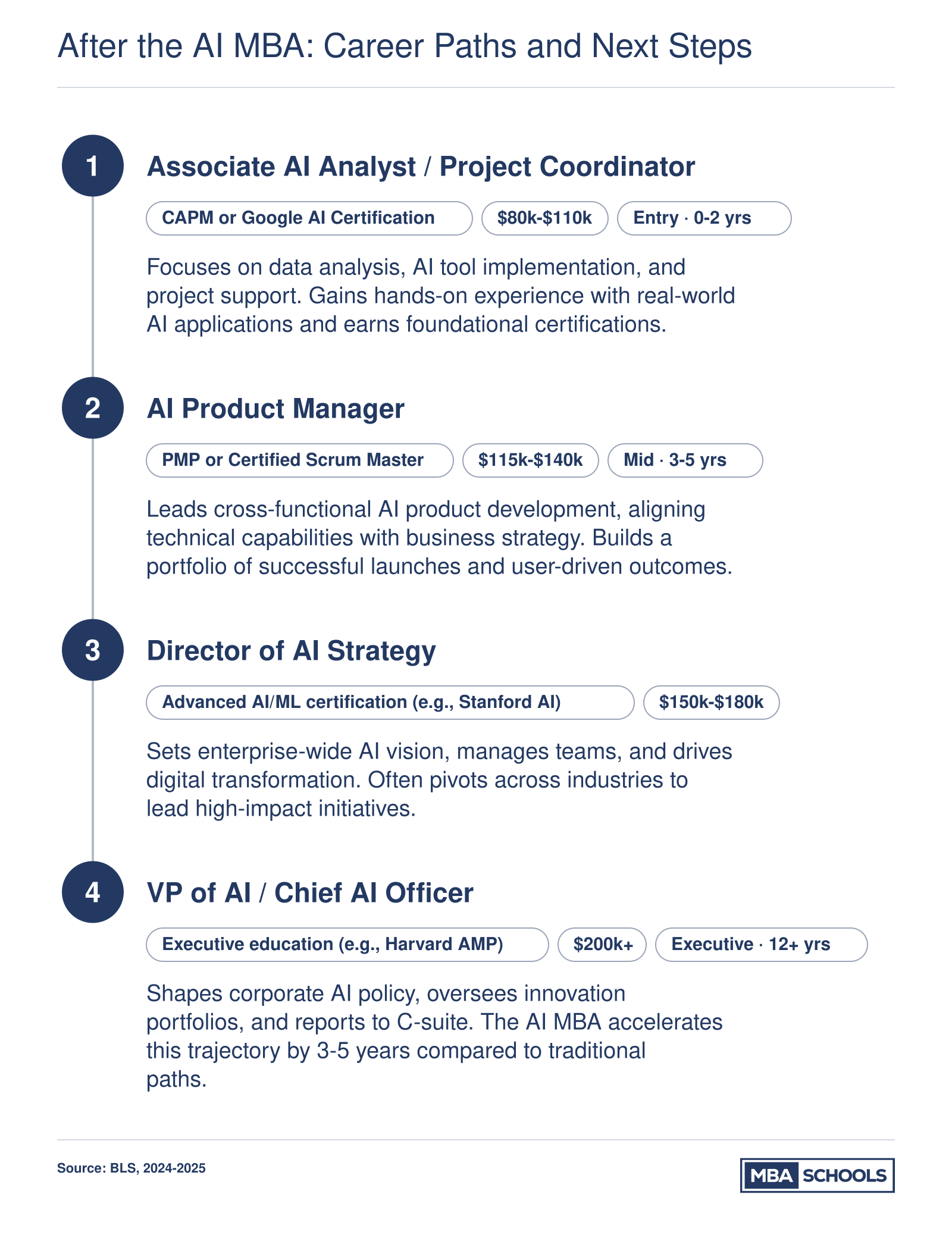
After the AI MBA: Career Paths and Next Steps
The journey from MBA graduate to AI executive is fast-tracked by strategic credentialing and cross-industry mobility. Below is a typical progression, though actual pathways often involve lateral moves across tech, finance, and consulting. An AI-focused MBA can shorten the timeline to senior leadership by 3-5 years.
How to Build an AI-Ready MBA Profile
The tension every aspiring AI-savvy business leader confronts is whether the investment in learning AI tools will pay off before those tools evolve into commodities. Spend too much time mastering today's platforms and you risk obsolescence; ignore them entirely and you cede ground to a generation of tech-native managers. The solution is not to become a data scientist, but to build a profile that blends strategic thinking with a working knowledge of AI's capabilities and limits. Here is how to structure your MBA career development while still in your MBA program.
Target Programs with Built-In AI Exposure
Choose MBA programs that integrate AI beyond a single elective. Look for dedicated AI tracks, research centers, or corporate-sponsored labs where you can apply machine learning to marketing, finance, or operations. Many schools now offer AI concentrations or specialized masters tracks. Prioritize ones that partner with tech firms to provide real-world datasets and capstone projects.
- AI-focused case competitions: Participate in events like the MBA Tech Innovation Challenge or data analytics hackathons. These simulate the cross-functional pressure employers value and provide tangible evidence of your ability to lead AI projects.
- Internships with an AI mandate: Target roles where the job description explicitly asks for experience with generative AI, prompt engineering, or data-driven decision making. Even a three-month project can yield a narrative for your resume.
Build a Portfolio That Speaks to Business Problems
Recruiters increasingly expect to see applied work, not just course titles. Create at least one end-to-end project using a generative AI tool to solve a tangible business problem. Document it on GitHub or a personal site with a clear business case, methodology, and results. For example, a project might use a large language model to automate customer sentiment analysis for a retail chain, complete with a cost-benefit analysis. This shows you can translate AI capabilities into business impact.
Acquire a Baseline Technical Vocabulary
You do not need to code, but you must speak the language. Understand the difference between supervised and unsupervised learning, and be able to explain why a large language model is not the same as a traditional machine learning model. Familiarity with concepts like fine-tuning, RAG (retrieval-augmented generation), and model evaluation helps you communicate credibly with data scientists and vendors. Free resources like Google's AI for Business Professionals course or LinkedIn Learning paths can get you there in weeks.
Network Within AI-Driven Business Circles
Join AI-focused professional communities on LinkedIn, such as "AI in Business" groups, and attend industry conferences like the AI Business Summit or local meetups. MBA networking not only alerts you to emerging roles but also connects you with mentors who have already navigated the transition. Many hiring managers for AI-product management or strategy roles are active in these circles.
Soft Skills Remain the Anchor
The GMAC survey confirms what experienced managers have always known: communication and problem-solving still top the list of employer demands1. AI proficiency is scaling fast, but the ability to frame a problem, build consensus, and tell a compelling story with data is what separates a technologist from a leader. In every project, report, and case interview, practice explaining complex AI concepts in terms a non-technical stakeholder would value. That marriage of technical awareness and interpersonal clarity is the profile that will stay relevant as tools evolve.