
What you’ll learn in this article…
- Rice Business launched an online MBA Early Career Track in June 2026 for professionals with under three years of experience.
- Several highly ranked online MBA programs now waive work experience requirements, opening the door for recent graduates.
- Employers increasingly view online MBAs from accredited schools as equal to on-campus programs, focusing on skills over tenure.
On June 23, 2026, Rice Business launched an Early Career Track for its MBA@Rice online program, granting professionals with under three years of experience direct entry to the same STEM-designated curriculum and faculty as seasoned managers. The move dismantles the entrenched belief that an elite MBA requires a mid-career resume.
Young professionals no longer wait. They view the degree as an accelerator, not a credential earned after proving themselves, driving demand for early career online MBAs that deliver the full toolkit while building experience. Whether an online MBA is worth it is a question more young professionals are asking earlier than ever before.
The result is a compressed timeline that amplifies long-term salary returns but forces harder conversations about readiness and employer buy-in. As top schools follow Rice's lead, the question is no longer whether professionals can pursue an MBA early, but whether they are prepared.
What Is an Early Career Online MBA?
Business schools are rethinking who belongs in the MBA classroom, and the result is a category of programs built specifically for professionals who haven't yet spent years climbing the corporate ladder.
An early career online MBA is a flexible graduate business degree designed for candidates with 0, 3 years of work experience, in contrast to traditional post-experience online MBAs that typically expect five to ten years of professional background. These programs deliver the same accredited MBA curriculum but structure the cohort experience, mentorship, and career-development resources around the needs of younger professionals.
A New Model for a Younger Generation
The core distinction is a pre-experience design that mirrors the rigor of any MBA but front-loads support. Rice Business's recently announced MBA@Rice program illustrates this clearly: it now operates two parallel tracks , an Early Career Track for those with less than three years of experience and an Experienced Track for those with three or more. Both cohorts complete the identical STEM-designated curriculum with the same faculty, earn the same Rice MBA degree, and integrate fully during the second year. What sets the early career cohort apart is a dedicated Leadership and Career Accelerator and a tight-knit first-year community that helps bridge the gap between academic learning and early professional development. This structure is becoming a template across the industry as schools recognize that high-potential candidates benefit from peer groups at a similar life stage without diluting academic standards.
Why Schools Are Lowering the Experience Bar
Rice's move reflects a broader structural shift, not an isolated experiment. In the past two years, multiple institutions have launched or retooled online programs to accept candidates with minimal or no work experience1:
- UC Davis now offers an Online Master of Management that requires zero years of professional experience and can be completed in just 15 months.
- San José State University has rolled out an Early Career MBA with concentrations in Global Leadership, Business Analytics, and Entrepreneurship & Innovation.
- University of Maryland Global Campus delivers an 18-month online MBA that accepts applicants with a bachelor's degree in any field.
- University of Phoenix compresses the path into as few as 12, 16 months, while Grand Canyon University and Southern New Hampshire University offer 18-month and 12-month online MBAs respectively.
These programs reflect rising demand from millennials and Gen Z professionals who want to accelerate their career trajectory without stepping away from the workforce. Recent data from the Graduate Management Admission Council underscores that more candidates are seeking earlier access to business education, and schools are responding with flexible, accessible formats.1
Same Degree, Same Faculty, Different Support
A common misconception is that an MBA admitting younger candidates must compromise on quality. In practice, online MBA programs respected by employers carry the same accreditation and are taught by the same tenured and industry-experienced faculty as their seasoned-professional counterparts. The difference lies in cohort design and wraparound support, not academic rigor. Jeff Fleming, interim dean of Rice Business, emphasized that the Early Career Track ensures students build a professional network from the start while receiving career coaching calibrated to those with less work history. The goal is to provide a structured runway, not a shortcut , students emerge with a fully respected MBA credential and the soft skills that traditional MBA graduates develop over many years of pre-MBA employment. For institutions, it's about expanding access to top-tier business education for a new generation of leaders.
Best Online MBA Programs for Early Career Professionals
The following ranking reflects online-delivery-eligible MBA programs evaluated on a mixed quality composite that includes institutional performance and value metrics. It is not solely an early-career friendliness list, but we have elevated programs where flexible admissions, accelerated timelines, or explicit early-career pathways align with the needs of young professionals.
- Academic quality and accreditation
- Career support for early professionals
- Affordability and value
- Program flexibility and format
- Admissions accessibility
- NCES-IPEDS federal institutional data — nces.ed.gov
- Independent program research
- Internal program database
- College Scorecard graduate earnings — collegescorecard.ed.gov

Empire State University
Empire State University offers a fully online MBA in Business Management designed explicitly for aspiring, early, and mid-career professionals. The program features a flexible foundation course option for recent non-business graduates, stackable advanced certificates, and strong partnerships with New York State agencies, making it especially practical for public-sector employees. With seven concentrations and asynchronous delivery, it accommodates working professionals while emphasizing strategic leadership and cross-cultural competence.
- 36-credit fully online program
- Completion possible in 20-27 months
- Seven concentrations including General Business and HR Management
- Foundation courses available for non-business undergraduates
- Designed for early- and mid-career professionals
- Optional advanced certificate for dual credential
- Asynchronous delivery with optional synchronous sessions
- Fall, spring, and summer starts
Master of Business Administration in Business Management — Online

Stony Brook University
Stony Brook University's MBA stands out for its explicit no-work-experience requirement, making it a natural fit for recent graduates and early-career switchers. The program offers both fully online and hybrid formats, with an accelerated 12-month full-time track and concentrations in Innovation and Operations Analytics. Its AACSB-accredited curriculum emphasizes data analytics and strategic management, with a strong STEM-adjacent focus in the innovation concentration.
- Hybrid format with online and on-campus options
- 36-48 credits depending on prior business education
- No prior work experience required
- GMAT optional
- Full-time 12-month option available
- Concentrations in Innovation or Operations Analytics
- Fall and spring semester starts with winter sessions
- Fully online delivery
- Emphasizes technological innovation and business analytics
- 12-18 months typical completion
- No work experience requirement
- 36-credit track for business undergraduates
- 48-credit track for non-business undergraduates
- Includes strategic management capstone and ethics in management
- Winter and summer session options
MBA (General) — Hybrid
MBA in Innovation (Online) — Hybrid

Jacksonville State University
Jacksonville State University's AACSB-accredited MBA provides a cost-effective online pathway with a built-in 4+1 accelerated option for its own undergraduates, making it a targeted choice for recent Alabama graduates. The program requires a GMAT score of 400 or a 3.0 GPA with three years of work experience, but JSU alumni receive a GMAT waiver. With a 30-credit curriculum and foundation courses for non-business majors, it emphasizes international business and leadership development.
- 30-credit hour AACSB-accredited program
- Fully online delivery with flexible pacing
- GMAT waiver available for JSU graduates and qualified applicants
- Foundation courses for those without business backgrounds
- 4+1 accelerated pathway for JSU undergraduates
- International business and technology focus
- Competitive online tuition rates
- Year-round admissions with multiple start terms
Master of Business Administration — Online

Arkansas Tech University
Arkansas Tech University offers a 100% online MBA with AACSB accreditation and three distinct tracks: General Business, Business Data Analytics, and Digital Marketing. Admission is flexible, with GMAT/GRE waiver options and a focus on data-driven decision-making. The program is particularly affordable, with in-state tuition rates extended to bordering states, and prepares graduates for management roles across industries.
- 100% online program
- Three concentrations: General Business, Data Analytics, Digital Marketing
- AACSB accredited
- GMAT/GRE waiver options available
- In-state tuition for bordering states
- Graduate assistantships and financial aid
- Minimum 2.75 GPA for admission
- Prepares for roles in business operations and technology
Master of Business Administration — Online
Youngstown State University
Youngstown State University’s online MBA is built for working professionals who want to accelerate their careers quickly. The 30-credit AACSB-accredited program can be completed in as few as 12 months through 7-week courses, with multiple start dates each year. Admission is flexible: a GMAT/GRE waiver is possible for those with work experience or a strong academic record. The curriculum emphasizes leadership, and the per-credit tuition is among the lowest in Ohio.
- 30 credit hours, 100% online
- Completion in as few as 12 months
- AACSB-accredited
- 7-week accelerated course format
- Multiple start dates throughout the year
- GMAT/GRE waiver may be available
- Leadership-emphasis curriculum
- In-state tuition $14,190 total
MBA – General — Online

Lamar University
Lamar University’s online MBA is designed to remove barriers for early-career students. The AACSB-accredited program requires no work experience, offers a GMAT/GRE waiver with a 2.5 GPA, and provides leveling courses for non-business majors. Its accelerated 8-week courses enable completion in as few as 12 months at a total tuition of $14,340. A Pre-MBA option helps students prepare before formal enrollment.
- 100% online, 30 credit hours
- Accelerated 8-week course format
- Completion possible in 12 months
- No work experience required
- GMAT/GRE waiver with 2.5 GPA
- Leveling courses for non-business undergraduates
- Total tuition $14,340
- Multiple start dates and Pre-MBA option
Master of Business Administration in General Business — Online

University of Arkansas at Little Rock
The University of Arkansas at Little Rock offers a hybrid Flex MBA that allows students to attend class on campus or via live Zoom, making it highly adaptable for working professionals in central Arkansas. It is the only AACSB-accredited MBA in Little Rock and the least expensive option in the area. Concentrations include General MBA, Business Analytics, and Human Resource Management, and the program can be completed in two to six years.
- Flex format: on-campus or real-time online attendance
- AACSB-accredited, the only one in Little Rock
- Five concentration options including Business Analytics
- 2-6 year completion timeline
- Least expensive MBA in the Little Rock area
- Coursera micro-credentials available
- Designed for working professionals
Master of Business Administration — Hybrid

University of South Dakota
The University of South Dakota’s AACSB-accredited MBA provides a hybrid and online pathway with an accelerated B.B.A./M.B.A. track for its undergraduates, making it a strong early-career option. The 33-credit program offers a General Business specialization, thesis and non-thesis options, and Business Essentials courses for non-business majors. It serves a largely rural state through multiple delivery formats, including online, on-campus, and a Sioux Falls site.
- 33-credit hour program, hybrid and online options
- AACSB-accredited
- Accelerated B.B.A./M.B.A. pathway for undergraduates
- Business Essentials courses for non-business backgrounds
- Concurrent J.D./M.B.A. available
- Thesis and non-thesis options
- Part-time online track for working professionals
- Sioux Falls, Vermillion, and online delivery
Business Administration (M.B.A.) — Hybrid

University of Nebraska-Lincoln
The University of Nebraska-Lincoln’s online MBA, recognized as a top-value program by Financial Times, is designed for early- and mid-career professionals. It requires no GMAT, offers rolling admissions with three annual start dates, and can be completed in as little as 1.5 years. With 48 credits at $700 per credit hour, the curriculum includes 10 core courses and 6 elective specializations, balancing flexibility with a rigorous business education.
- 48-credit fully online program
- No GMAT required
- Complete in 1.5-3 years
- Rolling admissions with three annual starts
- 10 core courses and 6 elective specializations
- Recommended minimum 3 years work experience
- Financial Times #1 Best Value MBA
- $700 per credit hour nationwide
Nebraska MBA — Online

East Tennessee State University
East Tennessee State University’s AACSB-accredited online MBA is a 33-credit program that can be finished in as few as 12 months through 7-week courses. It offers a general business concentration and admits students with a 2.5 GPA and GMAT scores, though waivers are available. With total in-state tuition around $22,000, it serves regional early-career professionals looking for a swift, accredited credential.
- 33 credit hours, fully online
- 7-week accelerated courses, multiple starts
- Completion in as few as 12 months
- AACSB-accredited
- 2.5 minimum GPA, GMAT may be waived
- General business concentration
- Total in-state tuition $22,176
Master of Business Administration — Online

University of North Carolina Wilmington
UNC Wilmington delivers a 100% online MBA that is AACSB-accredited and requires 36 credit hours. The program can be completed in 12 months via 7-week courses, and the GMAT is waived through 2025. It asks for a minimum 3.0 GPA and two years of work experience, positioning it for professionals who have some early work history but want to accelerate their careers. The tuition structure differentiates sharply between in-state and out-of-state students.
- 100% online, 36 credit hours
- AACSB-accredited
- Accelerated 7-week courses, 12-month completion possible
- GMAT waived through 2025
- Minimum two years work experience recommended
- In-state tuition $19,920.96 total
- Emphasis on core business functions and electives
Master of Business Administration — Online

University of Idaho
The University of Idaho’s online MBA in General Management is a 39-credit program with 8-week classes and live Zoom sessions. It requires no GRE, offers an expedited admission path for Idaho alumni, and can be completed in 15-24 months. The program is open to domestic students and includes a concurrent J.D./M.B.A. option, appealing to early-career professionals in the Pacific Northwest seeking flexibility and affordability.
- 39-credit fully online program
- 8-week classes with live Zoom sessions
- No GRE required for admission
- 15-24 month completion timeline
- Expedited admission for University of Idaho alumni
- J.D./M.B.A. concurrent option available
- $885 per credit hour
- Summer, fall, and spring start dates
General Management (M.B.A.) — Online
Detailed program information for this institution is not currently available in our database. Prospective students should contact the school directly for updated offerings and admission requirements.
- Program details are currently unavailable.
Program Not Specified — On-Campus
Work Experience Requirements: Which Programs Accept 0–3 Years?
The majority of online MBA programs still target mid-career professionals, but a clear divide is emerging: some schools hold firm to a minimum of two to five years of experience, while others have removed the floor entirely. For young professionals, this split defines which doors are open and what kind of preparation is needed to walk through them.
Programs With Zero Experience Requirements
Several AACSB-accredited institutions now accept applicants with no full-time work background:
- University of Northwestern Ohio offers an early-career online MBA that emphasizes undergraduate performance and life experience.1
- University of Dayton evaluates academic record and may consider GMAT or GRE scores for applicants without work history.2
- SMU Cox uses a holistic review and often grants GMAT waivers even to recent graduates.2
- Mercer University reports an average cohort experience of three years but does not require it; GMAT waivers are common.2
- Babson College welcomes zero-experience candidates with an entrepreneurial focus and GMAT-waivable admissions.2
- UT Dallas Professional MBA Online accepts inexperienced applicants, though the cohort average ranges from two to five years. GMAT or GRE is required but waivers are available.3
- Colorado State University requires no GMAT and sets no experience minimum.4
- Rice Business launched a dedicated Early Career Track in 2026 for professionals with less than three years of experience, offering the same curriculum and faculty as the standard track.
In contrast, University of Miami asks for at least two years of experience and does not require a standardized test.5 UW Foster's Hybrid MBA technically has no minimum but reports an average cohort experience of ten years, making early-career acceptance rare.6
Alternative Admissions Criteria
When work experience is thin, programs lean on other signals. Understanding GMAT waiver MBA options and test requirements is a useful first step. Typical alternatives include:
- Undergraduate GPA and rigor: A strong academic foundation compensates for a short resume.
- GMAT/GRE scores: Some schools require or recommend standardized tests for early-career candidates, though many offer waivers.
- Leadership and extracurricular depth: Demonstrated impact in campus, community, or entrepreneurial projects can substitute for a professional track record.
- Essays and interviews: These carry more weight to assess maturity, goals, and cultural fit.
- Quantitative readiness: For STEM-designated MBAs, prior coursework in math, statistics, or business may be essential.
Dedicated Early-Career Tracks vs. Low Minimums
Accepting early-career applicants is not the same as designing a program for them. Most of the schools above simply set a low or zero minimum. Rice Business, however, has built a distinct Early Career Track within its online MBA. This track adds a Leadership and Career Accelerator co-curricular course, places first-year students in a peer cohort, and then integrates them into the broader community in year two. Such a structure addresses the specific developmental needs of young professionals , networking, career exploration, and foundational leadership skills , that general low-experience admissions do not target.
When evaluating options, ask whether the school just lowers the bar or actually raises the support. A dedicated early-career track provides scaffolding that can accelerate MBA career paths and salaries more effectively than a standard program that happens to admit inexperienced students.
Questions to Ask Yourself
Career Outcomes and Salary ROI for Early Career Graduates
For young professionals, the MBA decision is a balancing act: you are betting on future earning power while shouldering the upfront cost and the opportunity cost of time. Early-career entrants have one enormous advantage: decades left to harvest the returns. A salary bump that compounds over 30 or 40 years can far exceed the program's sticker price, but the near-term math requires careful scrutiny.
The Long-Term Advantage of Starting Early
An MBA earned at 25 years old, rather than 35, adds an extra decade of post-degree earnings at a potentially higher salary plateau. Even a modest annual premium of $10,000, when multiplied by 35 years of work, translates to $350,000 in extra lifetime earnings before accounting for promotions, bonuses, or career-switch leapfrogging. This runway effect tilts the ROI equation decisively in favor of early-career graduates, who can afford to recoup tuition and modest debt over a longer horizon. How to calculate MBA ROI is worth exploring carefully before you commit to any program.
- Lifetime earnings compounding: Salary gains from an MBA are rarely one-time; they tend to accelerate as professionals move into management roles. Starting earlier puts you on a leadership trajectory sooner.
- Opportunity cost is often lower: Young professionals frequently have lower current salaries than mid-career peers, so the income given up during a part-time online program is typically smaller, improving net ROI.
Salary Trajectories: What We Can See
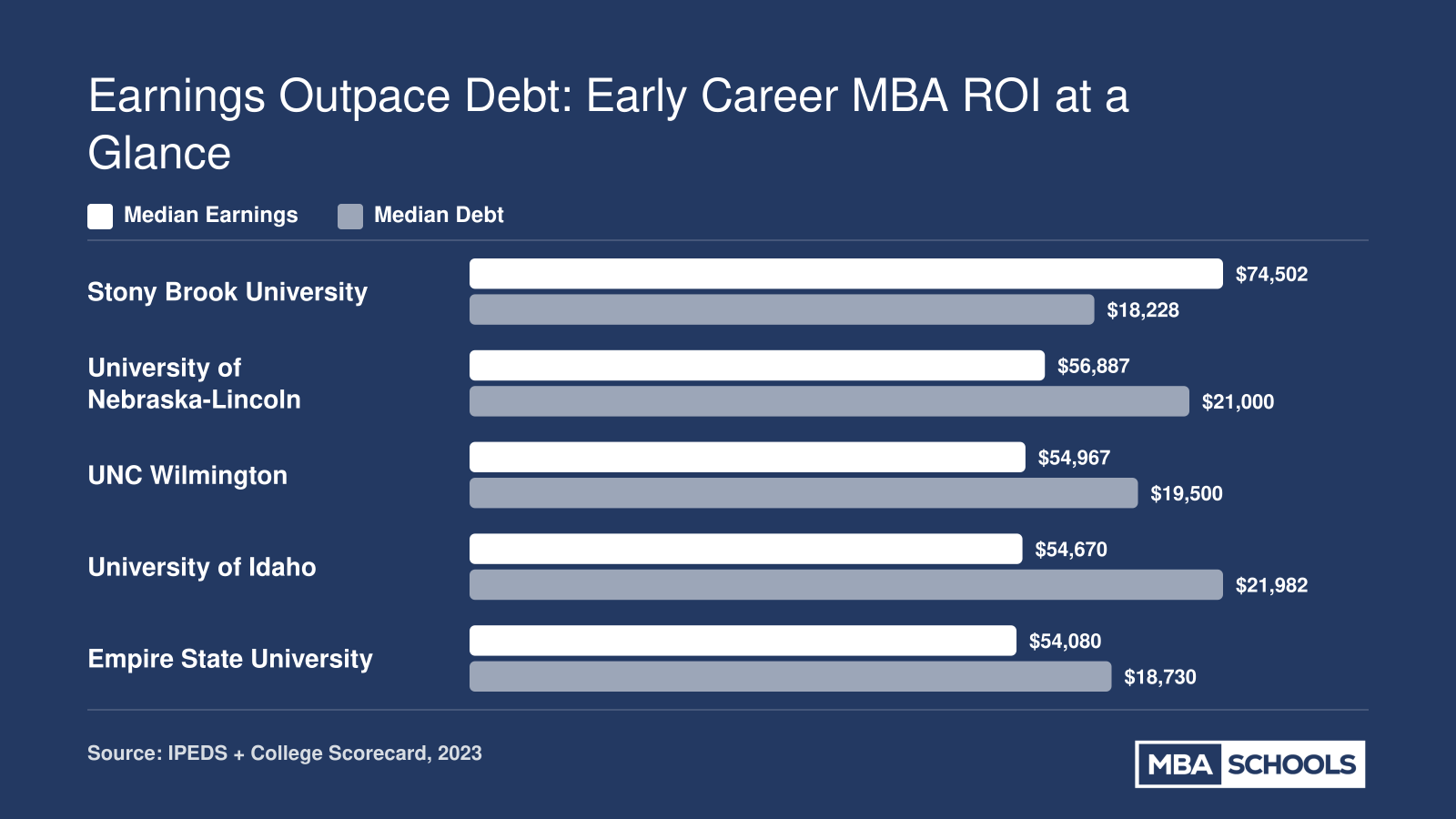
Detailed program-level earnings for online MBA programs are not yet published for current cohorts. Institutional snapshot data, while not specific to the MBA or to early-career graduates, offers a broad signal of earning power. For instance, the median earnings of working alumni 10 years after entering Stony Brook University is $74,502, while University of Nebraska-Lincoln graduates report a median of $56,887. These figures span all majors and degree levels, so MBA graduates may exceed them, or fall short, depending on pre-MBA experience.
- Early-career premium patterns: Available surveys from accrediting bodies suggest that MBA graduates typically see a 30, 50% salary increase within three years after graduation. Early-career learners, who start from a lower base, may experience the steepest percentage gains even if absolute dollars start below the median for experienced MBAs.
- Growth acceleration: One reason early-career programs include career accelerators and cohort-based leadership training is to compress the development timeline, rapidly boosting the earning curve of younger graduates.
Debt Load and Payback Periods
Median federal loan debt for graduate completers at these institutions provides a rough yardstick for what graduates actually borrow. Across the 12 schools shared with us, median debt levels range from approximately $18,000 to $24,000. For example, Stony Brook reports median graduate debt of $18,228; the University of Nebraska-Lincoln comes in at $21,000; Lamar University at $21,250.
If an online MBA program costs $15,000 to $25,000 in total tuition, typical for many ranked programs, and a graduate captures a $10,000 annual earnings premium, the payback period is often under three years. Because most students in these programs continue working while enrolled, they often avoid accumulating additional living-expense debt, further shortening the break-even window. Paying for an online MBA through employer benefits or financial aid can shorten that window even further.
- Hypothetical payback example: A $20,000 debt, repaid over 10 years at 6% interest, costs roughly $222 monthly. An annual salary premium of $10,000 boosts monthly take-home pay by about $700, making the loan comfortably serviceable.
A Necessary Caveat
The precise earnings outcomes for early-career entrants in these online programs are not yet available. Federal data by program, such as median earnings one year or four years after graduation, have not been released for many newer or smaller tracks. Early-career graduates may initially report lower absolute earnings than their mid-career counterparts, but strong growth trajectories could close that gap rapidly. Prospective students should weigh institutional brand, career support intensity, and curriculum STEM designation as forward-looking indicators of salary potential, and request employment reports directly from programs when possible.
Earnings Outpace Debt: Early Career MBA ROI at a Glance
While precise year-over-year salary growth for early-career MBA graduates is still emerging, the latest median earnings and debt figures from top programs make the return on investment clear.
Do Employers Value an Online MBA for Young Professionals?
Employer perceptions of an online MBA come down to two concrete concerns: the credibility of the degree itself and whether the candidate has enough substantive experience to apply the learning. For young professionals, the anxiety is often amplified, many assume that hiring managers will automatically discount an online credential. The reality is more nuanced.
What Employers Actually Care About
When evaluating MBA hires, employers look at three things before they even glance at delivery format: school reputation, accreditation status, and the rigor of the curriculum. Surveys from 2023 to 2026 consistently show that hiring managers do not view an online MBA as inferior by default when it comes from a respected, AACSB-accredited institution.1 In fact, the pandemic-era normalization of remote learning has largely erased old stigmas. What matters is whether the program challenged you. A degree from a top-50 business school that happens to be delivered online carries the same weight as its on-campus counterpart for most corporate, technology, and general management roles.
The Experience Factor (Not the Delivery Method)
If there is a perception gap for early-career candidates, it is rarely about the word "online" , it is about experience depth.2 A 26-year-old with two years of work history and an MBA may raise more questions than a 30-year-old with five years of experience and the same degree. Employers want to see that you can connect academic frameworks to real business problems. This is where format becomes irrelevant: a project-heavy online MBA that includes internships, consulting simulations, or a capstone with a real company does more to demonstrate readiness than simply having sat in a campus classroom. Consulting and investment banking roles still lean toward full-time, campus-based recruitment pipelines, but that preference is about structured sourcing channels, not a verdict on online learning.2
- School brand and accreditation: AACSB-accredited programs, especially those from recognizable universities, neutralize format bias. Employers trust the brand more than the medium.
- Curriculum and skills: Hiring managers prioritize evidence of analytical, leadership, and communication skills , all of which a well-designed online MBA delivers.
- Early-career advantage: With the rise of programs like Rice Business's Early Career Track, young professionals now earn the same degree with tailored career support, making format a non-issue for recruiters who know the school.
How to Neutralize Any Remaining Doubt
Your online MBA will be valued to the extent that you make its outcomes visible. Use every touchpoint , resume, LinkedIn, interviews , to highlight applied work: describe the global virtual team you led, the data analytics project that cut costs by 12%, the internship where you redesigned a supply chain. Concrete achievements override delivery format every time. Participate aggressively in your program's career treks, employer info sessions, and alumni mentorship circles. When a recruiter sees a candidate who can articulate business impact and has a strong network, the question of "online vs. campus" never comes up.
Is an Early Career MBA Worth It? Timing, Cost, and Opportunity
As online MBAs shed their second-class stigma and employers increasingly value skills over tenure, the early career window is opening wider than ever before. Deciding whether to pursue an MBA with limited experience hinges on a personal cost-benefit analysis that goes beyond sticker price. You need to gauge the degree's long-term earning power, the opportunity cost of studying alongside a full-time job, and whether you can finance it without taking on unmanageable debt. Fortunately, you can gather most of the evidence yourself using publicly available data and transparent program websites.
Evaluate the Financial Picture
Start with the numbers. Tuition costs for online MBA programs vary widely, so compare figures directly on each school's admissions or financial aid page. Look beyond the headline price: some programs bundle fees, while others charge separately for residencies or technology. Next, estimate your potential salary uplift. The Bureau of Labor Statistics (BLS.gov) publishes detailed wage data by occupation, industry, and degree level. Search for roles you might target after graduation, such as management analysts, marketing managers, and financial managers, and note the median pay. While BLS data won't isolate early career MBA holders, it gives a realistic baseline for calculating MBA ROI questions worth asking before you apply.
Account for Opportunity Cost
If you plan to study while working, the immediate earnings hit is minimal, but your time and energy are finite. Weigh the program's pace against your current job demands. For full-time or accelerated formats, calculate the salary you'd forgo during the program. Factor in that many early career professionals see faster promotion timelines after earning the credential, which can offset the initial loss.
Research Funding Sources
How you pay matters as much as how much you pay. Begin with your employer's tuition reimbursement policy; even junior roles sometimes qualify for partial support. Online MBA financial aid, employer reimbursement, and scholarship resources can help you map every available funding channel before committing to a program. Check professional associations in your target industry for scholarship listings. Many business schools offer merit-based aid, and some earmark scholarships for candidates with less than three years of experience. Don't overlook federal student aid: fill out the FAFSA to see if you qualify for loans or grants. School financial aid offices can also point you to assistantships or installment plans that ease cash flow.
Check Employer Perception
Value also depends on how hiring managers view an early career online MBA. While there's no single answer, you can gauge sentiment by browsing job postings on company career pages or professional networking sites. Note whether roles that match your ambition mention an MBA as a preferred qualification, and whether they specify AACSB accreditation or similar quality markers. Reach out to alumni through school LinkedIn groups to ask about their experience; many are willing to share candid feedback on whether the degree accelerated their career.
How to Choose the Right Program: Key Factors for Young Professionals
Match Curriculum to Your Starting Point
Early career online MBA programs should be designed for professionals with limited managerial experience. Look for curricula that build foundational business knowledge first: accounting, finance, marketing, and organizational behavior taught from the ground up. Some MBA programs assume you already have a working command of business fundamentals; that can leave early career students struggling. Confirm that the program's core courses do not require prior management roles and that electives let you explore functions before specializing. A well-structured early career track will front-load core competencies and gradually introduce strategic thinking.
Evaluate Cohort Dynamics
The peers you learn with shape your MBA experience. Programs that place early career students in a dedicated cohort create a supportive environment where you won't feel out of your depth. You'll share similar career stages and challenges, which reduces imposter syndrome and builds a strong network of future colleagues. On the other hand, mixed cohorts that blend early career and experienced professionals offer mentorship opportunities and exposure to seasoned perspectives. Both models work if you know yourself: do you thrive learning from veterans, or would you rather build confidence among peers on a similar trajectory? Choose the dynamic that aligns with your learning style and confidence level.
Prioritize Career Scaffolding
Career services for early career MBA students must go beyond resume reviews. Seek programs that offer a structured career development curriculum specifically for younger professionals. A Leadership and Career Accelerator, like the one embedded in Rice Business's new Early Career Track, provides personalized coaching, leadership workshops, and career planning that bridge the gap between classroom theory and professional practice. Look for dedicated career advisors who understand the job market for post-MBA early career talent, not just experienced managers. Strong programs will also offer networking events, mentorship pairings with alumni, and employer connections tailored to your experience bracket. A leadership MBA built around deliberate career scaffolding is especially valuable when you have fewer years of experience to leverage.
Demand Hands-On Learning Opportunities
With a thinner resume, practical experience within the MBA program becomes critical. Choose a program that integrates real-world projects, capstone consulting engagements, or internship opportunities directly into the curriculum. These experiences let you demonstrate competence to employers and build tangible achievements. Many top online MBAs now feature global consulting trips, simulation-driven courses, or client-based projects that allow you to apply concepts immediately. Prioritize schools that guarantee every student participates in at least one significant experiential learning milestone, not just as an optional add-on.
Verify Accreditation and Brand Strength
AACSB accreditation is the gold standard for business schools; do not consider a program without it. The school's brand carries additional weight when you have limited work experience to signal your potential. A recognizable university name on your resume opens doors and signals rigor. As you evaluate programs, check what employers think about online MBA degrees and independent rankings. While brand isn't everything, it can accelerate your early career trajectory when combined with a supportive curriculum and career coaching. Ensure the online MBA degree is identical to the on-campus version, with no "online" designation that could be misconstrued.
Spotlight: Rice Business Launches Early Career Track for Mba@rice Online
Rice Business announced the launch of an Early Career Track within its MBA@Rice Online MBA program on June 23, 2026, targeting professionals with less than three years of work experience.1 The new track, set to welcome its first cohort in October 2026, marks a significant innovation in online graduate management education, directly addressing the demand for accessible, high-quality MBA pathways from candidates earlier in their careers.
The Same Rigor, a Tailored Experience
Students in the Early Career Track complete the identical core curriculum taught by the same Rice Business faculty who lead the established Experienced Track, which serves professionals with three or more years of experience. Both tracks confer the same Rice MBA degree, and the Early Career Track retains MBA@Rice's STEM designation, a critical differentiator for international students and those seeking data-driven leadership roles. What sets the Early Career Track apart is a first-year cohort structure that fosters peer connection and professional networking for MBA students earlier in the program, followed by full integration into the broader MBA@Rice community in the second year.
Leadership and Career Accelerator
A defining feature of the Early Career Track is a co-curricular Leadership and Career Accelerator, designed to build managerial competencies, self-awareness, and strategic career planning skills alongside academic coursework. This dedicated support aims to accelerate the professional readiness of students who may have less workplace experience to draw upon during case discussions and group projects.
A Credibility-Rich Platform
MBA@Rice launched in 2018 and has since built a reputation as a rigorous, four-cohort-per-year online program.1 Interim Dean Jeff Fleming noted that the Early Career Track reflects Rice's commitment to "meeting students where they are," while MBA@Rice Director Barbara Bennett emphasized the value of a curated first-year cohort experience that "builds confidence and community" before integration with the broader class. These statements underscore the school's belief that early-career candidates, when properly supported, can succeed in an MBA program historically geared toward more seasoned professionals.
A Market Signal
Rice Business's move signals that top-tier business schools view early-career online MBA programs not as a diluted alternative but as a strategic growth area. For young professionals traditionally advised to accumulate years of experience before pursuing an MBA, this track validates a new, accelerated timeline, provided the curriculum and support structures are in place to make it work. Those weighing MBA admissions consulting by applicant type may find early-career-specific guidance increasingly relevant as more programs open dedicated pathways.
MBA Career Outlook: What General Business Managers Earn Nationally
While program-level earnings data shows early career MBA outcomes, the broader national wage data from the Bureau of Labor Statistics reveals the ceiling for experienced professionals in common post-MBA roles. The table below highlights median and percentile wages for General and Operations Managers and Management Analysts, two of the most frequent career paths for MBA graduates.
| Occupation | Total Employment | Median Annual Wage | 25th Percentile | 75th Percentile |
|---|---|---|---|---|
| General and Operations Managers | 3,584,420 | $102,950 | $67,160 | $164,130 |
| Management Analysts | 893,900 | $101,190 | $76,770 | $133,140 |
Frequently Asked Questions About Early Career Online Mbas
Below we answer the most common questions professionals ask when considering an early career online MBA. Use these insights to better understand admissions requirements, career outcomes, and whether this path fits your goals.