
What you’ll learn in this article…
- Top-tier MBA graduates secure salary jumps above $100,000, especially in consulting and tech roles.
- AI automates analytical MBA tasks, but leadership and strategic judgment remain uniquely human skills.
- Tennessee Watt financed a $135,000 Wharton AI MBA with savings, stock, and loans while building a business.
- Wharton, Stanford, and Booth now embed AI across core MBA courses, not just as electives.
A Google job offer signals career arrival. Walking away from one after three years to pay $135,000 a year for an MBA is something else entirely, and the timing makes it more striking. AI now automates associate-level marketing tasks, yet Tennessee Watt left her associate product marketing manager role at Google in 2024 to enroll in Wharton's MBA with an AI focus.
Her decision cuts to the heart of a debate: if machine learning absorbs knowledge work, why would a tech insider bet on business school? The answer is not that an MBA is obsolete. It is that the degree is being remade. Watt's story, viewed alongside hard ROI data, reveals which parts of an MBA curriculum are vulnerable to AI, and which skills still justify the six-figure tuition check.
Why Tennessee Watt Left Google for an MBA at Wharton, in the Age of AI
Tennessee Watt's path from a coveted role at Google to an MBA classroom at Wharton is not a story of rejecting tech. It is a deliberate move to expand her toolkit in an era when many assume AI makes business school irrelevant.1 Watt started at Google in 2021 as an associate product marketing manager in London, a role she landed after ten grueling interviews. Three years later, she walked away to enroll in Wharton's AI-focused MBA track. Her reasoning: the career paths she wanted to explore (search funds, fractional consulting, portfolio businesses) were not something AI micro-credentials could unlock.
From Google to Wharton: A Three-Year Journey
Watt's early career at Google gave her firsthand exposure to how AI reshapes products and marketing. But she observed that the most consequential decisions, which markets to enter, how to structure a venture, when to pivot a business model, still required judgment AI could not provide. Wharton's curriculum, which integrates AI tools into finance, strategy, and entrepreneurship, promised to close that gap. By mid-2024, she had committed, seeing the degree not as a safety net but as a launchpad into venture creation and flexible career architectures.
The Financial Calculus: $135,000 a Year and a Portfolio of Resources
Wharton's total cost of attendance runs roughly $135,000 per year, covering tuition, fees, room, and board.1 Watt financed the program through a blend of savings, vested Google stock, family support, and student loans. For prospective applicants weighing similar trade-offs, our financing MBA guide breaks down the full range of funding options. Watt's mix was deliberate: it let her preserve liquidity for entrepreneurial experiments during school while avoiding the pressure to immediately return to a high-salary tech job. She treated the investment as a calculated risk, one that would pay off if the degree opened doors to ownership stakes and diversified income, not just a bigger W-2.
Beyond the Credential: Career Paths AI Cannot Open
Watt credits the MBA with exposing her to career models that a pure tech track rarely surfaces. Through coursework and peer networks, she explored search funds (vehicles for acquiring and operating small companies), fractional consulting roles, and the idea of a portfolio business. During her second year, she launched Moonlight Club, a newsletter and community for multi-hyphenate women, testing a business thesis while still a student.1 These are not paths a machine-learning certificate can replicate; they require the social capital, deal-making fluency, and cross-functional literacy that a top-tier MBA cultivates. For a broader look at unconventional post-MBA roles, see our overview of non-traditional MBA career paths.
Countering the 'Skip Grad School' Narrative
The prevailing advice in tech circles is to forgo a degree and stack AI certifications or coding bootcamps. Watt's choice challenges that narrative. She acknowledges that AI skills are essential (Wharton's program embeds them) but argues that the MBA's value lies in its ability to teach resource allocation, negotiation, leadership, and opportunity recognition under uncertainty. For someone who already has a strong technical foundation, an MBA can be the differentiator that turns domain expertise into a multi-revenue business. Her story underscores that when the goal is ownership and optionality, a degree designed to build generalist business judgment may still be the most future-proof investment of all. Professionals weighing their next move can explore the full spectrum of MBA career paths to see where that judgment pays off.
What the Data Says About MBA ROI in 2025-2026
As the MBA job market navigates an era of rapid technological change, recent data confirms that the degree still delivers a meaningful salary premium, but the magnitude depends heavily on school tier, industry, and a graduate's ability to adapt.
Understanding Today's MBA Salary Lift
The 2025 GMAC Corporate Recruiters Survey places the median starting salary for U.S. MBA graduates at $125,000, about $25,000 higher than the median for experienced hires without an MBA.1 That national figure, however, masks wide variation.
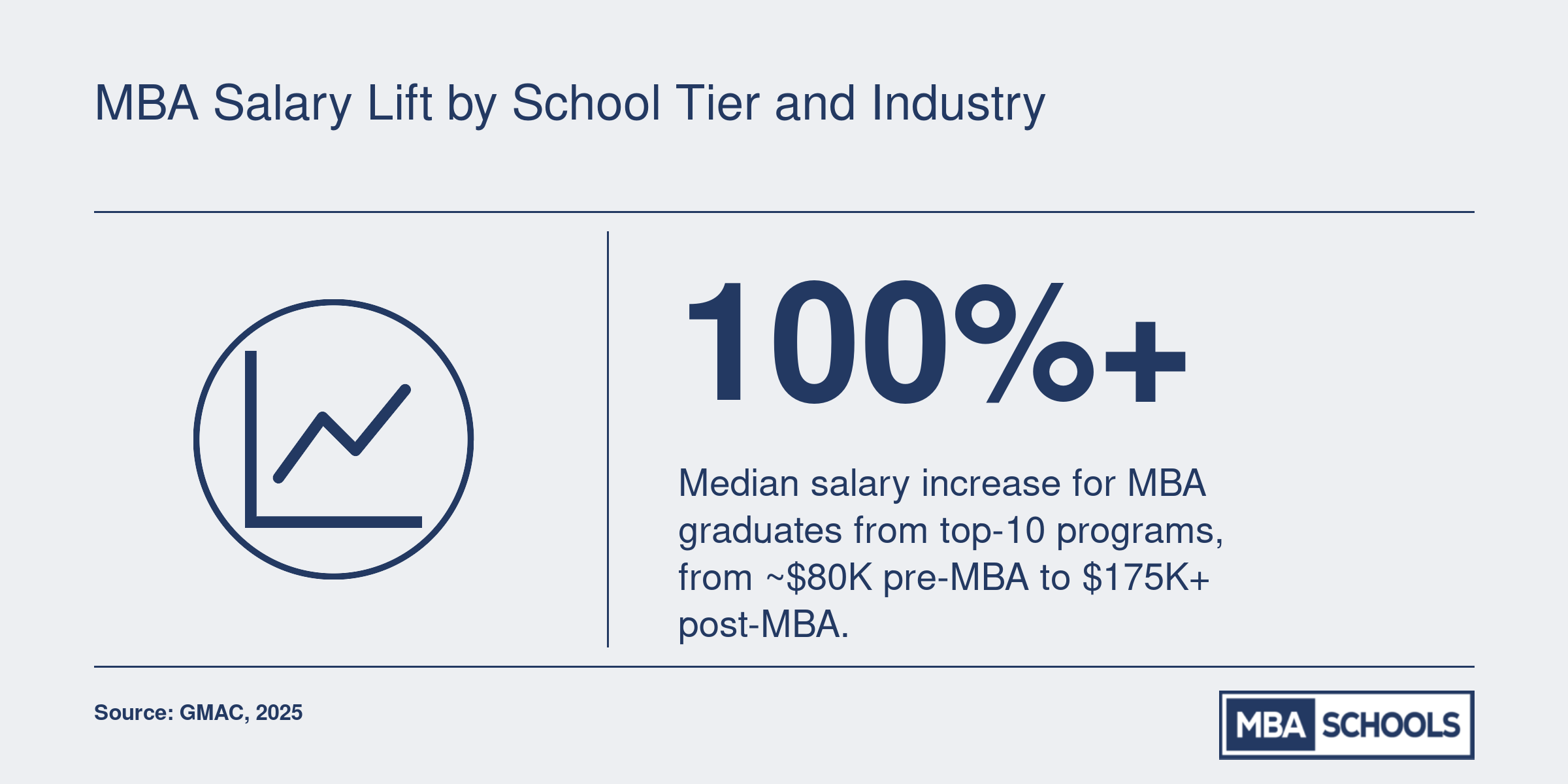
Top-10 programs consistently report median base salaries above $175,000, with signing bonuses often adding $30,000 or more. At mid-tier schools, the premium narrows: graduates typically land offers around $110,000 to $130,000, which may be only 15 to 20 percent above their pre-MBA earnings. For students who pivot into lower-paying sectors like operations or nonprofit management, the immediate lift can be negligible.
Payback Periods in an AI-Shaped Economy
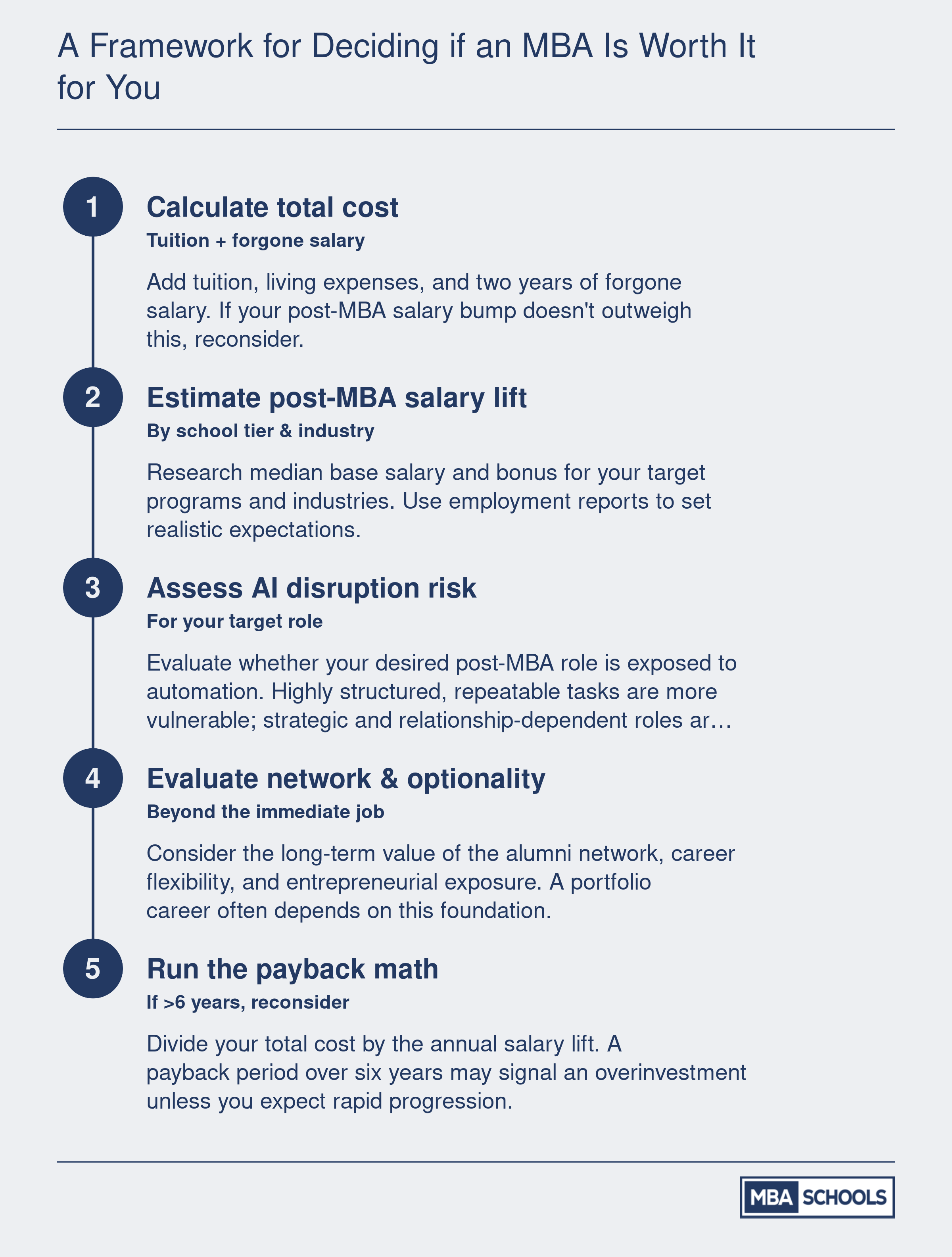
A typical two-year MBA now costs $170,000 to $220,000 in tuition, fees, and living expenses. Factoring in the opportunity cost of foregone salary, often $80,000 to $120,000 annually, total investment can exceed $350,000. Running those numbers through a structured framework to calculate MBA ROI is essential before committing.
For graduates entering consulting or investment banking at top-tier schools, payback can come within three to four years. Those whose new roles carry a more modest premium may need five to seven years to break even. The rise of AI adds an unfamiliar variable: roles subject to automation or offshoring could see salary growth stall, potentially lengthening payback timelines.
ROI Varies Sharply by Industry
Sector choice is the single largest ROI lever. Recent employment reports show consulting and investment banking medians often reaching $190,000 in base salary, while tech product management roles cluster around $160,000. In contrast, operations and general management roles at mid-tier firms offer $110,000 to $130,000, and nonprofit or social impact positions can dip below $100,000. For a deeper look at compensation across functions, see our guide to MBA career paths and salaries.
Prospective students should evaluate their target industry's resilience to AI displacement and the typical career progression rather than relying on a single average premium. The data makes one thing clear: an MBA's value is not monolithic, and a high-ROI outcome requires alignment among choosing the right MBA program, industry focus, and post-graduation agility.
MBA Salary Lift by School Tier and Industry
The financial return of an MBA varies widely by school prestige and industry, but top-tier programs consistently deliver a substantial salary jump that often exceeds six figures.
Which MBA Skills Are AI-Proof, and Which Are Already Being Automated
AI is reshaping the value of an MBA degree, but its effect is far from uniform. Rather than rendering the entire credential obsolete, automation is selectively displacing certain skill sets while elevating the importance of others. For MBA students and applicants, the practical question is not whether AI will change the job market, but which competencies will remain uniquely human and which are already being absorbed by algorithms.
The AI-Proof Core: Judgment, Leadership, and Influence
Businesses have always prized the ability to navigate ambiguity, align stakeholders, and make decisions with incomplete information. These capabilities rest on emotional intelligence, ethical reasoning, and the capacity to read social dynamics, areas where even the most advanced AI systems fall short. Strategic leadership, for instance, requires not just analyzing data but interpreting its implications for a specific organizational culture and competitive landscape. Negotiating a partnership, motivating a team through uncertainty, or crafting a brand narrative that resonates on an emotional level all depend on human judgment that cannot be codified into a training set.
Consultants, general managers, and executive-track professionals spend much of their time on trust-building and influence. AI tools can structure a meeting agenda or summarize a report, but they cannot read a room, sense resistance, or pivot a conversation in real time to overcome objections. These skills, often called "soft" but increasingly recognized as "durable," are likely to gain in scarcity as routine analytical work becomes commoditized.
Automating the Analytical: Where AI Excels
On the other end of the spectrum, repetitive cognitive tasks are highly automatable. Many of the quantitative foundations taught in MBA programs, including financial modeling, market-sizing exercises, optimization of supply chains, and even the initial drafting of strategic presentations, are now augmented or outright replaced by AI. Tools can generate sensitivity analyses, summarize regulatory filings, and segment customer data at a speed and accuracy that junior analysts cannot match. Firms are integrating these capabilities rapidly, which means the demand for MBAs who are purely technical analysts is contracting.
However, this does not eliminate the need for analytical thinking; it pushes the value proposition higher up the stack. The premium shifts to the ability to ask the right questions, critique model assumptions, and translate quantitative insights into narratives that drive decisions. MBAs who can bridge the gap between data science teams and the C-suite, interpreting AI outputs for non-technical audiences, are becoming indispensable.
Product Management and Operations: A Hybrid Picture
Post-MBA roles like product management and operations management sit at the intersection of technical and interpersonal demands, so their automation exposure is uneven. Product managers use AI to analyze user behavior and run experiments, but the core of the role, defining a vision, prioritizing features based on nuanced customer empathy, and negotiating with engineering and design teams, remains stubbornly human. Similarly, in operations, machine learning can optimize routing or inventory levels, but when a supplier fails or a factory floor faces a safety crisis, an algorithm cannot step in to lead.
Building an AI-Ready MBA Skill Set
The safest career strategies double down on skills that AI complements rather than supplants. This means deepening capabilities in ethical decision-making, cross-cultural communication, creative problem framing, and adaptive leadership. Choosing which MBA specialization is best for this new landscape matters more than ever, because the right concentration can accelerate your fluency in both technical and durable competencies. Business schools are responding by weaving AI literacy into the curriculum, but the real differentiator is the ability to use AI as a lever, not just a replacement, for human expertise. MBA students who graduate with both a technical understanding of AI and the durable skills of influence will be best positioned for careers for MBA graduates that outlast the automation wave.
How AI Is Reshaping MBA Curricula at Wharton, Stanford, Booth, and Beyond
Top-tier MBA programs have moved beyond offering a single elective on artificial intelligence: AI and data science now permeate core curricula, concentrations, and institutional partnerships, marking a fundamental shift in how business schools prepare leaders for an AI-driven economy.
Curricular Overhauls Across Top Schools
Across leading MBA programs, a total of 191 AI-focused courses were identified in 2026, with nine of those now embedded in required core curricula. That is a dramatic departure from just half a decade ago, when such courses were virtually nonexistent outside optional electives. Harvard Business School, for instance, mandates "Data Science and AI for Leaders" (DSAIL) for all students.2 Columbia Business School's AI in Business Initiative puts "AI Foundations for MBAs" and "Generative AI for Managers" front and center.3 Stanford GSB leads in volume, offering 30 AI courses, nine of them technically focused, while Chicago Booth's Applied AI concentration requires "AI Essentials," "Machine Learning in Finance," and "Starting an AI Company."3 These aren't casual electives; they reflect a structural reordering of what every MBA graduate is expected to know.
Wharton's Artificial Intelligence for Business Major
For Tennessee Watt, who left Google to pursue an MBA in artificial intelligence and machine learning, Wharton's AI for Business concentration was the draw. Launched for the 2025-2026 academic year, the major requires two foundational courses: "Applied Machine Learning in Business" and "Big Data Big Responsibilities."2 Beyond coursework, Wharton's 2024 partnership with OpenAI gave every MBA student access to ChatGPT licenses, embedding generative AI directly into case analyses, project work, and entrepreneurial ventures.3 Watt's experience illustrates the practical spillover: the skills and infrastructure she accessed through the AI track helped her launch Moonlight Club, a newsletter and community she built during her second year. The curriculum didn't just teach theory; it provided the tools and confidence to build a portfolio career.
Substance, Not Just Semantics
Skeptics might dismiss new course names as marketing, but the evidence points to substantive change. Nine top programs now offer formal AI concentrations, and 78% of business schools report teaching AI in their curricula as of 2024, a figure driven by new faculty hires, dedicated AI labs, and capstone projects with technology companies.3 When Wharton requires every AI-major student to grapple with machine learning applications and data ethics, or Booth adds an "AI Essentials" course to its core, these are not rebadged analytics classes. They represent a deliberate effort to equip leaders who can manage AI initiatives, not just understand them. Even the 46% of prospective MBA students who now expect AI to be part of their education are pushing schools to deliver depth.3 For those evaluating different MBA concentrations, the rise of dedicated AI tracks signals that this specialization is becoming as foundational as finance or strategy. The MBA that emerges is no longer a general management degree with a side of tech; it is a platform where AI literacy is table stakes.
Related Articles
MBA vs. AI Master's vs. Micro-Credentials: A Side-by-Side Career Comparison
How does a two-year MBA stack up against a specialized master's in AI or a handful of micro-credentials when it comes to salary, career ceiling, and network? The answer depends on where you are now and where you want to go. Each path opens distinct doors, and the right choice aligns cost, time, and professional ambition.
The Financial and Time Investment
- MBA (full-time, two years): Top-tier programs cost $150,000 to $220,000 in total tuition and fees. Mainstream programs may run $60,000 to $120,000. Two years out of the workforce also means forgone salary.
- Master's in Data Science or AI: One- to two-year programs typically range from $30,000 to $80,000. Many are designed for working professionals, allowing part-time enrollment.
- AI micro-credentials (certificates and specializations): Short courses from platforms like Google cost $300 to $5,000 and take a few months to complete. They offer rapid upskilling with minimal time off work.
Salary Trajectory and Career Ceiling
- MBA graduates: Top-tier programs report starting base salaries of $175,000 to $225,000, with mainstream programs around $110,000 to $130,000.1 MBAs often pivot into management, strategy, and consulting roles with clear routes to executive leadership.
- Master's in AI: Median annual wages for AI-focused master's holders sit at $131,450, with typical ranges from $125,000 to $160,000.2 These roles are heavily technical; career growth often leads to senior data scientist or AI architect positions.
- Master's in Data Science: Median wages of $112,590, with ranges of $110,000 to $140,000.2 Job growth is projected at 36% through 2033, but upward mobility may require additional business acumen.
- Micro-credentials: Salaries generally fall between $70,000 and $100,000, suitable for entry-level roles or supplementing an existing degree.3 They rarely unlock management tracks on their own.
Network Value and Employer Perception
Few factors separate these paths as sharply as their networks. An MBA cohort spans industries and functions, offering broad, durable connections often leveraged decades later. Master's programs build tighter technical circles, valuable but narrower. Professionals weighing whether are micromasters worth it should note that micro-credentials provide almost no network. Employers consistently favor degrees over certificates for leadership pipelines, though they value certificates as proof of current technical skill. The data underscores this: 91% of AI professionals hold a graduate degree, and 64% specifically hold a master's.3 Only 8% get by with a bachelor's alone.
Which Profile Fits Each Path
- Choose an MBA if you are switching careers, targeting management or consulting, or need a broad network to accelerate your trajectory. The cost is high, but the leadership ceiling is higher.
- Choose a master's in AI or data science if you want deep technical expertise and see yourself as a senior individual contributor or technical lead. The salary lift is substantial, and the credential is often a baseline requirement for advanced AI roles.
- Choose micro-credentials if you need to update a specific skill, test a new field, or enhance an existing degree. They are cost-effective for incremental upskilling but rarely replace a full degree in competitive job markets.
Questions to Ask Yourself
Who Should, and Shouldn't, Pursue an MBA in the AI Era
Evaluating an MBA in the AI era isn't about whether the degree is obsolete. It's about whether it's the right lever for your particular career trajectory. For some, the credential unlocks leadership roles that AI cannot touch. For others, faster, cheaper skill-building alternatives make more sense.
Profiles That Benefit Most from an MBA in the AI Era
Three archetypes get the strongest ROI from today's MBA:
- Technical professionals with 3-7 years of experience: If you are an engineer, data scientist, or IT specialist aiming to move into product management, general management, or strategy, an MBA fills the strategic, financial, and people-management gaps that pure technical roles rarely teach. This is the classic career-switcher path, and the one least threatened by AI, because it builds judgment and influence, not just code fluency.
- Non-technical professionals adding AI literacy: Marketers, consultants, HR leaders, and finance professionals who want to lead AI-driven teams without becoming developers gain AI fluency through MBA curricula that now embed machine learning, data strategy, and responsible AI. This contextual literacy, knowing what AI can and cannot do, is far more valuable than trying to compete with PhD engineers.
- Entrepreneurs and portfolio builders: The Wharton MBA gave Tennessee Watt exposure to search funds, newsletters, and fractional consulting, career models that defy traditional corporate ladders. If you seek to build a multi-revenue business or acquire a small company, an MBA ecosystem provides funding networks, co-founder talent, and risk-mitigation frameworks you won't find in a bootcamp.
When an MBA Is Not Your Best Bet
The degree's case crumbles when your primary goal is to add technical AI skills to an existing technical career. A master of science vs. an MBA comparison often reveals that a targeted MS, a bootcamp, or employer-sponsored certifications deliver these capabilities faster and at a fraction of the cost, without the two-year opportunity cost.
You should also think carefully if you are already earning total compensation above $200,000 in a technical role. The marginal salary lift from an MBA often won't justify the $250,000 to $400,000 in tuition and forgone wages, especially when top tech firms now promote senior individual contributors into leadership without a graduate degree. Finally, skip the MBA if financing it means catastrophic debt: the mental toll and constrained post-graduation options undermine the very career flexibility the degree is supposed to create.
Testing the Payback: Does the Math Work for Your Situation?
As earlier data shows, the projected post-MBA salary increase must cover total cost within a reasonable window. A payback period beyond four to five years usually signals that the investment is too aggressive for the return. For example, if your expected annual salary lift is $40,000 and all-in costs are $250,000, the six-plus-year payback stretches the commitment beyond most career break-evens. Run the numbers against multiple school tiers and industry pivots before you apply. Your future self will thank you.
Building a Portfolio Career After an MBA: Lessons from Watt's Moonlight Club
The standard post-MBA playbook sends graduates into consulting, banking, or corporate leadership tracks, but Tennessee Watt's path suggests a different playbook entirely. While at Google, her career options seemed bounded by the tech giant's internal ladders. During her second year at Wharton, however, she built Moonlight Club, a newsletter and community for multi-hyphenate women. That project represents a new kind of post-MBA outcome: the portfolio career, where professionals blend fractional consulting, creator businesses, search funds, and community-driven ventures.
From Google to Moonlight Club: A portfolio career in the making
Watt's story is not an outlier. At Wharton, she was exposed to search funds, a model where an MBA graduate raises capital to acquire and operate a small business, and to newsletter-based businesses that monetize niche audiences. These are paths no corporate recruiter would have pitched to her at Google. Moonlight Club taps into a growing creator economy, but what makes it viable is the business toolkit she sharpened at Wharton: audience building, financial modeling, and strategic positioning. The MBA gave her not just permission but a framework for stitching together multiple income streams, a model that is increasingly common among recent graduates.
The MBA's hidden curriculum: optionality and courage
Business schools are producing more founders and portfolio operators than ever. According to the Graduate Management Admission Council, 12% of 2024 MBA graduates started their own business immediately, and many more build side ventures during the program. The hidden return on investment is not just a salary lift; it is the mental model shift. Watt learned to see herself not as a job seeker but as a business builder. That courage to pursue a non-linear path did not come from a career center workshop. It came from immersion in an environment where classmates launched startups, pitched search funds, and debated the merits of fractional consulting over full-time roles. For those weighing this kind of leap, MBA networking strategies can make the difference between an isolated side project and a sustainable venture.
AI as a force multiplier for solo operators
AI tools dramatically lower the barriers to running a one-person or small-team business. Watt can automate newsletter operations, audience segmentation, and content scheduling. She can use AI-driven analytics to identify growth opportunities without a dedicated data team. For MBA graduates eyeing portfolio careers, AI functions as a co-founder or junior analyst, accelerating what once required entire departments. Wharton's AI curriculum gave Watt direct exposure to these tools, making the leap from idea to operating business far less daunting.
The takeaway: An MBA isn't just a salary bump
For applicants evaluating an MBA in 2026, the calculus should include more than starting salaries. The program's value may lie in the optionality it unlocks: the ability to test entrepreneurial hypotheses, build a network of collaborators, and develop the confidence to step off the conventional track. Graduates who want a clearer picture of their options can explore the best jobs for MBA graduates across industries. Watt's Moonlight Club is one artifact of that transformation. The portfolio career is not for everyone, but for those who want to blend passions, skills, and income sources, an MBA can provide the launchpad that a single corporate role never could.
A Framework for Deciding If an MBA Is Worth It for You
Use this five-step framework to determine whether an MBA is a smart investment for your specific career goals and financial situation. The framework balances immediate financial return with long-term career adaptability in a rapidly changing job market.
Frequently Asked Questions About MBAs and AI
As AI reshapes industries, many professionals question whether an MBA remains a smart investment. This FAQ distills the key takeaways from our analysis, blending data and real-world stories like that of Tennessee Watt, who left a tech career to pursue an MBA in AI. Here are the most pressing questions and their concise answers.
$135,000 a year. That's the price of a Wharton MBA, and for Tennessee Watt, it bought exposure to career paths AI hadn't yet imagined.
The degree retains its worth not because of the information it imparts (AI can replicate that) but because it upgrades your career operating system with leadership practice, a powerful network, and the optionality to pivot. Watt didn't attend Wharton to learn AI; she went to discover how to build a career in entrepreneurship like Moonlight Club. Before you dismiss or commit to an MBA, apply the decision framework from the previous section to see if this upgrade is right for you.