
What you’ll learn in this article…
- The standard application fee is $250, with sliding-scale waivers available.
- The behavioral assessment requires 130 forced-choice item pairs in 25 minutes.
- Yale SOM invites only 30-33% of applicants to a blind interview.
Yale SOM's acceptance rate dipped to 23% for the latest cohort, signaling intensifying competition for a seat in New Haven. The allure is clear: access to Yale's global brand, a tight-knit community, and a curriculum that integrates business with broader societal challenges.
For the Class of 2029, the application introduces a new behavioral assessment, a sliding-scale fee, and distinct pathways for Consortium and QuestBridge candidates. These elements reward applicants who prepare strategically, not just those with the strongest credentials.
What's New for the Class of 2029 Application Cycle
What has changed in the Yale SOM MBA application for the Class of 2029? The latest admissions cycle introduces a streamlined essay format, continues the video and behavioral assessment requirements, and adjusts application deadlines for the 2026-2027 season. In July 2026, the Yale School of Management detailed these updates on its admissions blog1, providing a clear roadmap for the MBA application process.
A Single Essay with Three Paths
The most visible change is the move to a single essay with three optional prompts. Candidates now choose one of the following: discussing a meaningful commitment, describing a community they have helped build, or recounting a significant challenge and their response. This overhaul of the MBA admissions essays replaces a previous multi-essay requirement, giving applicants more flexibility to highlight the story that best reflects their values and leadership style.
Behavioral Assessment and Video Questions Remain Core Components
Yale SOM continues to require both the behavioral assessment and video questions as part of the application. The behavioral assessment is a 25-minute online tool that measures interpersonal and decision-making preferences, while the video questions capture spontaneous responses to pre-recorded prompts. Neither component requires advance preparation, but both offer the admissions committee insight into qualities like communication, empathy, and resilience that transcripts alone cannot convey.
Updated Deadlines and Fee Structure
The Class of 2029 application has three rounds. Round 1 is due September 15, 2026, with decisions released December 3, 2026. Round 2 follows on January 6, 2027 (notification March 18, 2027), and Round 3 closes April 7, 2027 (notification May 13, 2027)2. The application fee remains $2503, and the school continues its sliding-scale fee waiver policy based on income. Candidates from over 700 Pell-grant-eligible schools automatically qualify for a waiver4, a practice that broadens access to the program.
What Stays the Same
As before, Yale SOM accepts both GMAT and GRE scores without any minimum threshold. Unofficial transcripts are acceptable at the application stage, and two professional MBA recommendation letters are required2 (the Silver Scholars program asks for one professional and one academic reference)5. The admissions team still evaluates candidates holistically, with no single element serving as a gatekeeper.
Class of 2029 Application Deadlines and Decision Dates
The Yale School of Management (SOM) has published its application timeline for the MBA Class of 2029. The cycle runs across three rounds, with clear deadlines and decision dates. Organizing your submission around these dates is essential for a timely and complete application.
Key Dates at a Glance
| Round | Application Deadline | Decision Release Date |
|---|---|---|
| Round 1 | September 15, 2026 | December 3, 2026 |
| Round 2 | January 6, 2027 | March 18, 2027 |
| Round 3 | April 7, 2027 | May 13, 2027 |
All deadlines occur at 5:00 p.m. Eastern Time, and late applications are not accepted. It is the applicant's responsibility to ensure that all MBA application requirements, including standardized test scores and recommendations, are submitted by the deadline.
What Happens After the Deadline
Yale SOM follows MBA admissions rounds: applications are held until the deadline passes, and then the admissions committee evaluates all files together. This cohort review approach allows for a fair comparison of candidates within the same round. Decisions are released on a uniform date for each round, and all applicants receive notification simultaneously through the online portal.
Interviews are conducted by invitation only and typically occur in the weeks following the submission deadline. Candidates invited to interview will receive guidance on scheduling. Final decisions take into account the application, interview, and any updates provided.
Choosing Your Round
- Round 1 offers an early decision and is ideal for those who have completed thorough preparation by September. Receiving a decision in December gives admitted students ample time to plan for the upcoming academic year.
- Round 2 is the most popular round, with a January deadline. It balances preparation time with a still-strong chance of admission. Decisions arrive in mid-March.
- Round 3 has an April deadline and May decision. Though seats are more limited, exceptional candidates can still secure admission. It suits those who started the process later or improve their profile in the preceding months.
For the most current deadlines, applicants should always check the official Yale SOM admissions website1 before submitting.
Questions to Ask Yourself
Application Requirements Checklist: Everything You Need
Yale SOM requires the following materials for your MBA application. Ensure each component is carefully prepared and submitted by the deadline.
- Standardized Test ScoresGMAT or GRE scores are required for the Class of 2029 application. There is no minimum score requirement, but strong performance is advised.
- Two Professional RecommendationsSubmit recommendations from two individuals who can speak to your professional performance and leadership potential.
- TranscriptsProvide transcripts from every institution you have attended. Non-English transcripts must be accompanied by certified translations.
- RésuméA current professional résumé highlighting your work experience, education, and achievements is required.
- EssaysYou must complete the required essay prompt. The essay is a critical component to convey your fit and goals.
- Behavioral AssessmentYale SOM requires a behavioral assessment as part of the application process to evaluate interpersonal skills and decision-making.
- Video QuestionsA series of video questions will gauge your communication skills and spontaneous thinking. You will record answers through the application portal.
- Application FeeA non-refundable application fee of $125–$250 is required.
- International Applicant RequirementsInternational candidates must provide certified English translations for transcripts not originally in English. Be prepared to submit visa documentation upon admission.
The Essay Prompt and How to Approach It
The required essay is the centerpiece of your Yale SOM application, your best opportunity to show the admissions committee who you are beyond the numbers.
The Prompt: Three Choices, One Essay
For the 2026-2027 cycle, applicants select one of three prompts,1 each with a 500-word limit.1 The prompts remain unchanged from the prior year,2 offering a focus on commitment, community, or challenge. You will choose from:
- Commitment essay: Describe a significant commitment you have made to a person, organization, or cause. Explain what drew you to this commitment, how you upheld it, and what it revealed about your character and values.
- Community essay: Reflect on a time you contributed meaningfully to a community, group, or organization. Detail your role, the impact of your actions, and what you learned about yourself and the community.
- Challenge essay: Discuss a significant challenge or failure you faced. Describe how you responded, what you learned, and how the experience shaped your perspective.
There is also an optional information section (truly optional).1 where you can address any extenuating circumstances or additional context not covered elsewhere.
What Yale SOM Seeks: Leadership, Values, Fit
Yale SOM’s admissions committee uses the essay to assess three core dimensions. First, leadership potential: not just titles, but how you influence others, take initiative, and drive results. Second, values alignment with the school’s mission of educating leaders for business and society. They look for evidence of integrity, intellectual curiosity, and a commitment to making a difference. Third, fit: your ability to articulate why Yale SOM’s culture, resources, and community are right for you. Even when the prompt does not ask “why Yale,” your story should implicitly connect to what the school values.
Strategic Writing Tips
Approach your essay like an MBA personal statement: be specific and use concrete examples with measurable impact whenever possible. Instead of saying you led a team, describe how you motivated three direct reports to increase sales by 20% in six months. Connect your narrative to Yale’s mission by showing how your past actions align with a broader purpose. Demonstrate impact by explaining not just what you did but why it mattered. Avoid generic statements about wanting to “grow” or “make an impact.” Show, don’t tell.
Structure and Word Limit
With 500 words, brevity and clarity are essential. Start with a compelling hook that draws the reader in. Use the middle paragraphs to develop your story with detail and reflection. Conclude by tying your experience back to your future goals and what you will bring to Yale SOM. Stay within the word limit; the online application will enforce it strictly.
Behavioral Assessment and Video Questions Explained
The behavioral assessment requires you to respond to 130 forced-choice item pairs in 25 minutes. Developed by ETS, this non-cognitive instrument adapts as you progress, presenting pairs of statements that reveal how you naturally handle interpersonal situations and decision-making. There are no right or wrong answers, and no advance preparation is necessary.
Behavioral Assessment: Measuring Interpersonal and Decision-Making Traits
The assessment is designed to surface traits like collaboration, resilience, and ethical reasoning. Yale SOM treats it as a light-touch component, adding context without acting as a gatekeeper. By evaluating patterns across 130 pairings, the assessment helps the admissions committee understand your instinctive approaches to leadership and teamwork.
Video Questions: Demonstrating Communication Skills
After completing the behavioral assessment, you will record responses to two video questions through the Kira Talent platform. For each question, you have 60 seconds to respond. The prompts, which are not designed to test business knowledge, ask you to speak spontaneously, much like impromptu mba interview questions that assess communication clarity and English fluency in a conversational setting.
English Proficiency and How These Components Fit
For the Class of 2029, Yale SOM no longer requires a separate English proficiency test like TOEFL or IELTS. Instead, the video questions serve as the primary method to evaluate your spoken English ability. This does not mean the video questions replace the live mba admissions interviews , they are a distinct step in the application process. Both the behavioral assessment and the video questions carry light weight relative to essays, recommendations, and the rest of your profile. They provide the admissions committee with a more complete, human-centered picture of your candidacy.
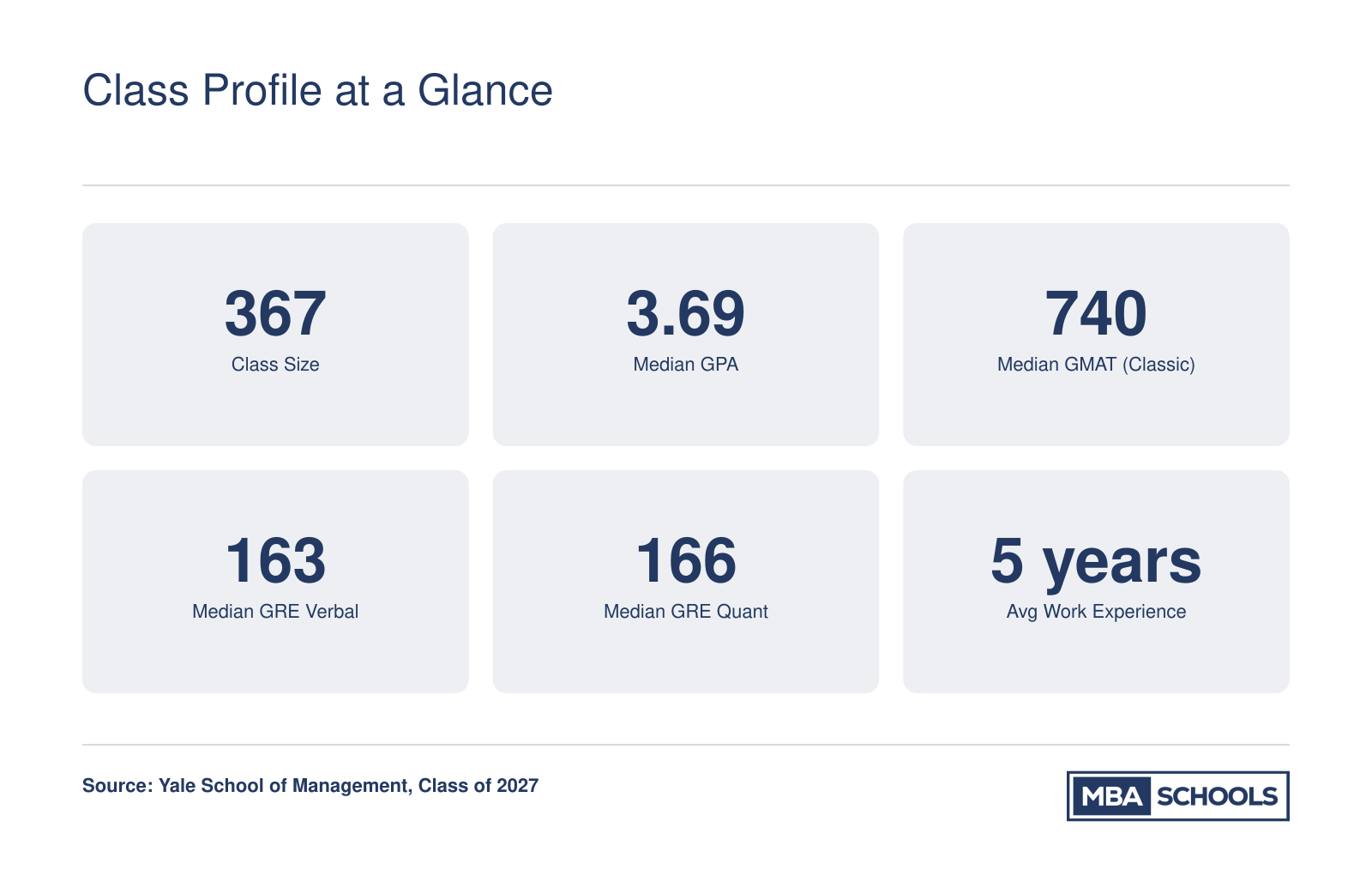
Class Profile at a Glance
Yale School of Management's most recent class profile reflects its rigorous selection standards. The Class of 2027 brings together a diverse cohort with strong academic and professional backgrounds. These figures underscore the competitive nature of the program and can help you benchmark your own profile.
Application Fee and Sliding-Scale Waivers
How much does the Yale SOM MBA application cost, and can I get a fee reduction?
Standard Application Fee
For the 2026-2027 admissions cycle, the application fee for the Yale School of Management MBA program is $2501. This fee is nonrefundable and must be submitted with your application.
Sliding-Scale Fee Reductions
Yale SOM offers a reduced application fee of $1751 to applicants whose total annual compensation falls below a certain threshold. The school uses a sliding-scale model based on your total annual compensation, including salary, bonuses, and other income. Although specific income brackets are not published, this reduction aims to help candidates from lower-income backgrounds. To qualify, you will need to provide documentation of your earnings, such as a recent tax return or pay stub, as part of the fee reduction request. Verification is required, and the reduced fee is granted at the discretion of the admissions office.
Automatic Fee Waivers
Certain applicants automatically qualify for a full application fee waiver.2 These include: - U.S. military personnel (active duty or veteran) - Members of the Forté Foundation - Applicants who can demonstrate significant financial hardship
If you believe you meet one of these criteria, you can indicate this within the online application. The admissions committee reviews fee waiver requests and typically communicates decisions promptly.
How to Request a Fee Reduction or Waiver
All fee reduction and waiver requests are made directly within the online application portal. After starting your application, look for the fee waiver section and select the option that applies to you. You must submit your request at least 48 hours before the deadline of the round to which you are applying.1 This advance notice ensures the admissions office has time to review your documentation and process the waiver. Do not wait until the last minute: if your request is denied, you will still need to pay the full fee before the deadline.
Interview Process and What to Expect
Landing an interview is a significant milestone: Yale SOM invites only 30-33% of applicants1, but the blind format shifts the focus entirely to your live conversation, making every minute count.
Interview Format and Structure
Yale SOM uses a blind interview, meaning your interviewer has not read your application.2 They will have your resume and the pre-interview quote you submitted, but nothing else. This levels the playing field: you control the narrative, and the conversation is your chance to connect on a personal level. Interviews last about 30 minutes and are conducted one-on-one by a current student, admissions committee member, or alum. You can choose between a virtual or in-person meeting, and both formats carry equal weight in the evaluation process.3
How Invitations Work
Interviews are by invitation only and are required for admission. Invitations roll out on a rolling basis after each application deadline,3 so some candidates hear back quickly while others wait several weeks. If you receive an invitation, you must submit a quote that resonates with you within 48 hours2, and this quote often becomes a jumping-off point during the interview. Not receiving an invitation is rare for admitted students, as every admitted applicant completes an interview.
Preparing for the Interview
- Know your resume inside out. Because the interviewer sees only your resume, be ready to walk through your career path, decisions, and accomplishments without leaning on your essays.
- Practice behavioral questions. Expect prompts like “Tell me about a time you led a team through conflict” or “Describe a failure and what you learned.” Use specific examples and structure your answers concisely.
- Reflect on your pre-interview quote. Choose a quote that genuinely reflects your values or leadership philosophy, and be prepared to explain its significance.
- Connect with the Yale SOM community. Reach out to current students or alumni to understand the culture. Observing how they talk about the school can help you convey fit naturally.
After the Interview
There is no separate post-interview decision timeline. Final decisions are released on the round’s notification date,3 several weeks after the interview window closes. While waiting, continue engaging with the school through admissions events or conversations, it reinforces your interest but does not influence the decision.
Choosing Your Round: R1 Vs. R2 Vs. R3 Strategy
Applying in the right round is as strategic as the application itself. Yale SOM accepts applications in three rounds, each with distinct trade-offs. Your choice affects your admission likelihood, financial aid, and the quality of your submission.
Why Round 1 Favors the Well-Prepared
Round 1 typically offers the largest number of available seats and the greatest access to merit-based scholarships before funds are depleted. The committee is fresh, and you signal strong interest. However, the September deadline requires early preparation: GMAT/GRE scores, essays, and recommendations must be polished months ahead. If your profile is competitive and your materials are ready, Round 1 maximizes your chances.
Round 2: The Sweet Spot for Most Applicants
Round 2 remains the most popular round, with a January deadline that provides additional months to strengthen test scores, secure compelling recommendations, and refine your narrative before getting an MBA. While more seats remain than in Round 3, competition increases, and some scholarship money may have been allocated to Round 1 admits. It is the right choice if you need extra time to present your strongest application.
The Case for Round 3, and Its Risks
Round 3, with an April deadline, is the narrowest window. Only a handful of seats are left, and scholarships are scarce. Yet it can be viable for standout candidates with urgent circumstances, such as a sudden career shift or a late decision to pursue an MBA. If you have an exceptional profile (high GMAT/GRE, unique work experience) and a compelling reason for applying late, you might still secure a spot. However, do not count on financial aid.
Yale SOM does not offer an early decision option, so Round 1 serves as the earliest opportunity. No matter your round, begin refining your materials now. Starting early gives you the best shot in any round, but for Round 1, the clock starts now.
Consortium, Questbridge, and Silver Scholars Applicants
Applying to Yale SOM's MBA program isn't a one-size-fits-all process. While many candidates use the direct application, others opt for mission-driven pathways like the Consortium for Graduate Study in Management or the QuestBridge Graduate School Match, and college seniors can pursue the Silver Scholars program.1
Consortium for Graduate Study in Management
The Consortium streamlines your MBA applications to Yale SOM and other member schools through a common application. It focuses on promoting diversity and inclusion in business leadership. Applicants who use the Consortium are automatically considered for merit-based, full-tuition fellowships at Yale SOM.1 Deadlines for the Consortium typically fall in early October and early January, aligning closely with Yale SOM's Round 1 and Round 2, but you must verify exact dates on the Consortium website. Visit the Consortium's official page to begin your application.
QuestBridge Graduate School Match
QuestBridge connects high-achieving, low-income students with top graduate programs. If you are a QuestBridge scholar, you can apply to Yale SOM through the Graduate School Match. This program operates on its own timeline, with a binding match process that usually requires submitting your application by late September. Accepted students receive a full-tuition scholarship and other support.1 Because the schedule differs from Yale SOM's direct rounds, you should follow QuestBridge's deadline schedule closely and review eligibility criteria on their website.
Silver Scholars Program
College seniors with exceptional leadership potential can apply to the Silver Scholars program, which admits students directly from undergraduate studies. The admissions process mirrors the standard MBA application in terms of rounds and requirements, but you apply during your senior year. If admitted, you will complete a summer internship between your first and second years of the MBA, gaining real-world experience before returning to finish your degree.1 Learn more about this unique pathway on Yale SOM's Silver Scholars page.
Frequently Asked Questions About Yale SOM MBA Application
Applying to Yale SOM brings up many practical questions about interviews, tests, and the unique video component. Below are clear answers to help you navigate the process confidently.