
What you’ll learn in this article…
- Median base salary for Booth MBAs reached $175,000 in 2025.
- 89.1% of graduates secured full-time offers within three months.
- Consulting and finance captured 68.3% of 2025 Booth job acceptances.
How much do Chicago Booth MBA graduates earn, and how quickly do they land roles? The 2025 employment report confirms that 89.1 percent of full-time MBAs accepted offers within three months of graduation, with a median base salary of $175,000.1 For those who also received a sign-on bonus, the median was $30,000, pushing total first-year compensation well past $200,000.
These outcomes reflect Booth's deep strengths in finance and consulting, where over two-thirds of the class accepted positions. The school's structured recruiting pipelines and alumni network give students early access to top firms, making the MBA a powerful vehicle for fast career acceleration in best MBA jobs like consulting and finance.
Median Salary and Total Compensation: What Booth MBAs Earn
For many professionals, the decision to pursue an MBA ultimately comes down to a simple calculation: does the immediate salary jump justify the time and tuition invested? For Chicago Booth graduates, the 2025 employment report answers that question decisively.
Base Salary and Signing Bonus Breakdown
The median starting base salary for Booth's full-time MBA class of 2025 reached $175,000.1 On top of that, 65% of graduates who accepted offers reported receiving a sign-on bonus, with a median amount of $30,000.1 This means a typical Booth MBA entering a new role walks away with over $205,000 in first-year guaranteed cash compensation. And the upside is substantial: high-earning graduates reported base salaries as high as $400,000.
Comparing Booth Salaries to National Benchmarks
To put that $175,000 figure in perspective, consider median earnings for common post-MBA roles across the U.S. economy. According to MBA career paths and salaries data, general and operations managers earn a median of $102,950 nationally, while management analysts bring in $101,190. Even financial managers, who often command higher pay, have a national median of $161,700. Booth's median base salary exceeds all of these, including the financial manager median by over 8% and nearly doubles the median for general managers. The immediate premium is stark.
The High-End Potential
The range of reported salaries underscores the opportunity for outsized outcomes. While the median reflects a strong central tendency, graduates entering top-tier consulting, private equity, or senior corporate roles can land base packages approaching $400,000. Combined with performance bonuses and equity, total compensation can be far higher.
Immediate ROI Against Pre-MBA Earnings
Although individual pre-MBA earnings vary, the typical baseline for top MBA applicants is well below six figures. If a pre-MBA salary were $70,000, the median Booth base alone represents a 150% increase, and that is before considering the bonus. The short-term financial payoff is a powerful argument for the investment. And with long-term salary growth (alumni average $231,939 three years out, a 114% increase over pre-MBA), you can calculate MBA ROI and see the return compound.
Top Industries and Functions for Booth Graduates
Consulting and finance together claimed 68.3% of Booth’s 2025 full-time MBA class, with consulting alone drawing 36.7% of graduates and financial services another 31.6%. Technology followed at 14.1%, while healthcare attracted 4.1%. The remaining 13.5% spanned consumer goods, energy, real estate, and other fields.1 These numbers confirm that Booth is a premier pipeline into the highest-paying MBA career paths.
Function-Level Breakdown: Where Salaries Peak
The function placement data reveals an even sharper concentration in high-compensation roles. Management consulting, the top function, absorbed 37.8% of the class. Investment banking placed 11.9%, product management 7.3%, corporate strategy 6.2%, investment management 5.8%, and private equity 5.5%. Each of these functions delivered median base salaries well above $150,000, often with substantial sign-on bonuses.
- Management consulting: Median base salary $190,000; median sign-on bonus $30,000.
- Investment banking: Median base salary $175,000; median sign-on bonus $50,000.
- Private equity: Median base salary $185,000.
- Investment management: Median base salary $172,500; median sign-on bonus $35,000.
- Product management: Median base salary $169,100; median sign-on bonus $40,000.
A small cohort entering the legal field saw the highest median base at $225,000, while technology overall paid a median of $151,000, with a $37,500 bonus. These figures demonstrate that function often dictates compensation more than industry, and Booth grads consistently cluster in the highest-paying MBA salary lanes.1
Booth’s Infrastructure Fuels High-Demand Placements
The school’s flexible curriculum, deep employer relationships, and career services ecosystem channel students into these roles. Students can tailor MBA concentrations in analytic finance, strategic management, or entrepreneurship, while on-campus recruiting, treks, and alumni networks provide a direct line to elite firms. More than 72% of graduates said Booth-facilitated connections were instrumental in landing their offers, delivering strong return on investment for graduates.1
Internships and the Path to Full-Time Offers
For MBA candidates, the summer internship has shifted from a short-term work experience to a critical full-time hiring pipeline at top programs. Students now treat MBA internships as extended interviews, and employers use them to assess fit before extending permanent offers. At Chicago Booth, this pathway is especially well-defined, with the career services team helping students secure positions that align with their long-term goals.
Researching Internship Outcomes
Prospective students can explore internship-to-full-time conversion patterns by reviewing school employment reports, which often summarize industry placement and offer timelines. Authoritative sources such as the U.S. Bureau of Labor Statistics (BLS) provide broader salary benchmarks for business occupations, while professional associations like the MBA Career Services & Employer Alliance publish industry standards. Booth’s own website details internship compensation ranges and program structure, giving applicants a realistic preview.
Taking a Proactive Approach
To gauge the internship pipeline, connect with current students or alumni through formal networking events. Ask about the on-campus recruiting cycle and how the school's MBA career services best practices support off-cycle searches. Understanding these dynamics early can help applicants evaluate whether a program’s internship ecosystem matches their career ambitions. While exact conversion rates vary year to year, the consistent presence of top-tier employers in Booth’s internship roster suggests a robust pipeline.
Geographic Placement and Salary by Region
While Chicago Booth MBAs earn a median base salary of $175,000, the real value varies by location. The table below shows the top three metro destinations for the class of 2025 alongside the median wage for financial managers in each area, illustrating how far a dollar stretches in high-cost hubs like New York and San Francisco versus Chicago.
| Metro Area | % of 2025 Booth Class | BLS Median Salary (Financial Managers) |
|---|---|---|
| Chicago | 30.7% | $164,470 |
| New York City | 26.7% | $216,520 |
| San Francisco Bay Area | 11.3% | $211,730 |
International Student Outcomes at Chicago Booth
For the Class of 2025, Chicago Booth reported an 89.1% job offer rate within three months of graduation, and 95% of job acceptances were in the United States.2 While the school does not publish separate employment statistics by citizenship, this near-total domestic placement signals strong career outcomes for international students, who constituted a significant share of the class.
Job Offer Rates and the International Student Experience
International MBAs seeking to switch careers navigate additional hiring considerations around visa sponsorship, which can lengthen search timelines. The Chicago Booth MBA program integrates dedicated career coaching, access to international recruiter networks, and workshops on U.S. employment regulations to narrow this gap. The full-time MBA designation includes STEM certification, permitting eligible international graduates to work in the U.S. for up to three years through Optional Practical Training (OPT) extensions.
Industries and Visa Pathways
Technology firms, historically heavy sponsors of H-1B visas, are a natural fit: 14.1% of the class entered the sector in 2025.1 International graduates also secured roles in consulting (36.7%) and financial services (31.6%), where top firms regularly sponsor.1 The median base salary for positions located outside the U.S. was $130,000, reflecting roles in Latin America, Asia, and other regions, while overall median salary stood at $175,000.2
Placement by Region
Just 5% of accepted offers were based outside the United States, meaning the vast majority of international graduates remained in-country after their degree. A small number of students returned to home regions, including 2.1% in Latin America and the Caribbean and 1.3% in Asia, often pursuing leadership roles in local markets.
Booth’s Support Infrastructure
Career services offer industry-specific advising, visa strategy sessions, and events matching students with multinational employers ready to sponsor. This robust support structure is especially valuable for international job seekers building U.S. professional networks.
Questions to Ask Yourself
Entrepreneurship and Startup Careers at Booth
For many MBA graduates, the choice between a stable corporate salary and the uncertainty of starting a business is a pivotal one. For those considering an MBA for startup founders, Chicago Booth’s entrepreneurial ecosystem offers a compelling bridge: equipping students with capital, mentorship, and a powerful network to de-risk the leap. Among the 2025 full-time MBA class, 38 graduates founded their own companies, 20 accepted positions at startups, and 57 returned to their employers under sponsorship, often to lead new initiatives.1 This significant entrepreneurial cohort reflects a culture where launching a venture is not an outlier but a well-supported career path.
New Venture Challenge and Startup Funding
The centerpiece of Booth’s startup support is the Edward L. Kaplan New Venture Challenge (NVC), which in 2025 awarded $2.26 million to 10 teams.1 Over its 30-year history, NVC alumni ventures have collectively raised more than $2 billion in funding and achieved over $11 billion in exit value.2 These figures underscore a pattern of outsized success: Booth-founded startups regularly attract venture capital and scale into market leaders.
Polsky Center and Entrepreneurial Resources
Beyond NVC, the Polsky Center for Entrepreneurship and Innovation provides a comprehensive suite of resources. It houses incubator space, connects students with seasoned entrepreneurs-in-residence, and facilitates access to early-stage investors. In 2025, five Booth students received Student Entrepreneurship Awards for their venture progress.3 The MBA’s entrepreneurship MBA concentration further allows students to customize their coursework in venture finance, strategic growth, and lean startup methodology.4 For career switchers eyeing startup roles, an MBA in entrepreneurship careers can smooth the transition, with Polsky’s job boards, treks to innovation hubs, and alumni-founder network providing the bridge.
Did you know that startups launched through Chicago Booth's New Venture Challenge have collectively generated over $8.5 billion in mergers and exits? This milestone, reported by the University of Chicago News, underscores the school's strength in fostering entrepreneurial ventures that achieve significant scale.
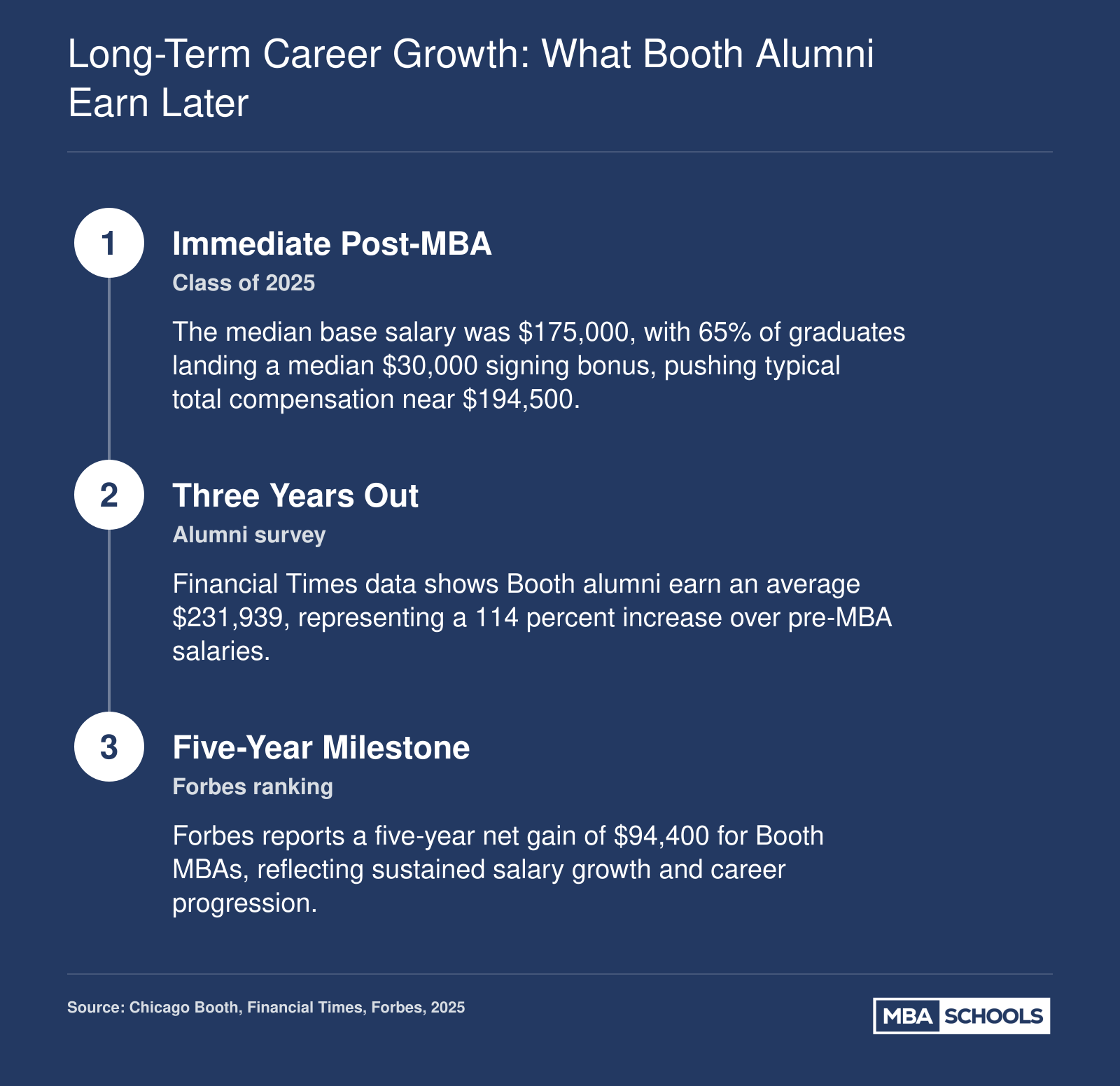
Long-Term Career Growth: What Booth Alumni Earn Later
While first-year compensation grabs headlines, the long-term value of a Chicago Booth MBA becomes clear over time. The figures below show how Booth alumni's earning power compounds in the years after graduation.
How Booth MBA Salaries Compare to Other M7 Business Schools
When stacked against its M7 peers, Chicago Booth delivers a median salary on par with the top-tier, with signing bonuses that mirror the industry standard.1 The table below breaks down the key metrics for the Class of 2025, allowing a direct Kellogg vs Booth look at the numbers.
M7 Salary and Offer Rate Comparison
| School | Median Base Salary | Signing Bonus | Job Offer Rate |
|---|---|---|---|
| Booth | $175,000 | $30,000 | 89.1% |
| Kellogg | $175,000 | $30,000 | 88% |
| Wharton | $185,000 | $30,000 | 91% |
| Harvard | $184,500 | $30,000 | 90% |
| Stanford | $185,000 | $30,000 | 90% |
| MIT Sloan | $175,000 | $30,000 | 91% |
| Columbia | $175,000 | $30,000 | 92% |
Why Salaries Differ Slightly Across M7 Schools
The modest gaps in median base salary are often attributable to the mix of industries and geographic locations that graduates pursue. Booth sends a significant share of graduates into consulting and investment banking, roles that offer standardized high base salaries across firms. Schools like Stanford and Harvard, by contrast, see a larger proportion entering technology, private equity, and venture capital, where compensation packages can push medians above $180,000. Additionally, location plays a role: many Booth graduates accept roles in Chicago, home to top MBA programs in Chicago, a market with a lower cost of living than New York City or San Francisco. This means that even a median base salary of $175,000 can offer strong purchasing power relative to higher nominal salaries in pricier cities. Ultimately, Booth’s outcomes align tightly with the M7 average, and the school’s strong employer relationships and broad industry reach ensure that graduates remain highly competitive across all major sectors.1
Frequently Asked Questions About Chicago Booth MBA Careers
Find answers to common questions about Chicago Booth MBA career outcomes, from starting salaries and bonuses to industry placement and entrepreneurship support. These insights draw from the school's latest employment data and alumni surveys.