
What you’ll learn in this article…
- Round 4 applications carry significantly lower acceptance odds at top programs like INSEAD.
- Non-refundable MBA deposits typically run around $3,000 at leading US schools.
- Request a deferral from your accepting school before declining to preserve your safety net.
A Reddit user, Gemini_No, posed the question bluntly in mid-2026: should you walk away from a confirmed offer at a strong UK business school to chase a Round 4 application at INSEAD, knowing your GRE score sits below the school's median? The dilemma struck a nerve because it distills the universal tension MBA applicants face between the security of an acceptance in hand and the ambition of reaching a dream program.
The stakes extend beyond personal preference. Declining a sure seat involves financial risk, ethical considerations about holding a spot you may vacate, and a clear-eyed assessment of whether reapplication would actually improve your odds. For sponsored candidates or international students, the calculus grows even more constrained.
The Psychology of the Dream School: Are You Chasing Prestige or Fit?
Before you walk away from a confirmed offer, interrogate why the other school feels so magnetic. Applicants routinely conflate two very different things: the emotional pull of a globally recognized brand, and the practical alignment of a program with the career they actually want to build , supported by mba career development resources. Both are valid inputs into your decision, but only one of them will still matter five years after graduation, when knowing how to calculate MBA ROI becomes essential.
Prestige Bias Is Real, and It Is Expensive
Consider the recent case of a Reddit poster who holds a confirmed offer from a leading UK business school for September intake but is contemplating a Round 4 application to INSEAD in January. On the surface, INSEAD is the obvious "dream." But dig deeper: is the pull the one-year format, the truly global cohort and its international immersion MBA benefits, the strength of the consulting recruiting pipeline out of Fontainebleau and Singapore? Or is it the name recognition when telling family and colleagues where you got in? An INSEAD alumna who commented on the thread was blunt: Round 4 is a poor bet, and it only makes sense if the GRE score (currently below INSEAD's average) can be lifted first. That is a fit problem masquerading as a prestige problem.
Build a Side-by-Side That Forces Honesty
List the concrete, non-brand advantages of each program against your target post-MBA role:
- Alumni density in your target industry and geography: The importance of alumni network in choosing mba programs is clear: where do graduates actually land?
- On-campus recruiters: Which firms interview, and for which functions?
- Curriculum specialization: Does the elective catalog match your pivot?
- Cultural fit: Class size, teaching method, cohort background.
Self-Reflection Questions
- If nobody in your life would ever learn where you went, would you still pick the dream school?
- Can you name three specific career resources at the dream school that the safe school lacks?
- Are you rejecting the safe school for what it is, or for what it is not (i.e. not the dream)?
If your answers lean on rankings and reputation rather than resources and outcomes, you are chasing prestige, not fit.
Financial Fallout: Deposits, Scholarships, and What You Stand to Lose
How much money will you actually forfeit if you decline an MBA acceptance to wait for your dream school?
The answer depends on several factors, but the financial stakes are often higher than applicants initially expect. Beyond the deposit itself, you may be walking away from scholarship funds, favorable tuition rates, and even employer sponsorship arrangements that took months to secure.
Understanding Deposit Policies and Refund Windows
Most MBA programs require an enrollment deposit to hold your seat, and these deposits vary widely across schools. Some programs use a tiered deposit system, requiring an initial payment upon acceptance followed by additional installments as orientation approaches. Refund policies are equally variable: some schools offer full refunds if you withdraw before a specific deadline, while others consider deposits entirely non-refundable from day one.
To get accurate information, consult an MBA acceptance checklist on the program's website, where deposit policies and deadlines are typically detailed under sections labeled "Admissions" or "Cost & Financial Aid." However, written policies do not always capture the nuances, so contact the admissions office directly via email or phone to confirm the most current refund terms. These policies can change year to year, and what applied to last year's cohort may not apply to yours.
Scholarship Offers: A Separate Set of Deadlines
Scholarship funding adds another layer of complexity. Many schools extend scholarship offers alongside admissions decisions, but these awards often come with their own acceptance windows and non-refundable conditions. You may have less time to decide on a scholarship than you do on the admission itself, and some awards require a firm commitment before you would hear back from a dream school's later round.
Review scholarship offer letters carefully, and cross-reference MBA scholarship deadlines to ensure you don't miss acceptance windows. Look for language specifying whether the funding can be deferred, whether partial acceptance is possible, and what happens if you withdraw after accepting the award. Losing a scholarship is not just about the dollar amount; it changes your entire financial calculus for the program, potentially pushing you toward higher loan burdens or limiting your post-MBA flexibility.
Cross-Checking Policies and Real Experiences
For additional clarity, cross-check policies on authoritative aggregators like GMAC or AACSB, which sometimes compile comparative data on program costs and financial aid structures. You can also search real student experiences on forums such as GMATClub, where applicants often share firsthand accounts of deposit deadlines, refund negotiations, and scholarship conditions. These discussions can reveal unwritten norms, such as whether schools have historically granted extensions or partial refunds under certain circumstances.
Calculating Your True Exposure
Before making any decision, tally your total financial exposure. This includes:
- Non-refundable deposits: The amount you will lose outright if you withdraw.
- Scholarship value: The cumulative funding you forfeit by declining.
- Opportunity cost: Potential tuition increases or lost employer sponsorship if you reapply next cycle.
- Application fees: The cost of applying to your dream school again, including test retakes if needed.
The sum of these figures represents your true financial risk. For some applicants, this number is manageable. For others, it represents a year's salary or more. Knowing exactly what you stand to lose is the first step toward making a decision you can live with.
Questions to Ask Yourself
The Ethical Dilemma: Holding a Seat While You Wait
Seat-holding means accepting an offer and paying a deposit at one business school while actively pursuing admission elsewhere, with the intention of withdrawing if a preferred program says yes. It is a common temptation during admissions season, and it carries real consequences that extend beyond the forfeited deposit.
What Top Programs Say About Double-Depositing
Most elite MBA programs publish explicit policies on this practice, often found in their admissions FAQs or enrollment agreements. Language varies, but the expectation is consistent: once you accept an offer and pay a deposit, the school considers you committed to that seat. Some programs go further and ask candidates to affirm that they are not holding a seat elsewhere. Violating that agreement can result in rescinded offers, and in rare cases, schools have shared information with one another about applicants who double-deposit.
If you are weighing a confirmed UK offer against a future application to a school like INSEAD, the ethical line is clearer than it might seem. Paying a deposit at one school while openly planning to apply elsewhere for a later intake is not the same as quietly holding two seats simultaneously, but it still demands transparency.
Reputation Risk in a Small World
The MBA admissions community is smaller and more interconnected than most applicants realize. Admissions directors regularly speak at the same conferences, participate in the same podcast circuits, and occasionally move between institutions. Former and current admissions leaders at top programs have publicly discussed how they view seat-holding, and the consensus is that it damages an applicant's credibility. If you withdraw from a school under circumstances that suggest you were never genuinely committed, that reputation can follow you, particularly if you reapply to the same school or if recommenders are shared across applications.
Applicant forums are filled with cautionary accounts from candidates who held seats and later faced uncomfortable questions during interviews at other programs, or who found that their withdrawal was noted in ways that affected referral credibility.
A More Strategic Path
Rather than holding a seat as an insurance policy, consider these alternatives:
- Request a deferral: Many programs allow admitted students to defer their start date by one year. This preserves your seat without the ethical gray area of double-depositing.
- Contact admissions directly: Reach out to the school where you hold an offer and ask for their formal deposit policy. Many will provide a written document outlining refund timelines and withdrawal procedures.
- Be transparent about your timeline: If you are waiting on another program's decision, some admissions offices will grant short extensions. They would rather have an honest conversation than discover later that you were never planning to enroll.
The cost of holding a seat dishonestly is not just financial. It takes a spot away from another qualified candidate, strains your relationship with both schools, and introduces unnecessary risk into a process that already demands your full integrity. In a professional degree built on MBA networking and trust, how you handle this decision says something about the kind of leader you intend to become.
Reapplication Realities: Can You Get in Next Year?
Reapplying with a stronger profile versus accepting a solid offer today: that is the core tension facing any MBA candidate who considers walking away from a confirmed seat. The good news is that declining an offer does not place you on a blacklist. The more complicated news is that reapplication is far from a guaranteed path.
What Schools Actually Think About Reapplicants
Top business schools generally treat reapplicants neutrally, provided the candidate demonstrates meaningful growth between cycles. Harvard Business School, for example, states that reapplicants receive no advantage or disadvantage, and roughly 10 percent of each entering class consists of candidates who applied before. Michigan Ross reports that reapplicants make up 5 to 10 percent of its incoming cohort and are not viewed negatively.1 MIT Sloan has noted that its reapplicant admit rate can run a few percentage points higher than the overall rate of about 15 percent, likely because those who return tend to come back with genuinely improved profiles.2
The takeaway: schools welcome you back, but only if you bring something new to the table.
The Numbers Behind a Second Shot
Admission rates at elite programs remain punishing regardless of whether you are a first-time or repeat applicant. Stanford's overall admit rate sits near 7 percent. Harvard's hovers around 11 percent. Even slightly less selective top-ten and top-25 programs, where admit rates range from about 19 to 22 percent (Wharton, Booth, Kellogg, Columbia), reject the vast majority of applicants in every cycle. Broadly, data from MBA admissions consulting for reapplicants suggests that reapplicant success tracks closely with first-time applicant success when genuine improvements are present.1 Without those improvements, the outcome is predictable.
For a candidate like the one in the Reddit thread who sparked this discussion, the critical variable is clear: a GRE score that currently falls below INSEAD's class average. An INSEAD alumna commenting on the thread specifically flagged raising that score as essential. At competitive programs, test scores in the range of 325 or above on the GRE (or 725 or above on the GMAT) are typically expected to stay in the running.3
Building a Stronger Reapplication
If you do choose to decline and reapply, a productive gap year should address every weakness an admissions committee could identify. A practical roadmap includes:
- Retake the GRE or GMAT: This is non-negotiable if your current score sits below your target school's median. Structured prep over three to four months can yield meaningful score gains.
- Earn a promotion or expand your leadership scope: A title change or a measurable increase in responsibility demonstrates upward trajectory that admissions readers notice.
- Refine your essays: Explain what you did during the gap year and why the additional time deepened your conviction about the program. Vague narratives about "needing more time" will not persuade.
- Apply in an earlier round: The Reddit thread highlighted that Round 4 at INSEAD is a poor strategic choice. A disciplined how to apply for an mba strategy targets earlier rounds, where more seats are available and your intent reads as more committed.
The Risk You Cannot Eliminate
Even with a flawless reapplication strategy, there is no guarantee of admission. An applicant who declines a reputable UK program today could find themselves without any MBA offer a year from now. That scenario is not hypothetical; it happens regularly at schools with single-digit or low-teen admit rates. Before walking away from a confirmed seat, be honest about whether you can tolerate the possibility of ending up with no MBA at all, not just a delayed one.
Questions to Ask Yourself
Communicating With Your Dream School: Waitlists, Deadlines, and Tactful Negotiation
How do you tell your dream school that another program’s deposit deadline is approaching, without it sounding like an ultimatum? For waitlisted applicants juggling a competing offer, this is the most delicate part of the process: tone and timing matter equally.
Use Leverage Without Applying Pressure
A competing offer is legitimate information the admissions committee wants to know about. Schools understand that candidates have parallel timelines and finite deposit windows. What they do not want is a candidate who sounds transactional or entitled. Many MBA programs, including INSEAD, encourage waitlisted applicants to reach out if they face a time constraint.1 LBS and the US M7 tend to move waitlists as seats free up after deposit deadlines pass, which means movement is reactive, not scheduled.1
Send a short, professional note as soon as you know your deadline.2 A workable four-sentence structure:
- Sentence 1: Reaffirm that the school remains your first choice and thank the committee for continued consideration.
- Sentence 2: Disclose that you hold an offer from another program with a deposit due on [specific date].
- Sentence 3: Politely ask whether the committee can provide guidance on timing or expedite a decision if possible.
- Sentence 4: Optional brief update on anything materially new (a promotion, a higher score on MBA entrance exams) only if it genuinely strengthens your file.
What to Avoid
Skip repeated follow-ups, ultimatums, and padding your file with recycled MBA recommendation letters.MBA recommendation letters1 One clean message beats three anxious ones. Do not overpromise ("I will absolutely enroll if admitted") unless you mean it, because admissions officers talk and reputations follow applicants into future cycles.
Applying This to a Round 4 Reality
In a scenario like Gemini_No’s Reddit thread, an actual dilemma posted on r/MBA, an INSEAD Round 4 waitlist decision (a late-stage MBA admissions round MBA admissions rounds) could realistically arrive weeks or even months after a September-intake UK program’s deposit deadline. Since waitlist movement can be unpredictable, the odds of a clean, timely answer are slim. That is exactly why the email should go out early, and why the honest question to ask the committee is not "can you say yes," but "can you tell me where I stand before I lose my other seat."2
Special Considerations: Sponsored Candidates and International Students
The decision to decline a secured MBA offer grows significantly more complex when an employer is covering part or all of the cost, or when visa sponsorship and immigration timelines are in play. These two groups face constraints that self-funded domestic applicants simply do not.
Employer Sponsorship and Contractual Obligations
If your company is sponsoring your MBA, the fine print in your sponsorship agreement deserves careful scrutiny before you consider walking away from an accepted offer. Many corporate sponsorship contracts specify the school, the start date, or both. Declining an offer that your employer has already approved, with the goal of reapplying elsewhere the following year, could trigger repayment clauses or, in some cases, void the sponsorship entirely.
Before making any move, review the exact language in your sponsorship agreement; understanding employer sponsorship for mba can prevent unexpected financial obligations. Key questions to answer include:
- Does the contract name a specific institution, or does it allow you to attend any program from an approved list?
- Is there a deadline by which you must begin the program?
- What are the financial consequences if you defer or switch schools?
- Does the agreement require you to return to the company for a set period after graduation, and does that change if you alter the plan?
If your agreement is ambiguous, consult your HR department or legal counsel before declining. In many organizations, sponsorship decisions involve multiple stakeholders, and surprising them with a last-minute change can damage both the funding arrangement and the professional relationship.
Visa and Immigration Timelines for International Students
International applicants face an additional layer of logistics that can make switching schools far riskier. Every country has its own student visa process, and the timelines vary widely. If you hold an offer from a UK institution, for example, you would be navigating one visa framework. Pivoting to a school in France, Singapore, or the United States means starting a different immigration process from scratch, with distinct visa options after mba in us vs europe.
General factors to investigate include:
- Processing lead times: Some student visas require months of lead time. Late-round acceptances can compress that window dangerously.
- Financial proof requirements: Many visa applications require evidence of funds well before the program starts. Shifting plans mid-cycle may mean assembling new documentation under pressure.
- Conditional offers: Some schools issue conditional admission that depends on visa approval by a certain date. Missing that deadline could cost you both seats.
To research the specifics for your situation, start with the official government immigration website for the country where your target school is located. School admissions offices also typically publish visa guidance tailored to admitted students. For U.S. programs, the school's international student services office can outline document transfer procedures and deadlines.
Doing Your Own Due Diligence
Rather than relying on secondhand advice, go directly to authoritative sources. School websites publish detailed admissions and visa timelines. Government labor data from sources like BLS.gov can help you compare post-MBA career outcomes across regions. Professional associations in your target industry often publish compensation benchmarks and hiring trend reports that can inform whether the career payoff of your dream school justifies the added risk and complexity.
The bottom line for sponsored and international candidates is that the margin for error is thinner. A miscalculation on visa timing or a misread sponsorship clause can leave you without a school, without funding, or both.
How to Decline Respectfully: Templates, Portals, and Timing
Declining an MBA offer is more than an administrative step; it reflects your professionalism. A respectful withdrawal, executed promptly, preserves relationships with admissions officers who may cross your path later in your career.
Before You Click Decline
Review your offer letter for any specific withdrawal instructions. Most schools now handle this through the online admissions portal: log in, locate your decision, and select the option to decline or withdraw. Some portals require a short reason; a simple “I have decided to accept an offer that better fits my current circumstances” suffices. Do not over-explain or critique the program.
A Template for Your Decline Email
If the portal directs you to notify the admissions committee directly, or if you want to send a courtesy note, adapt the following:
- Email subject: Withdrawal of Application , [Your Full Name] - Body: Dear Admissions Committee,
I am writing to formally decline my offer of admission to the [Program Name] MBA program. I am grateful for the opportunity and for the time your team invested in reviewing my candidacy.
After careful reflection, I have decided to pursue a path that aligns more closely with my current professional and personal goals. I hold the program in high regard and hope our paths cross in the future.
Thank you again for your consideration.
Sincerely, [Your Full Name]
Keep the tone warm but brief. You do not need to disclose where you are going instead.
Timing, Deposits, and Waitlisted Candidates
Decline as soon as you are certain. Holding a seat you will not use is unfair to waitlisted applicants and can strain the goodwill you may need if you reapply later. If you paid a deposit and the refund window is still open, act immediately: refund policies vary, but many schools offer partial refunds within a few weeks of the payment date. Check your offer letter for the exact deadline. Even if the deposit is non-refundable, releasing your seat early is the ethical choice.
A clean, respectful withdrawal leaves the door open. Admissions professionals tend to remember courteous candidates; you never know when you might need a reference, a corporate partnership, or even a future application to that same institution.
Questions to Ask Yourself
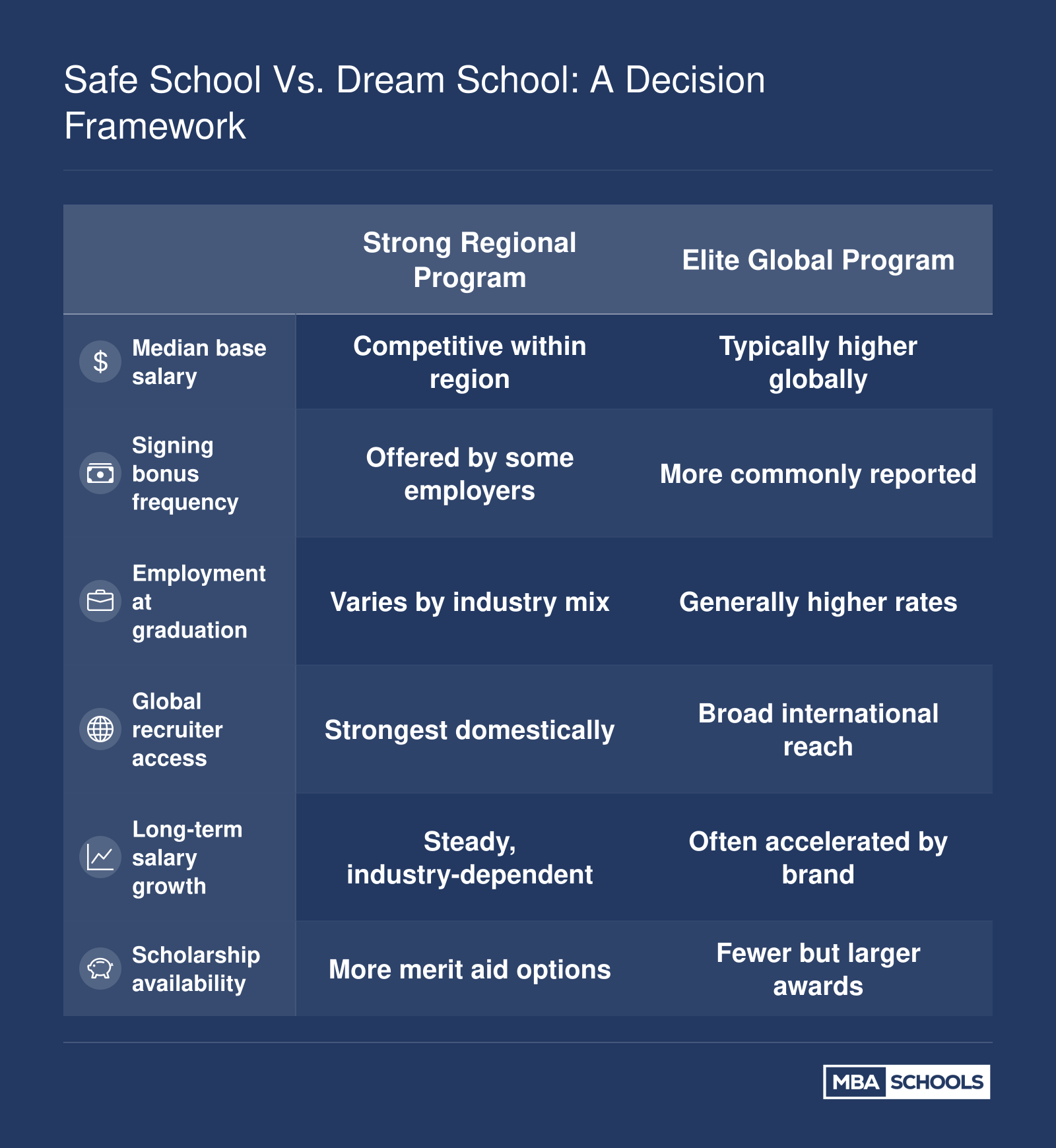
Safe School Vs. Dream School: A Decision Framework
Before declining a confirmed MBA offer in pursuit of a higher-ranked program, weigh the measurable differences across several dimensions. Each school publishes an annual employment report with median salary, signing bonus, and placement rate data. Cross-reference these with independent sources like the Financial Times MBA rankings, which include salary growth and career progress metrics, and alumni outcome surveys for longer-term trajectory insights.