
What you’ll learn in this article…
- SFBU's AI-taught MBA Pro+ costs just $10,000 total.
- AACSB accreditation remains the top quality signal for employers.
- Mid-career professionals gain the most ROI from low-cost MBAs.
The MBA market is being forced to answer an uncomfortable question: can a degree priced at $10,000 do the same job as one costing ten times as much? On July 16, 2026, San Francisco Bay University, a nonprofit, WASC-accredited school in Fremont, California, launched MBA Pro+, an online program that replaces live lectures with AI avatars and charges just $10,000 in total tuition. The model upends the traditional assumption that career-transforming business education requires a six-figure investment. For cost-conscious applicants weighing whether the MBA debt is worth taking on, this experiment arrives at an ideal moment. Whether employers will treat an AI-taught MBA as equivalent to conventional degrees remains unproven, and the salary outcomes that have long justified the price of top-tier programs are now part of a live experiment.
SFBU's $10,000 MBA Pro+: What the AI-Taught Model Actually Looks Like
SFBU's MBA Pro+ doesn't just trim the cost of business school , it completely reimagines how an MBA is delivered, replacing live lectures with AI-driven instruction while reserving human faculty for high-impact mentorship. This model, launched in July 2026, challenges decades of pedagogical tradition and raises the stakes for established programs struggling to justify six-figure tuition.
AI Instruction at Scale: Bayley and the Avatars
The program is built on a proprietary AI system named Bayley, which powers a suite of faculty-developed AI avatars. These avatars are not generic chatbots; they are meticulously designed to replicate the teaching style, expertise, and even the personality of SFBU's own faculty members. Students access course content, case discussions, and feedback through 24/7 AI-enhanced interactions, freeing them from scheduled class times. The centerpiece is a signature exercise: students practice negotiating a salary increase with an "avatar boss" that parses their arguments, tone, and tactics, then delivers immediate, detailed feedback. This kind of active, repeatable skill-building, impossible in a passive lecture hall, hones the practical negotiation and communication abilities that employers consistently rank among the most valuable MBA skills employers want.
From Lectures to Mentorship: How Faculty Roles Change
With AI handling the bulk of content delivery, human instructors step into a distinctly different role. President Nick Ladany described the shift as moving from "sage on the stage" to mentor, coach, and career strategist. Each student is paired with a faculty mentor, with a target ratio of 20:1 to 50:1, a figure that sounds large until you realize the mentors are no longer grading stacks of exams or delivering the same lectures term after term. Instead, they guide professional development, help students apply lessons to real-world scenarios, and advise on career transitions. This structure retains the personal touch that many MBA candidates value, while leveraging AI to handle the content volume that would otherwise demand a much larger and costlier faculty roster. Those considering this path would do well to understand what an MBA teaches you before weighing AI-delivered formats against traditional ones.
How the $10,000 Price Tag Becomes Possible
SFBU achieves its low tuition through a combination of structural efficiencies. The university is a nonprofit institution, accredited by the WASC Senior College and University Commission (not AACSB, the more common gold standard for business schools), which keeps resources focused on education rather than shareholder returns.2 Ladany points out that SFBU has no athletic programs, a choice that cuts at least 10% from what tuition would otherwise need to cover. Most significantly, AI avatars replace the heavy variable cost of instructor-led lectures, allowing the program to scale enrollment without proportionally increasing expense. Initial cohorts are capped at 100 students per month, with a projected total of 300 to 400 for 2026, starting in September through rolling admissions.3 This careful calibration ensures quality control while testing the model's economics.
An Outlier, or the First of Many?
SFBU's fully AI-taught MBA remains an anomaly in 2026. Other schools have experimented with AI elements, Quantic's app-based MBA uses interactive, automated lessons, and Wharton has piloted AI-driven simulations, but none have built an entire accredited program around AI avatars as the primary instructors. For prospective students weighing this option, understanding how online MBA degrees are viewed by employers is a critical part of the calculation. The broader industry is watching: if SFBU can demonstrate strong learning outcomes and employer acceptance, it could accelerate a trend toward unbundling the faculty role and using technology to lower costs. For now, MBA Pro+ stands alone as a radical experiment in educational delivery.
How Low-Cost MBAs Actually Work: Tuition Models Explained
The traditional MBA charges per credit hour and often penalizes out-of-state students, but a new generation of affordable programs is flipping the script with flat fees, subscriptions, and all-inclusive pricing.
Per-Credit-Hour Pricing: The Most Common Model
Many low-cost MBAs, especially those at public universities or private non-elite schools, charge a set rate per credit hour. A typical program requires 30 to 48 credits; at $300 to $500 per credit, your tuition lands between $9,000 and $24,000. This model gives you flexibility: if you already hold a graduate certificate or can test out of core courses, you pay only for the credits you actually need. The trade-off is that per-credit prices often rise annually, so finishing slowly can cost more than the initial estimate. For a fuller picture of what drives these figures, see our breakdown of online MBA cost across program types.
Flat-Rate and Subscription Models: Pay by Program or Term
A growing number of disruptors opt for a single, all-in price for the entire MBA. SFBU's $10,000 MBA Pro+ is the most publicized example, covering everything from instruction to AI-driven feedback tools. Subscription-style MBAs, like Western Governors University's competency-based model, charge a flat fee per six-month term regardless of how many courses you finish. If you accelerate and complete more credits per term, your total cost drops dramatically. Both models reward speed and clarity: the price you see upfront is what you pay, with no surprise tuition hikes.
The Residency Factor: In-State vs Out-of-State Online
Public universities have historically charged online MBA students out-of-state tuition, sometimes doubling the per-credit rate. A program listing $400 per credit for residents might bill non-residents $900, turning an affordable degree into a $40,000+ commitment. Fortunately, many schools now offer a single online tuition rate regardless of where you live. When researching, confirm whether the published price applies to all online learners or only to in-state applicants.
Hidden Costs That Inflate the Sticker Price
A $12,000 tuition figure rarely tells the whole story. Expect additional charges that can add $3,000 to $6,000 or more. Common culprits include:
- Technology and proctoring fees: Online courses often charge per-semester fees for learning platforms and remote exam monitoring.
- Textbooks and subscriptions: Digital access codes and required software may not be included in tuition.
- Capstone or residency travel: Some low-cost programs require one or two on-campus residencies; airfare, lodging, and meals are on you.
- Graduation fees: A final bill for diploma processing, regalia, and commencement can surprise students at the finish line.
Always request a full program cost sheet that itemizes every mandatory fee before enrolling.
The Real Total Cost Range
When you factor in all line items, the genuine all-in price of a low-cost MBA typically runs from $10,000 to $25,000. That contrasts sharply with traditional programs, where even in-state public MBAs often exceed $60,000 and top-25 schools routinely cross $150,000. The gap is meaningful, but only if you account for the hidden costs that turn a bargain sticker into a larger investment. Before committing, it is worth working through the questions to ask when calculating MBA ROI to ensure the numbers genuinely favor your career goals.
Accreditation Tiers: AACSB Vs. ACBSP Vs. Regional, and Why It Matters for Your MBA
When you research MBA programs, accreditation is the quality assurance mechanism that separates rigorous degrees from questionable credentials. It tells employers, lenders, and licensing boards that your coursework meets established academic standards.
How Accreditation Works for MBA Programs
There are two main types of accreditation. Institutional accreditation covers an entire university from a regional agency like WASC, HLC, or SACSCOC. Programmatic accreditation focuses specifically on business schools and their curricula. MBA accreditation types include three major business accreditors: AACSB, ACBSP, and IACBE, each with a different focus and level of prestige.
AACSB: The Business School Gold Standard
The Association to Advance Collegiate Schools of Business (AACSB) accredits only about 5 percent of business schools globally. It emphasizes research output, faculty qualifications, and curricular innovation. For MBA graduates targeting competitive roles in finance, consulting, or Fortune 500 leadership tracks, AACSB accreditation matters at the baseline level. Some of the most affordable AACSB-accredited MBAs now cost under $10,000, including the online program at Georgia Southwestern State University, priced at $9,503 for the full degree in 2025-2026.2
ACBSP and IACBE: Respected Alternatives
The Accreditation Council for Business Schools and Programs (ACBSP) focuses on teaching excellence and student learning outcomes rather than faculty research. It is common among teaching-focused public universities and online programs. Eastern New Mexico University offers an ACBSP-accredited MBA for $9,510, for example.2 The International Accreditation Council for Business Education (IACBE) takes an outcomes-based approach, ensuring programs demonstrate student achievement. While both are legitimate, they carry less prestige than AACSB in employer screening. Fitchburg State University's IACBE-accredited MBA costs $13,080.2
Regional Accreditation Alone: Solid but Limited
Many budget MBAs, including the new SFBU MBA Pro+ launched in July 2026, hold regional accreditation without a business-specific stamp. SFBU is institutionally accredited by WASC, the same body that accredits Stanford and UC Berkeley. This satisfies federal financial aid eligibility and most HR filtering algorithms. However, it does not signal the same business-focused rigor as AACSB. Fort Hays State University's MBA, priced at $12,668, is another example of a regionally accredited program without AACSB.2
Why the Distinction Matters for Your Career
Your MBA's accreditation tier directly influences how employers perceive the degree. AACSB accreditation opens doors at top consulting firms and investment banks that actively recruit from accredited schools. ACBSP and IACBE still provide solid recognition, especially in education, government, and mid-market companies. Regional-only accreditation can suffice if you plan to stay in your current industry, leverage an MBA for a promotion, or launch a business. For the SFBU model, the regional accreditation establishes a legitimate foundation, but the AI-driven format is untested in the job market. Understanding whether an online MBA is respected by employers will become an increasingly relevant question as early graduates enter the workforce. For now, cost-conscious applicants should weigh the low price against the potential need to explain their degree's pedigree in competitive hiring processes.
ROI and Salary Outcomes for Affordable MBA Graduates
For many MBA applicants, the central tension is whether a lower tuition bill today will cost them more in lost earning power tomorrow. The rise of sub-$15,000 programs forces a reexamination of calculating MBA ROI, where the upside of a low-cost degree can be immediate and the risk is capped, unlike the six-figure financial exposure of many traditional full-time MBAs.
The Payback Math: A $10,000 MBA vs. a Six-Figure Degree
A degree that costs $10,000 essentially breaks even with a single year's salary bump of $10,000. By contrast, a top-25 program priced at $120,000 requires a raise of $30,000 sustained over at least four years just to recover the principal, not including interest on loans. Real-world examples from low-cost online programs reinforce this advantage. Indiana University's Kelley Direct Online MBA, with a payback period of just two to three years, demonstrates that affordable programs can generate quick ROI.2 Kelley students typically entered with salaries around $55,000 and saw increases of $15,000 to $25,000, yielding annual returns between 10 and 16 percent.2
Realistic Salary Ceilings for MBA Holders
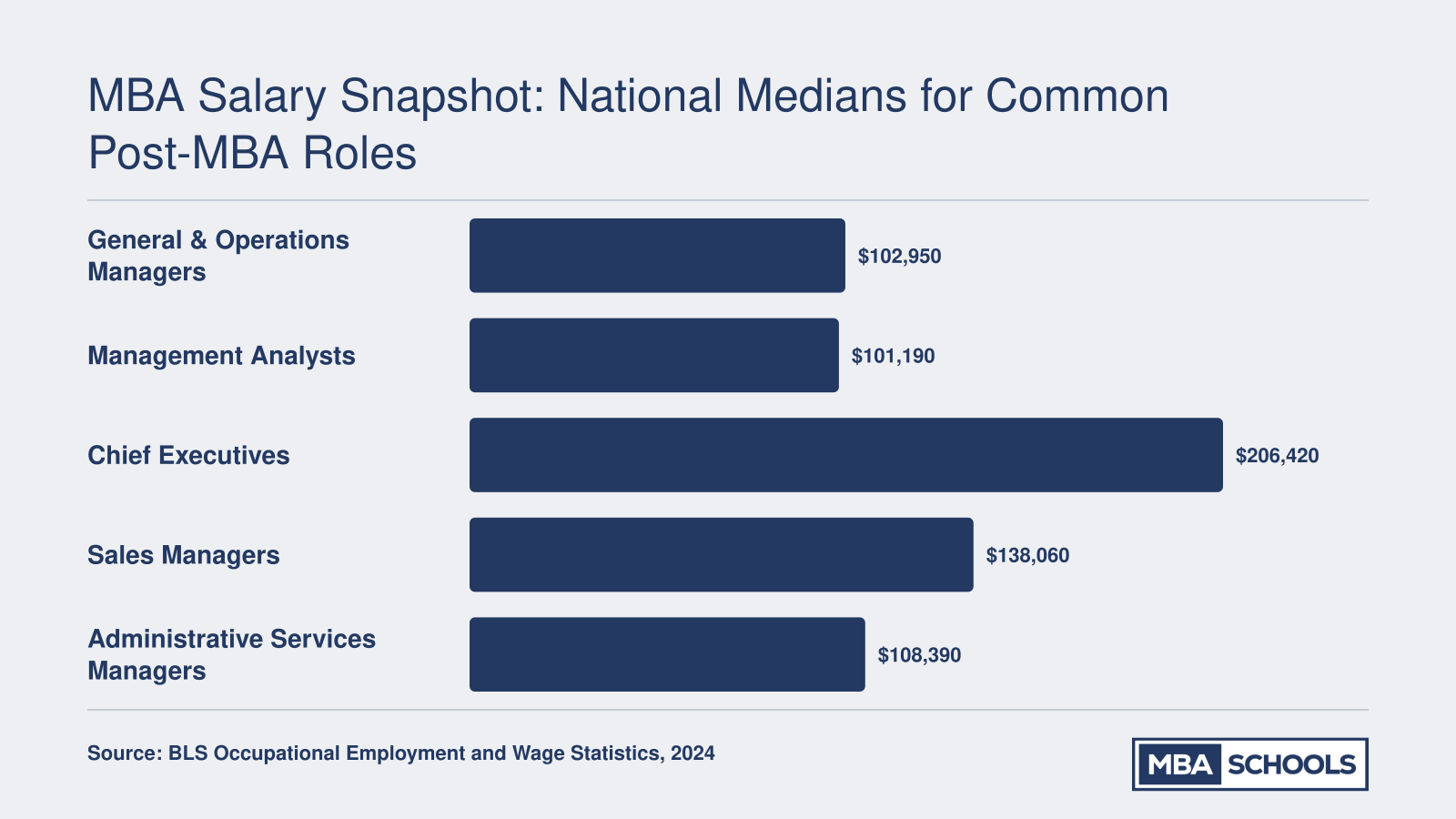
National wage data grounds expectations. General and Operations Managers earn a median annual wage of roughly $103,000, while Management Analysts earn about $101,000.3 These are not the $200,000-plus salaries reported by elite consulting and banking employers but represent the broad middle of the market where most MBA graduates build careers. The projected growth for business and financial occupations is 7 percent from 2024 to 2034, signaling expanding demand for managerial talent.3
The Salary Gap: Top-10 vs. Affordable Online Programs
The earnings divide between top-tier and accessible programs remains wide. Graduates from top-10 schools command starting base salaries in the $175,000 to $205,000 range, with total compensation packages often exceeding $220,000 when bonuses are included. Regional and online MBA programs show base salaries of $85,000 to $115,000 and total compensation between $95,000 and $130,000.3 This differential underscores why career changers targeting prestige industries may still need a high-brand program, but it also highlights the strong absolute returns that lower-cost degrees can deliver for those already established in their fields.
Opportunity Cost: The Hidden Advantage of Low-Cost Programs
A working professional who completes a $10,000 online MBA while continuing to earn avoids the opportunity cost of forgoing salary for two years, a loss that can range from $150,000 to $250,000 for a full-time student. When accounting for this foregone income, the true cost of a residential program can approach half a million dollars. The low-cost model eliminates this trade-off, allowing learners to invest in their education without interrupting their earnings trajectory. Even a modest salary increase, typical of programs priced under $15,000, can yield a positive return within months.
ROI Is Personal: When Low-Cost Wins and When It Doesn't
For mid-career managers seeking a credential to unlock a promotion, a $10,000 MBA can deliver an outsized ROI because the degree is purely additive. The median salary increase across all U.S. MBA graduates is 46 percent, but that figure is skewed by high earners.2 For someone already earning $80,000, a 15 percent bump to $92,000 recovers the tuition in about a year and a half. For career switchers targeting investment banking or strategy consulting, however, the brand premium of a top-10 school continues to unlock opportunities that a low-cost program cannot replicate. Whether the MBA career switch pays off ultimately hinges on whether the buyer needs the credential to advance within their current field or to achieve a complete employer-mediated career reset.
Related Articles
MBA Salary Snapshot: National Medians for Common Post-MBA Roles
While an MBA can open doors to top-paying roles, actual salaries vary by occupation and experience. These national median wages from the Bureau of Labor Statistics (2024) reflect broad occupational earnings, not program-specific outcomes.
Highest-Paying States and Metro Areas for MBA-Track Careers
For MBA graduates, location significantly impacts earning potential. The table below highlights the top five states for two common post-MBA roles, General and Operations Managers and Management Analysts, based on the latest U.S. Bureau of Labor Statistics data.
| State | Occupation | Median Annual Wage |
|---|---|---|
| Georgia | General and Operations Managers | $99,800 |
| Michigan | General and Operations Managers | $99,660 |
| South Carolina | General and Operations Managers | $99,340 |
| North Carolina | General and Operations Managers | $99,190 |
| Oregon | General and Operations Managers | $98,580 |
| North Carolina | Management Analysts | $98,700 |
| Louisiana | Management Analysts | $98,680 |
| Texas | Management Analysts | $98,650 |
| Tennessee | Management Analysts | $97,410 |
| Delaware | Management Analysts | $97,030 |
Quality Vs. Cost: What You Gain and Give up With a Budget MBA
The conversation around MBA value has shifted from simple rankings to a more nuanced calculation of return on investment. As affordable programs proliferate, the question is not just about tuition price tags, but about what you are trading in exchange for a lower cost.
What You Gain
A budget MBA offers immediate financial relief. Many programs allow you to graduate with little or no debt, starting your post-MBA career without the weight of large loan payments. For career switchers or working professionals, this can mean a faster break-even point and greater flexibility to pursue roles that align with personal passions rather than just high salaries. Some employers value the grit and resourcefulness of candidates who found creative ways to upskill affordably. Non-traditional MBA career paths often reward exactly this kind of cost-conscious thinking.
What You Give Up
The trade-offs often lie in the less-visible pillars of a business school experience: alumni network value, dedicated career services, and employer brand recognition. Traditional full-time MBAs invest heavily in cultivating corporate relationships, hosting recruiting events, and curating a powerful network that pays dividends over a lifetime. Budget programs, particularly online-only models, may lack the same depth of career support or the cachet that opens doors at top-tier consulting firms or investment banks. Employer skepticism about academic rigor or lack of in-person teamwork can also surface.
How to Evaluate Quality Signals
To bridge the information gap, turn to transparent, third-party data. Start with each program's employment report and look for placement rates, salary data, and the list of hiring companies. Then cross-reference with government sources like the U.S. Bureau of Labor Statistics (BLS.gov) for occupational outlook and median pay in your target field. Professional associations such as the Graduate Management Admission Council (GMAC) and accrediting bodies (AACSB, ACBSP) publish employer surveys that shed light on demand for MBA skills. If you are still weighing whether the degree itself makes sense for your situation, reviewing what an MBA degree covers can sharpen that decision. A program that openly shares outcome data signals confidence in its results, while a sparse or vague report may warrant caution.
Who Should Consider a Low-Cost MBA, and Who Shouldn't
A low-cost MBA delivers the strongest return for candidates who need a credential to unlock their next role rather than a brand to open doors.
Ideal Candidates for a Low-Cost MBA
- Mid-career professionals: Those with 7 or more years of experience who already have a track record of results benefit most from the management frameworks and formal credential a budget MBA provides, without the burden of six-figure debt.
- Entrepreneurs and small-business owners: When you need practical skills in finance, marketing, and operations, not a network of bulge-bracket alumni, a $10,000 to $30,000 program aligns cost with the immediate value. best MBA for entrepreneurs covers program options worth comparing.
- Public-sector and nonprofit leaders: With median post-MBA salaries in these fields often below $80,000, a traditional $100,000 degree rarely breaks even. An affordable option preserves the promotion-eligible credential while keeping debt manageable.
- Tech professionals: In product management, engineering leadership, and operations, skills and experience outweigh school prestige. A low-cost MBA adds business vocabulary and strategic thinking without requiring a career interruption that tech employers discount.
When a Budget MBA Falls Short
- Management consulting aspirants: Firms like McKinsey, Bain, and BCG recruit almost exclusively from top-15 full-time MBA programs. Without those recruiting pipelines, breaking in is exceptionally rare.
- Investment banking candidates: Bulge-bracket and elite-boutique banks rely on target-school on-campus recruiting that low-cost programs simply cannot replicate. part-time MBA investment banking placement illustrates why even alternative pathways face steep odds.
- Network-first career changers: If your primary goal is an influential alumni base in a specific industry or geography, a regional, affordable program rarely matches the density of a leading national school.
Many low-cost programs offer GMAT waivers and flexible GPA thresholds, widening access. Use those flexibilities as entry points, but verify they do not signal weak outcomes. Before enrolling, check whether online MBA respected by employers research applies to your target sector, and confirm recognized institutional accreditation and published employment data.
How to Evaluate an Affordable MBA Program: A Decision Checklist
Use this checklist to separate genuine value from false savings when considering low-cost MBA programs.
- Confirm programmatic accreditationVerify that the program holds AACSB, ACBSP, or IACBE accreditation, regional accreditation alone may not carry the same weight with employers.
- Audit the true total costLook beyond tuition to mandatory fees, residency travel, technology subscriptions, and textbooks. A $10,000 program can quickly double if these are hidden.
- Demand recent career outcomesAsk for employment rates, salary increases, and job-placement data specific to the program. Vague claims or reliance on national averages signal weak outcomes.
- Test the learning modelIf AI-driven, request a demo of the platform and clarity on human support. A 20:1 mentor ratio means nothing if mentors are inaccessible.
- Gauge employer perceptionSearch LinkedIn for alumni in your target role and ask recruiters if they recognize the school. A low price is worthless if your MBA isn't respected.
Common Questions About Low-Cost MBA Programs
Prospective students often have practical questions about the value and perception of low-cost MBA programs. Below, we address the most common concerns with data-backed insights.