

What you’ll learn in this article…
- DFW hosts 21 to 24 Fortune 500 headquarters, giving MBA graduates direct access to telecom, energy, and finance recruiters.
- In-state tuition at public DFW schools like UT Dallas can cost roughly half the rate of private programs such as SMU Cox.
- Programs range from highly selective (around 8% admission rate) to open access, with many now offering GMAT waivers for qualified applicants.
- Full-time, part-time, online, and hybrid MBA formats are available across more than a dozen accredited DFW programs.
Dallas-Fort Worth is home to 21 Fortune 500 headquarters, trailing only New York among U.S. metros. That corporate density translates directly into MBA recruiting pipelines, internship access, and post-graduation placement in sectors from telecom and defense to financial services and healthcare. For candidates weighing programs, the practical tension is real: tuition at DFW's top private schools can exceed $140,000, while strong public options like UT Dallas Jindal come in well under half that for Texas residents.
The metro supports more than a dozen MBA programs, spanning elite privates like SMU Cox and TCU Neeley, research-driven public flagships, and flexible online formats built for working professionals. If you are just beginning to explore your options, our overview of accredited mba programs is a useful starting point. Format, cost, and industry alignment vary dramatically across that range, and the right fit depends less on brand recognition than on how a program's outcomes match your career trajectory.
Best MBA Programs in Dallas-Fort Worth: Rankings Overview
The Dallas-Fort Worth metroplex and broader Texas landscape offer MBA programs spanning elite private research universities, flagship public institutions, and specialized health science centers. Our ranking weighs cost, career outcomes, and institutional strength rather than brand prestige alone, giving working professionals a realistic picture of where their tuition dollars will go furthest. Because the list includes both public and private schools, in-state residents can find dramatically different price points, while out-of-state and international candidates should pay close attention to how tuition gaps affect long-term ROI.
- Tuition and net price
- Graduate earnings outcomes
- Graduation and retention rates
- Student-to-faculty ratio
- Program breadth and format flexibility
- Independent program research
- NCES-IPEDS federal institutional data — nces.ed.gov
- College Scorecard graduate earnings — collegescorecard.ed.gov
- Internal program database

The University of Texas at Dallas
Located in Richardson, UT Dallas is the only top-ranked school on this list physically inside the DFW metroplex, giving students direct access to the region's corporate employers, alumni base, and recruiting events without relocating. The Naveen Jindal School of Management offers 15 MBA concentrations, from business analytics to project management, plus double-degree options pairing the MBA with an MS in Information Technology and Management. In-state tuition near $15,200 makes it one of the most affordable paths to a DFW-connected MBA, and an online Executive MBA option broadens access for professionals who need scheduling flexibility.
- 15 concentration options including business analytics
- 12 credit hours required per concentration
- Covers predictive modeling and data management
- Prepares for marketing, financial, and healthcare analytics roles
- Academic certificates in project management available
- Designed for full-time students and working professionals
- 15 concentration options including business analytics
- 12 credit hours required per concentration
- Covers predictive modeling and data management
- Prepares for marketing, financial, and healthcare analytics roles
- Academic certificates in project management available
- Designed for full-time students and working professionals
- 15 concentration options including business analytics
- 12 credit hours required per concentration
- Covers predictive modeling and data management
- Prepares for marketing, financial, and healthcare analytics roles
- Academic certificates in project management available
- Designed for full-time students and working professionals
MBA, Business Analytics — On-Campus
Executive MBA with an emphasis in Project Management, Project Management — Online
MS in Information Technology and Management / MBA — On-Campus

Rice University
Rice University's Jones Graduate School of Business in Houston pairs a 6:1 student-to-faculty ratio with a 94.6% graduation rate, signaling intensive mentorship and strong completion outcomes. The MBA with Healthcare Specialization capitalizes on Houston's Texas Medical Center, the world's largest, offering career treks, on-campus recruiting, and a graduate certificate in healthcare management. Rice also organizes dedicated career treks to Dallas-Fort Worth, connecting MBA students with the metro's growing corporate landscape and expanding alumni network in the region. Tuition is approximately $57,030 per year, but a median net price near $13,370 reflects substantial financial aid.
- 12 credit hours of healthcare-focused electives
- No entrance exam required for admission
- Full-time and part-time format options
- Capstone project required for completion
- Earn a Graduate Certificate in Healthcare Management
- Career treks to healthcare organizations and DFW employers
- On-campus recruiting tailored to healthcare MBAs
- Mentorship from second-year MBA students
- Five-year dual degree combining medicine and business
- Collaboration with Baylor College of Medicine
- Focus on healthcare leadership and innovation
- Rigorous curriculum with hands-on learning
- Campus-based program in Houston
- Strong academic background required for admission
MBA with Healthcare Specialization — On-Campus
MBA/MD, Healthcare — On-Campus

The University of Texas at Austin
UT Austin's McCombs School of Business is consistently recognized among the nation's top public MBA programs, offering concentrations in finance, supply chain, and marketing alongside executive and dual-degree tracks. In-state tuition around $12,000 per year makes it a compelling value for Texas residents, though out-of-state students will pay closer to $23,000. With a 97% retention rate, an 88.9% graduation rate, and STEM designation available for the finance concentration, McCombs graduates are well-positioned for roles in consulting, investment banking, and operations across Texas and beyond.
- Concentration in Supply Chain and Operations Management
- Cross-functional curriculum covering logistics and procurement
- Access to Operations Fellows student organization
- Prepares for supply chain analyst and project manager roles
- Consulting firms highly value program graduates
- Campus-based experience in Austin
- AACSB accredited with six concentration options
- STEM designation available for finance concentration
- Top-ranked Finance Department nationally
- 40% of job offers placed in the finance sector
- MBA Investment Fund and Venture Fellows participation
- Two-year full-time program requiring GMAT
- AACSB accredited with six concentration options
- STEM designation available for finance concentration
- Top-ranked Finance Department nationally
- 40% of job offers placed in the finance sector
- MBA Investment Fund and Venture Fellows participation
- Two-year full-time program requiring GMAT
- Top 10 ranked MBA marketing program
- Access to industry leaders and real-world projects
- World-renowned research faculty
- AACSB accredited curriculum
- Campus-based learning environment
- Extensive alumni network across Texas
- Top 10 ranked MBA marketing program
- Access to industry leaders and real-world projects
- World-renowned research faculty
- AACSB accredited curriculum
- Campus-based learning environment
- Extensive alumni network across Texas
- Top 10 ranked MBA marketing program
- Access to industry leaders and real-world projects
- World-renowned research faculty
- AACSB accredited curriculum
- Campus-based learning environment
- Extensive alumni network across Texas
Master of Business Administration, Supply Chain and Operations Management — On-Campus
Full-Time MBA, Finance — On-Campus
MBA — On-Campus
Executive MBA — Hybrid
MBA/JD — On-Campus
MD/MBA — On-Campus

Texas A & M University-College Station
Texas A&M's Mays Business School delivers a STEM-designated MBA plus MS Analytics dual degree in 22 months, combining 61 credit hours of business and data science coursework in a cohort-based environment. The university's massive Aggie Network provides career support across every major Texas metro, including DFW. In-state tuition starts near $11,750 per year at the institutional level, though the dual-degree program lists total tuition around $110,000. An Executive MBA delivered in a hybrid format from the Houston campus adds another option for senior professionals.
- STEM-designated dual degree completed in 22 months
- 61 credit hours with a five-semester capstone
- Cohort-based structure with fall start dates
- Merit-based scholarships and financial aid available
- Impact Fridays and Career Labs for professional development
- Global study abroad programs included
- GRE or GMAT required for admission
- Access to the Aggie Network for career support
- 21-month hybrid program based in Houston
- Bimonthly weekend class schedule
- 45 credit hours with capstone project
- Requires 10 years of professional experience
- Includes Washington Campus Seminar
- Tuition approximately $125,000 for residents
- Five-year dual-degree program
- 100% residency match rate reported
- Multiple specialized tracks available
- Competitive scholarship options
- Leadership skill development emphasis
- Comprehensive medical and business education
Full-Time MBA + MS Analytics — On-Campus
Executive MBA — Hybrid
MD + Master of Business Administration — On-Campus

The University of Texas Health Science Center at Houston
UTHealth Houston offers a hybrid MD/MBA program in collaboration with the University of Houston-Clear Lake, designed for medical students who want to lead in healthcare administration, entrepreneurship, or consulting. The 4-to-5-year timeline integrates medical school credits with MBA coursework, including summer and online classes for scheduling flexibility. A 5:1 student-to-faculty ratio and median institutional earnings near $88,757 ten years after enrollment reflect the school's focus on high-impact health professions.
- Hybrid format completed in 4 to 5 years
- Shared credit hours between medical and MBA curricula
- Summer coursework and online classes for flexibility
- Financial aid available for each degree separately
- Collaboration with University of Houston-Clear Lake
- Prepares graduates for healthcare leadership roles
- Online dual degree combining MBA and public health
- Flexible format designed for working professionals
- Healthcare management and public health focus
- Business strategy integrated into curriculum
- Bachelor's degree and work experience required
- Financial aid available
MD/MBA — Hybrid
MBA/MPH — Online

The University of Texas Medical Branch at Galveston
UTMB Galveston's MD/MBA dual degree pairs a rigorous medical curriculum with a full 39-credit MBA, enabling students to finish both degrees in as few as five years. The program accepts the MCAT in lieu of GMAT/GRE for MBA admission, removing a common barrier for medical students. A 10:1 student-to-faculty ratio and median institutional earnings above $92,900 ten years post-enrollment underscore the earning power of healthcare-trained business leaders.
- Dual degree completable in five years
- Full 39-credit MBA curriculum included
- MCAT accepted for MBA admission
- Healthcare-focused business coursework
- Flexible enrollment with separate application
- Financial aid available for both degrees
MD/MBA — Hybrid

The University of Texas Health Science Center at San Antonio
UT Health San Antonio's MD/MBA dual-degree program combines five years of clinical training with business coursework delivered in person at UTSA. The program targets future healthcare leaders who want to merge clinical expertise with organizational strategy. In-state tuition at the institutional level is among the lowest in this ranking at roughly $4,650, though MBA costs are set by the partnering business school. Median graduate debt of $15,000 and earnings near $82,200 a decade out reflect the program's healthcare-career orientation.
- Five-year dual degree with structured timeline
- In-person MBA coursework at UTSA
- Requires acceptance into medical school first
- Combines clinical and business education
- Separate financial details for each school
- Designed for healthcare leadership careers
MD/MBA — On-Campus

Baylor College of Medicine
Baylor College of Medicine partners with both Rice University and Baylor University to offer five-year M.D./M.B.A. dual degrees, giving medical students two distinct pathways to pair clinical training with business acumen. The Rice partnership provides access to a top-tier business school and Houston's medical center ecosystem, while the Baylor University partnership adds a full-time MBA rooted in a different institutional culture. These options are best suited for physicians who intend to pursue healthcare administration, entrepreneurship, or consulting.
- Five-year dual degree with Rice Business
- Focus on healthcare leadership and innovation
- Campus-based program in Houston's medical center
- Opportunities in healthcare administration and consulting
- Combines Baylor medical training with Rice MBA
- Tailored for aspiring healthcare executives
- Five-year dual degree combining M.D. and M.B.A.
- Includes full-time M.B.A. study at Baylor University
- Focus on healthcare leadership
- Tailored for healthcare professionals
- Campus-based program format
- Combines two distinct institutional strengths
M.D./M.B.A. at Rice University — On-Campus
MD/MPH Dual Degree Program — On-Campus
M.D./M.B.A. Baylor University Dual Degree Program — On-Campus

Texas A & M International University
Texas A&M International University in Laredo offers one of the most affordable AACSB-accredited online MBAs in Texas, with total program tuition around $11,010 for in-state students across 30 credit hours. Concentrations in Healthcare Administration, International Business, and Management can be completed in as few as 12 months through asynchronous, seven-week course terms. GMAT/GRE waivers are available for qualified applicants, and prep modules help students without a business background get up to speed before core courses begin.
- AACSB accredited, 30 credit hours total
- Completable in 12 months, six start dates per year
- Total tuition approximately $11,010 for Texas residents
- Asynchronous online format with 7-week terms
- GMAT/GRE waiver available for qualified applicants
- Healthcare informatics and leadership coursework
- Prep modules for non-business backgrounds
- AACSB accredited with $367 per credit hour in-state
- 12-month completion possible at 30 credit hours
- Six start dates annually across fall, spring, summer
- No thesis or capstone required
- Expedited track available for qualified students
- Career preparation for global business roles
- Online delivery, 30 credit hours total
- AACSB accredited with GMAT/GRE waiver option
- Seven-week course sessions for accelerated pacing
- Core courses include strategic management
- Flexible for working professionals
- International focus woven into curriculum
Master of Business Administration in Healthcare Administration — Online
MBA in International Business — Online
MBA in Management — Online

University of Houston-Clear Lake
The University of Houston-Clear Lake provides AACSB-accredited MBA concentrations in Environmental Management and Management Information Systems through hybrid and online formats, making it a practical option for Houston-area professionals who need evening or weekend flexibility. At roughly $9,762 per year for in-state students, UHCL's tuition is among the lowest of any accredited MBA in the greater Texas region. GRE/GMAT waivers are available for applicants meeting GPA thresholds, lowering one more barrier to entry.
- MBA with Environmental Management concentration
- 30 credit hours, available online or hybrid
- GRE/GMAT waiver for applicants with 3.0+ GPA
- AACSB accredited with industry-informed curriculum
- Covers environmental law and pollution control
- 16-week course format with MBA Launch Track option
- Faculty with direct industry experience
- MBA with Environmental Management concentration
- 30 credit hours, available online or hybrid
- GRE/GMAT waiver for applicants with 3.0+ GPA
- AACSB accredited with industry-informed curriculum
- Covers environmental law and pollution control
- 16-week course format with MBA Launch Track option
- Faculty with direct industry experience
Business Administration MBA, Environmental Management — Hybrid
Business Administration MBA, Management Information Systems — Hybrid
DFW MBA Tuition and Cost Comparison
MBA tuition in the Dallas-Fort Worth area varies widely depending on whether a school is public or private. Public universities in Texas offer a significant in-state tuition advantage, often half the out-of-state rate or less. The "Average Net Price" column below reflects the institution-wide average cost after grants and scholarships for all undergraduates and graduates combined. It serves as a useful benchmark for affordability, but your actual cost will depend on your residency status, financial aid package, and program-specific fees. Private institutions charge the same tuition regardless of residency, which can simplify budgeting but may result in higher sticker prices.
| School | Type | City | In-State Tuition | Out-of-State Tuition | Avg. Net Price (Institution-Wide) |
|---|---|---|---|---|---|
| University of North Texas at Dallas (UNTD) | Public | Dallas | $6,379 | $13,759 | $6,420 |
| Texas Woman's University (TWU) | Public | Denton | $8,520 | $15,900 | $11,963 |
| University of North Texas (UNT) | Public | Denton | $9,091 | $16,471 | $15,649 |
| The University of Texas at Arlington (UTA) | Public | Arlington | $11,249 | $26,073 | $13,951 |
| The University of Texas at Dallas (UT Dallas) | Public | Richardson | $15,168 | $29,548 | $18,267 |
| Texas Tech University | Public | Lubbock | $9,518 | $17,918 | $19,070 |
| University of Houston | Public | Houston | $10,051 | $19,231 | $14,276 |
| University of Houston-Clear Lake (UHCL) | Public | Houston | $9,762 | $19,194 | $15,563 |
| The University of Texas at San Antonio (UTSA) | Public | San Antonio | $10,116 | $28,720 | $10,836 |
| The University of Texas at Tyler (UT Tyler) | Public | Tyler | $8,480 | $17,264 | $13,323 |
| The University of Texas at El Paso (UTEP) | Public | El Paso | $7,166 | $16,621 | $9,403 |
| Texas A&M International University | Public | Laredo | $6,650 | $15,490 | $3,637 |
| The University of Texas Rio Grande Valley (UTRGV) | Public | Edinburg | $8,589 | $15,971 | $4,831 |
| Rice University | Private | Houston | $57,030 | $57,030 | $13,370 |
| North American University | Private | Stafford | $12,460 | $12,460 | $18,721 |
Questions to Ask Yourself
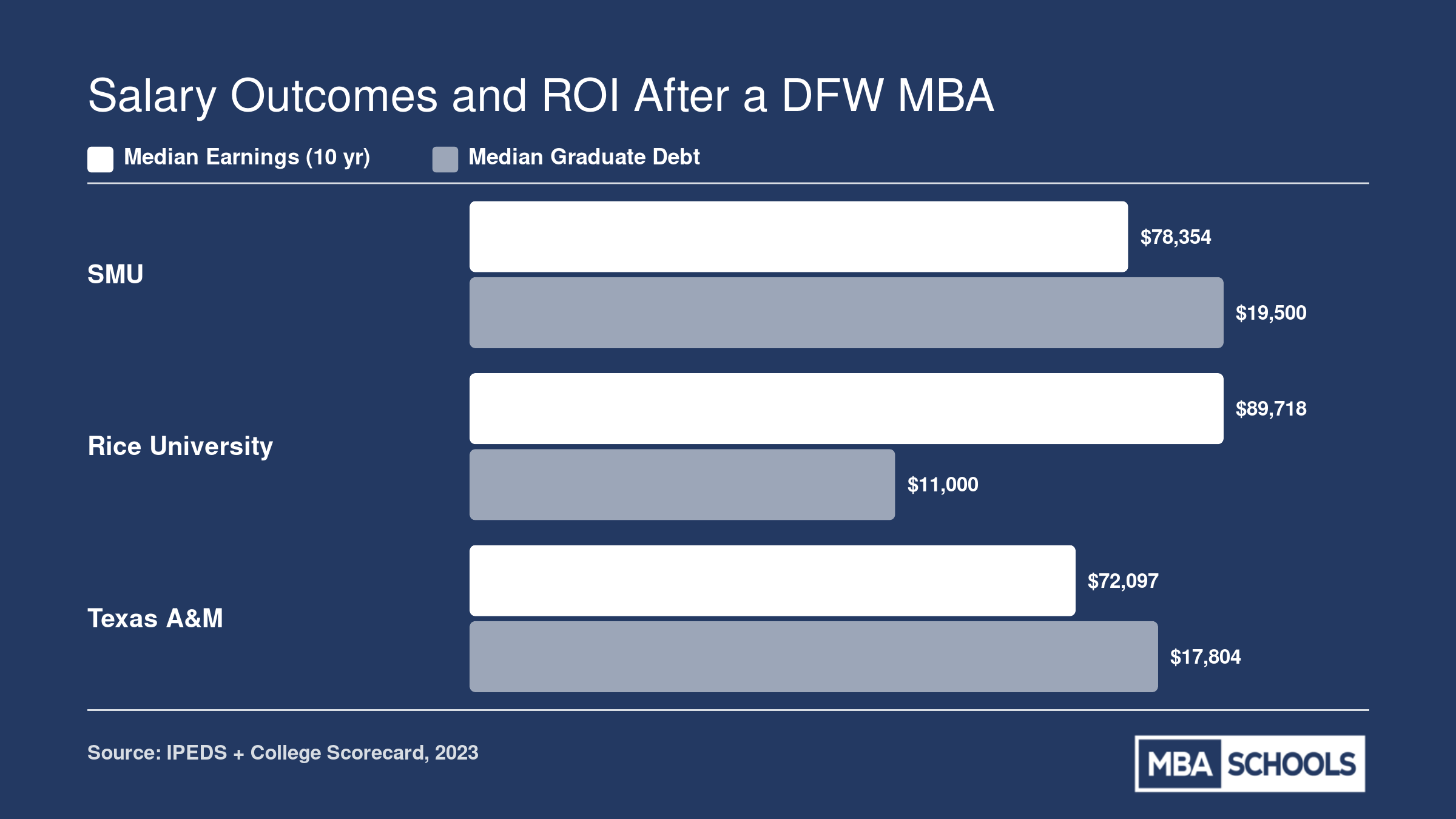
Salary Outcomes and ROI After a DFW MBA
Program-level earnings data (such as one-year and four-year post-completion salaries) are not yet available for most DFW MBA programs. However, institution-wide median earnings ten years after enrollment offer a useful proxy for long-term ROI. When you compare those earnings against median graduate debt, the payoff picture becomes clear: graduates from top Texas MBA-granting institutions typically earn four to eight times their median debt load, signaling strong returns on investment across the board.
Admission Requirements, Acceptance Rates, and GMAT Waivers at DFW MBA Programs
The Dallas-Fort Worth metro offers MBA programs across a wide selectivity spectrum. At the institutional level, admission rates range from roughly 8% at the most selective private universities in Texas to over 90% at open-access public campuses. DFW-specific programs fall comfortably in between: UT Dallas, for instance, has an overall institutional admission rate near 65%, while SMU and TCU are more selective. Keep in mind that MBA-specific acceptance rates can differ from the university-wide figure, so contact individual programs for the most current data.
GMAT and GRE Waiver Policies Across DFW Schools
If you have been dreading the GMAT or GRE, you are in luck. Every major DFW MBA program now offers some form of test waiver, though the qualifying criteria vary considerably.1
- SMU Cox School of Business: Currently test-optional for MBA applicants, meaning you can apply without submitting a GMAT or GRE score at all.2
- UT Dallas Jindal School of Management: Test-optional. Waiver candidates typically need at least five years of professional work experience, a minimum 3.0 undergraduate GPA, or a recognized professional certification such as a CPA or CFA.1
- TCU Neeley School of Business: Test-optional. Applicants with at least three years of work experience and a 3.0 or higher GPA generally qualify for a waiver.3
- UNT G. Brint Ryan College of Business: Test-optional. Waiver eligibility usually requires five years of work experience and a 3.0 GPA minimum.1
- University of Dallas: Offers GMAT and GRE waivers but is not fully test-optional. You will generally need seven or more years of professional experience and a 3.0 GPA to have the test requirement waived. If you do not meet those thresholds, plan on submitting a score.1
- Baylor Dallas MBA: Test-optional. Waiver criteria include five years of work experience and a slightly higher GPA floor of 3.2.1
No-GMAT MBA Options in Dallas-Fort Worth
This is one of the most frequently searched questions about DFW MBA programs, and the answer is encouraging. SMU Cox, UT Dallas Jindal, TCU Neeley, UNT Ryan, and Baylor's Dallas MBA are all fully test-optional as of the 2026 admissions cycle. That means you can submit a complete application without ever sitting for the GMAT or GRE, regardless of your work history or GPA. For programs that are not test-optional, like the University of Dallas, pursuing a waiver is straightforward if you meet the experience and GPA benchmarks.
Even at test-optional schools, submitting a strong GMAT or GRE score can bolster your application, especially if your GPA is below the program's median or you are competing for merit-based scholarships. Treat the test as an optional asset, not a mandatory hurdle.
Other Admission Requirements to Verify
Beyond standardized tests, DFW MBA programs share a common set of application components, though the specifics differ. For a broader look at what business schools expect, our guide to mba application requirements covers the fundamentals.
- Undergraduate GPA: Most programs look for a 3.0 or above. Baylor's Dallas MBA sets the bar slightly higher at 3.2 for waiver eligibility.
- Essays and personal statements: Nearly every program requires at least one essay addressing career goals, leadership experience, or reasons for pursuing the MBA.
- Letters of recommendation: Typically two, often from professional rather than academic references. Our detailed walkthrough on crafting an mba letter of recommendation can help you guide your recommenders.
- Resume and work experience: While some full-time programs accept candidates straight from undergrad, most professional and part-time MBA tracks expect two to five years of post-graduation experience.
- Transcripts and interviews: Official undergraduate transcripts are universally required. Some programs, particularly SMU Cox and TCU Neeley, incorporate an admissions interview as part of the evaluation process.
Because each school updates its requirements annually, always confirm deadlines, prerequisite coursework, and documentation needs directly on the program's admissions page before you apply.
Full-Time Vs. Part-Time Vs. Online MBA Formats in DFW
Choosing the right MBA format is one of the most consequential decisions you will make, and DFW schools give you more options than almost any other metro. The format you select should align with your career goals, financial situation, and tolerance for career interruption. Below, we compare the three main delivery models across the dimensions that matter most to working professionals.
| Dimension | Full-Time MBA | Part-Time / Evening / Weekend MBA | Online MBA |
|---|---|---|---|
| Typical Duration | 2 years (some accelerated options run 16 to 21 months) | 2.5 to 3 years (evening or Saturday classes fit around a work schedule) | 12 to 24 months (self-paced or cohort-based, often with 7- or 8-week terms) |
| DFW Schools Offering This Format | SMU Cox, UT Dallas Jindal, TCU Neeley offer traditional on-campus full-time cohorts | SMU Cox (Professional MBA), UT Dallas (Evening and Flex), TCU Neeley (Evening), UNT (Evening) | UT Dallas (Online MBA), UNT (Online MBA), Parker University (fully asynchronous online MBA) |
| Total Cost Range (Tuition) | Higher overall: private programs like SMU Cox exceed $100,000; public options such as UT Dallas Jindal start near $15,000 per year for Texas residents | Similar per-credit rates to full-time, but employer tuition reimbursement often offsets costs; spreading payments over 2.5 to 3 years eases cash flow | Generally the lowest total outlay; programs like Parker University list tuition around $14,898 and UT Tyler's online MBA runs roughly $32,000 total |
| Career Interruption | Significant: you leave the workforce for 2 years, forgoing salary and benefits | Minimal: you continue earning a full salary while attending class on evenings or weekends | None: coursework is asynchronous, so you study on your own schedule without disrupting employment |
| Networking and Recruiting Access | Strongest: daily contact with a dedicated cohort, on-campus recruiting events, corporate treks, and direct access to DFW employer pipelines | Strong: evening cohorts include experienced professionals already embedded in DFW companies; alumni networks and employer info sessions are accessible | More limited: virtual networking, discussion boards, and optional on-campus immersions; some programs include in-person residency weekends |
| Internship Opportunities | Built into the curriculum between first and second year; ideal for career switchers who need hands-on industry exposure | Rare, since students are already employed; experiential learning typically comes through workplace projects or consulting practicums | Generally not included; students apply coursework directly to their current roles |
| Best Fit | Career switchers, early-career professionals seeking a new industry, or candidates targeting consulting and finance recruiting cycles | Working professionals who want to advance within their current company or industry without leaving the workforce | Professionals in demanding or travel-heavy roles who need maximum scheduling flexibility and a lower total investment |
| Hybrid and Weekend Variants | Some full-time programs incorporate online modules or Saturday workshops, but attendance is primarily on campus | TCU Neeley and SMU Cox offer Saturday or alternating-weekend intensives alongside weeknight sessions, blending in-person and virtual elements | UT Dallas and University of Houston-Clear Lake offer hybrid MBAs that combine online coursework with periodic in-person sessions |
The Dallas-Fort Worth metroplex is home to 21 Fortune 500 company headquarters as of 2025, making it one of the most concentrated corporate hubs in the country. Major employers span industries from telecom (AT&T) to energy (ExxonMobil) to defense (Lockheed Martin), giving MBA graduates a uniquely diverse recruiting landscape right in their backyard.
Industry Connections: Corporate HQs, Finance, and Energy Recruiting in DFW
Few MBA markets in the United States can match the sheer density of Fortune 500 headquarters found in Dallas-Fort Worth. With 24 Fortune 500 companies based in the metro1 and 54 across Texas2, DFW students have direct access to employer pipelines that MBA candidates in smaller markets simply cannot replicate. That proximity shapes recruiting seasons, internship availability, and the long-term alumni networks that make a degree pay off.
The DFW Corporate Landscape by Sector
The region's employer base is remarkably diversified, which means MBA graduates are not dependent on a single industry cycle.3
- Telecom: AT&T is headquartered in Dallas and remains one of the largest private employers in the metro.
- Energy: Energy Transfer Partners, HF Sinclair, EnLink Midstream, and Vistra Corp all call DFW home, anchoring a robust energy and utilities corridor.
- Finance and real estate: Charles Schwab (Westlake) and CBRE Group (Dallas) represent a growing financial services footprint, and major banks including Goldman Sachs and Capital One maintain significant DFW operations.
- Defense and engineering: Lockheed Martin's aeronautics division in Fort Worth, along with Fluor Corporation (Irving) and Jacobs Solutions (Dallas), feed a steady demand for MBA talent in program management and government contracting.
- Healthcare: McKesson (Irving) and Tenet Healthcare (Dallas) sit at the center of one of the country's fastest-growing healthcare economies.
- Tech: Texas Instruments, headquartered in Dallas, is joined by a widening roster of tech employers establishing or expanding DFW offices.
- Aviation: American Airlines (Fort Worth) and Southwest Airlines (Dallas) both recruit locally for strategy, operations, and finance roles.
How Proximity Translates into Recruiting Pipelines
When a Fortune 500 company is headquartered minutes from a business school campus, the relationship extends well beyond career fairs. Corporate executives serve as guest lecturers and advisory board members. Internship cycles are easier to structure around evening and weekend class schedules. And alumni who land roles at these firms become a self-reinforcing network, pulling future graduates into the same organizations. Understanding how to navigate these relationships is essential, and our guide on working with MBA recruiters covers the process in detail.
SMU Cox, for example, benefits from deep ties to the Dallas financial and consulting communities, with on-campus recruiting events that draw regional offices of major firms. UT Dallas Jindal leverages its location in Richardson, a corridor thick with telecom and tech employers, and has built corporate partnership programs that connect students with project-based learning at local companies. TCU Neeley, situated in Fort Worth near Lockheed Martin and American Airlines, is well positioned for students targeting defense, aviation, and supply chain management MBA career paths.
The Part-Time and Evening MBA Advantage
DFW's corporate concentration creates a distinctive advantage for professionals pursuing part-time or evening MBA formats. Students who already work at firms like AT&T, Texas Instruments, or McKesson can apply classroom concepts to real projects the next morning, and their employers often subsidize tuition through education assistance programs. Many of the region's largest employers appear on the list of companies that pay for MBA degrees, making the financial case even stronger. Evening networking events in Uptown Dallas or Las Colinas regularly bring together classmates, alumni, and corporate sponsors in the same room, creating organic connections that full-time students in less industry-dense metros would need to engineer deliberately.
For prospective MBA students evaluating DFW against other major metros, the takeaway is straightforward: the region's employer diversity reduces concentration risk, and the physical proximity of so many headquarters turns an MBA program's career services office into a genuine competitive asset rather than a formality.
Related Articles
MBA Concentrations and Specializations Available in DFW
Choosing the right MBA concentration can be just as important as choosing the right school, especially in a metro where industry demand shapes hiring patterns. The Dallas-Fort Worth area's deep bench of Fortune 500 headquarters in energy, telecom, finance, and healthcare means certain specializations carry outsized recruiting value. The table below maps key DFW-area MBA programs to their notable concentrations so you can quickly identify which school aligns with your career goals.
| School | Location | Notable Concentrations / Specializations | Total Concentration Options | Industry Alignment in DFW |
|---|---|---|---|---|
| UT Dallas (Jindal School) | Richardson, TX | Business Analytics, Finance, Supply Chain Management, Healthcare Management, Innovation and Entrepreneurship, Real Estate, plus additional options | 15 | Analytics and finance roles align with the Telecom Corridor and major financial services employers headquartered in DFW |
| Parker University | Dallas, TX | Health Care Management, plus additional options | 4 | Healthcare management ties directly to the region's large hospital systems and health services employers |
| Rice University (Jones School) | Houston, TX | MBA with Healthcare Specialization (12 credit hours; located near the Texas Medical Center) | N/A | Healthcare specialization is a standout for candidates targeting hospital administration, health insurance, and medical device sectors |
| Texas A&M (Mays Business School) | College Station, TX | Full-Time MBA + MS Analytics (dual degree, STEM-designated, 61 credit hours) | N/A | The STEM-designated analytics dual degree appeals to candidates pursuing data-driven roles at DFW tech and consulting firms |
| UT Austin (McCombs School) | Austin, TX | Supply Chain and Operations Management | N/A | Supply chain expertise is highly valued by DFW logistics hubs and major retailers headquartered in the region |
| University of Houston (Bauer College) | Houston, TX | Entrepreneurship (MBA/MS dual degree), plus additional options | 6 | Entrepreneurship training suits DFW's growing startup ecosystem and venture activity across North Texas |
| UT Tyler | Tyler, TX (online delivery) | Cyber Security (36 credit hours, fully online, AACSB accredited) | N/A | Cybersecurity concentration meets rising demand from defense contractors, financial institutions, and tech companies in DFW |
| University of Houston-Clear Lake | Houston, TX (hybrid/online) | Environmental Management (30 credit hours, AACSB accredited) | N/A | Environmental management is a differentiator for candidates targeting sustainability and compliance roles at energy firms with DFW offices |
| Texas A&M International University | Laredo, TX (fully online) | Healthcare Administration (30 credit hours, AACSB accredited) | N/A | Affordable, fully online healthcare admin track for working professionals who want to serve the growing DFW health sector remotely |
| Texas Tech University Health Sciences Center | Lubbock, TX (hybrid) | Health Organization Management (joint MD/MBA available, 42 credit hours, AACSB accredited) | N/A | Designed for physician leaders; health organization management concentration prepares graduates for executive roles in hospital systems |
DFW MBA Options for International Students
Dallas-Fort Worth is one of the most internationally connected business metros in the United States, and its MBA programs reflect that global orientation. If you are an international student considering a DFW MBA, you will find programs that actively recruit globally, offer visa support, and connect you to a corporate landscape filled with multinational employers. That said, each program handles international admissions differently, so understanding the details before you apply is essential.
Visa Sponsorship and STEM OPT Eligibility
The most critical question for international applicants is whether a program sponsors F-1 student visas and qualifies for Optional Practical Training (OPT), including the extended STEM OPT period that allows up to 36 months of post-graduation work authorization in the U.S.
UT Dallas Jindal School of Management is a standout on both fronts. Jindal sponsors F-1 visas1 and its MBA is STEM OPT eligible2, giving graduates a meaningful runway to secure employer-sponsored work authorization after completing the degree. This is a significant advantage for students who want to stay and work in the DFW market.
By contrast, the UT Austin McCombs Working Professional MBA offered at the DFW location does not sponsor F-1 visas.3 That program is designed for professionals already working in the area, so international applicants without existing U.S. work authorization should look elsewhere. SMU Cox and TCU Neeley both enroll international students in their full-time MBA cohorts, though prospective applicants should confirm current visa and STEM designation details directly with each school's admissions office.
International Cohort Size
Knowing that you will have peers who share the experience of studying abroad matters. At UT Dallas Jindal, roughly 37% of the most recent full-time MBA cohort identified as international students, with 17 international students in a class of 46.2 That is a sizable presence and suggests a program culture accustomed to supporting students from diverse national backgrounds. SMU Cox and TCU Neeley also typically enroll meaningful international cohorts in their full-time programs, though exact percentages fluctuate year to year.
Support Services and Global Exchange Opportunities
UT Dallas operates a dedicated International Center that assists with visa processing, cultural adjustment, and employment advising. The Jindal School also offers study abroad and exchange programming, with application deadlines structured around both fall and spring semesters.4 SMU and TCU each maintain international student offices and global exchange partnerships, which can add valuable cross-border experience to your resume.
Cost Considerations for International Students
Tuition is one area where international students need to plan carefully. At public universities like UT Dallas and UNT, out-of-state tuition rates apply to international students and can be meaningfully higher than in-state rates. UT Dallas does offer an International Education Fund Scholarship specifically for international students, which can help offset that gap.4 Private institutions like SMU Cox and TCU Neeley charge the same tuition regardless of residency, so there is no out-of-state surcharge, but base tuition at those schools tends to be higher overall.
Before committing, international applicants should request a full cost-of-attendance breakdown from each program, including health insurance requirements, and inquire about merit scholarships, graduate assistantships, or fellowships open to non-U.S. citizens. Funding packages vary significantly, and exploring mba scholarships for international students early in the process is strongly recommended. Even a partial scholarship can reshape the ROI calculation. For broader guidance on financing mba costs, consider comparing loan options and employer tuition reimbursement alongside scholarship opportunities.
How to Choose the Right DFW MBA Program
With more than a dozen MBA programs in the Dallas-Fort Worth metro, narrowing down the right fit demands a structured approach. Rather than defaulting to name recognition alone, evaluate each program across four key dimensions: budget, career goals, format flexibility, and long-term return on investment. If you need a broader framework, our guide on how to choose the right MBA program for your career goals walks through these factors in detail.
Start With Your Budget
Total MBA costs in DFW range from roughly $25,000 at public universities to well over $100,000 at top private schools. Before applying anywhere, determine how much you can realistically invest, factoring in tuition, fees, opportunity cost if you leave full-time work, and potential scholarship aid. If you reviewed the tuition comparison table earlier in this guide, use those figures as your baseline. A working professional earning a strong salary may find that a lower-cost part-time program preserves income while still delivering meaningful credential value. For a wider look at budget-friendly options, see our ranking of the cheapest MBA programs nationwide.
Align With Your Career Goals and Target Industry
Different programs cultivate different recruiting pipelines. If your goal is breaking into corporate finance or consulting, look for schools with established employer partnerships at major DFW headquarters. If you are targeting healthcare management or supply chain roles, prioritize programs with dedicated concentrations and alumni networks in those sectors. Ask yourself: does this program place graduates where I want to be in five years? Our resource on how to choose an MBA specialization can help you match concentrations to career outcomes.
Here are a few scenario-based examples to illustrate:
- Finance professional seeking evening classes: A part-time or Professional MBA at a school with strong finance recruiting, typically in the $50,000 to $80,000 range, may deliver the best balance of flexibility and outcomes.
- Career switcher targeting tech or operations: A full-time MBA with a supply chain or information technology concentration could open doors at DFW-based firms in telecom and logistics.
- International student prioritizing OPT and visa sponsorship: Programs with dedicated international student services, strong STEM-designated options, and employer connections matter more than sticker price alone.
Weigh Format and Flexibility
Full-time programs offer deeper immersion and stronger on-campus recruiting, but they require stepping away from your paycheck. Part-time and evening formats let you keep working, though the timeline stretches to three years or more. Online and hybrid options add geographic freedom but may limit networking. Match the format to the reality of your current obligations, not just your preferences.
Think About Long-Term ROI
Tuition is only one side of the equation. Salary outcomes after graduation, which we outlined in the ROI section above, reveal how quickly a program pays for itself. Cross-reference what you would spend against median post-MBA earnings for each school. A program that costs $30,000 more but consistently places graduates into roles paying $20,000 or more above your current salary may deliver a stronger return within just a few years.
Put It All Together
Map your top two or three programs against these four axes. If one school consistently scores well across budget, career alignment, flexibility, and ROI, that is likely your strongest option. When trade-offs emerge, decide which axis matters most at this stage of your career.
Frequently Asked Questions About MBA Programs in Dallas-Fort Worth
Prospective MBA students in the Dallas-Fort Worth metro frequently ask about cost, admissions requirements, and career outcomes. Below, we address the most common questions using data and insights discussed throughout this guide.
Additional MBA Programs in Dallas-Fort Worth
Beyond the top-ranked programs, the Dallas-Fort Worth metroplex and surrounding Texas regions offer a wide variety of MBA options. This directory includes additional AACSB-accredited schools, many with flexible online or hybrid formats tailored for working professionals.