
What you’ll learn in this article…
- Stanford GSB and UC Berkeley Haas anchor the Bay Area with the highest post-MBA earning power and global prestige.
- AACSB-accredited public programs at San Jose State and SF State offer respected MBAs at a fraction of private school tuition.
- MBA graduates in major tech hubs like San Francisco often earn well above the national median starting salary of $120,000.
- Accredited online and hybrid formats from Bay Area schools give working professionals flexibility without losing access to Silicon Valley networks.
Stanford GSB reported a median base salary of $175,000 for its 2024 MBA class. San Francisco State University charges under $8,000 a year in tuition for California residents. That spread captures the core tension facing professionals weighing MBA programs in the San Francisco Bay Area: the region offers world-class credentials at nearly every price point, but the gap in cost, selectivity, and post-graduation earnings between the top and bottom of the market is enormous.
The Bay Area's ranked programs span elite full-time options at Stanford and UC Berkeley Haas, mid-tier private schools like Santa Clara Leavey and the University of San Francisco, and affordable CSU campuses including San Jose State and Cal State East Bay. Proximity to Silicon Valley's hiring pipelines and venture capital networks remains the region's defining advantage, yet that same ecosystem pushes Bay Area living costs well above national averages, making total cost of attendance a critical variable that tuition alone does not capture.
Best MBA Programs in San Francisco Bay Area: 2026 Rankings
The San Francisco Bay Area is one of the most dynamic MBA markets in the world, anchored by proximity to Silicon Valley's tech giants, a thriving venture capital ecosystem, and a culture that rewards entrepreneurial thinking. Our 2026 rankings evaluate California MBA programs on institutional outcomes, graduation strength, affordability after aid, and program depth. Several top-ranked schools sit directly in the Bay Area, while others in the broader California UC and CSU systems offer compelling value, flexible formats, and specialized concentrations that serve Bay Area professionals. Note that net price figures cited below reflect institution-level averages after financial aid for all students, not guaranteed MBA-specific costs.
- Graduation and retention rates
- Institutional earnings after graduation
- Net price after financial aid
- Program breadth and concentrations
- Admissions selectivity
- College Scorecard graduate earnings — collegescorecard.ed.gov
- Internal program database
- Independent program research
- NCES-IPEDS federal institutional data — nces.ed.gov

Stanford University
Stanford University's Graduate School of Business sits at the epicenter of Silicon Valley, offering joint and dual-degree MBA pathways that pair business leadership with law, medicine, and engineering. With a 3.6% admission rate and a 6:1 student-to-faculty ratio, it is among the most selective and intimate MBA environments in the country. Stanford reclaimed the top spot in U.S. News' 2026 full-time MBA rankings, and its institutional median earnings of $124,080 at ten years reflect the caliber of outcomes graduates can expect. The institution-level average net price after aid is approximately $13,807.
- Combines Stanford Law and GSB curricula
- Flexible start at either law or business school
- Knight-Hennessy Scholars funding available
- Prepares for leadership across law and business
- Campus-based program in Stanford, CA
- Emphasizes collaboration and cross-disciplinary thinking
- Five-year dual-degree combining MD and MBA
- Prepares graduates for healthcare leadership roles
- Competitive admissions through both medical and business schools
- Located on Stanford's main campus
- Integrates clinical training with business strategy
- Ideal for physicians pursuing executive careers
Joint JD/MBA Degree Program — On-Campus
MD/MBA — On-Campus

University of California-Berkeley
UC Berkeley's Haas School of Business offers one of the most comprehensive MBA portfolios in the Bay Area, spanning a full-time MBA, an Executive MBA in hybrid format, and concurrent degrees in law, public health, and engineering. The full-time program is AACSB-accredited, reports a 95% job placement rate, and channels graduates into consulting, finance, and technology. Haas's location in Berkeley gives students direct access to the UC Berkeley Startup Accelerator and an entrepreneurial network stretching across San Francisco and the greater Bay Area. The institution's median ten-year earnings stand at $92,446, with an average net price of approximately $13,481 after aid.
- AACSB-accredited two-year cohort program
- Approximately $75,000 total program tuition
- 95% job placement rate reported
- Career paths in consulting, finance, and tech
- GMAT required; 3.0 GPA minimum
- Scholarships and financial aid available
- Experiential learning with world-renowned faculty
- AACSB-accredited two-year cohort program
- Approximately $75,000 total program tuition
- 95% job placement rate reported
- Career paths in consulting, finance, and tech
- GMAT required; 3.0 GPA minimum
- Scholarships and financial aid available
- Experiential learning with world-renowned faculty
- AACSB-accredited two-year cohort program
- Approximately $75,000 total program tuition
- 95% job placement rate reported
- Career paths in consulting, finance, and tech
- GMAT required; 3.0 GPA minimum
- Scholarships and financial aid available
- Experiential learning with world-renowned faculty
- AACSB-accredited two-year cohort program
- Approximately $75,000 total program tuition
- 95% job placement rate reported
- Career paths in consulting, finance, and tech
- GMAT required; 3.0 GPA minimum
- Scholarships and financial aid available
- Experiential learning with world-renowned faculty
- 22-month hybrid format for working leaders
- Field immersions in global business hubs
- Access to top Haas faculty and alumni network
- Flexible scheduling designed for professionals
- Focus on leadership and innovation
- Diverse, global student cohort
- Four-year concurrent degree with Berkeley Law
- First two years in law school, third at Haas
- Final year allows electives in both schools
- Minimum eight semesters at UC Berkeley
- Campus-based interdisciplinary program
- Combines legal expertise with business leadership
- 2.5-year concurrent degree with School of Public Health
- Health Management and Innovation concentration
- Two full-time summer internships required
- Requires approximately five years of work experience
- Integrated admissions review process
- Focus on healthcare leadership and policy
- Four-semester concurrent degree program
- Combines MBA with Master of Engineering
- Lower cost than completing degrees separately
- Technical undergraduate background required
- Prepares for tech industry leadership roles
- Interdisciplinary real-world projects included
MBA, Entrepreneurship — On-Campus
MBA, Finance — On-Campus
MBA, Marketing — On-Campus
Full-Time MBA Program — On-Campus
MBA for Executives — Hybrid
MBA/JD — On-Campus
MBA/MPH, Health Management and Innovation — On-Campus
MBA/MEng — On-Campus

University of California-Los Angeles
UCLA Anderson School of Management, located in Los Angeles, rounds out California's elite MBA trio with strong finance and marketing concentrations and an extensive suite of dual-degree options. Anderson reports a median salary of $175,000 for finance graduates, with nearly 70% receiving a $50,000 signing bonus. The school also offers hybrid Executive MBA formats, including a global dual-degree partnership with the National University of Singapore. While outside the Bay Area geographically, UCLA Anderson's alumni network extends heavily into San Francisco tech and finance circles. The institution-level average net price is approximately $12,548 after aid.
- Specializations in Corporate Finance and Investment Management
- $175,000 median salary for finance graduates
- Nearly 70% receive a $50,000 signing bonus
- Applied Management Research capstone projects
- Finance Career Nights and Investment Finance Association
- Fink Center for Finance & Investments resources
- $140,000 median earnings for marketing graduates
- 29.6% of class hired into marketing roles
- 71% of graduates receive signing bonuses
- Morrison Family Center for Marketing resources
- Marketing Association Club and CMO Speaker Series
- Applied Management Research capstone required
- $140,000 median earnings for marketing graduates
- 29.6% of class hired into marketing roles
- 71% of graduates receive signing bonuses
- Morrison Family Center for Marketing resources
- Marketing Association Club and CMO Speaker Series
- Applied Management Research capstone required
- 22-month hybrid executive format
- Flexible bi-weekly or monthly class schedules
- Average cohort has 15 years of work experience
- Over 30 elective courses available
- 20+ hours of individual executive coaching
- Global experience component included
- 22-month hybrid executive format
- Flexible bi-weekly or monthly class schedules
- Average cohort has 15 years of work experience
- Over 30 elective courses available
- 20+ hours of individual executive coaching
- Global experience component included
- Four-year dual degree with UCLA School of Law
- Concentrations in corporate law, trade, and consulting
- Separate admissions to both schools required
- Campus-based interdisciplinary coursework
- Prepares for leadership in law and business
- Financial aid available across both programs
- Three-year concurrent degree program
- GRE or GMAT accepted for admission
- 10-week summer internship required
- 78 quarter-credit units total
- Professional capstone consulting project
- Weekday onsite format in Los Angeles
MBA, Finance — On-Campus
Full-Time MBA, Brand Management — On-Campus
Master of Business Administration — On-Campus
UCLA Anderson Executive MBA — Hybrid
UCLA-NUS Executive MBA — Hybrid
J.D./M.B.A., international trade, corporate law and finance, public service, industrial relations, management consulting — On-Campus
MD / Masters in Business Administration (MBA) — On-Campus
MPH in Health Policy/MBA in Management, Health Policy — On-Campus
MPH in Health Management/MBA in Management, Health Management — On-Campus

Lincoln University
Lincoln University, a private institution in Oakland, offers an accessible and flexible MBA with concentrations in Management Information Systems and Human Resources Management. At an estimated total cost of around $23,600, it is one of the most affordable options in the Bay Area. The hybrid MIS concentration blends management fundamentals with coursework in AI applications, digital marketing, and e-commerce. Lincoln's 15:1 student-to-faculty ratio supports a personalized learning experience, and the program is designed for working professionals who want to complete their MBA in approximately two years.
- Hybrid format blends online and campus sessions
- 36 graduate units; 12 concentration credits
- Estimated total cost approximately $23,600
- Coursework in AI applications and digital marketing
- Capstone options include research project or case study
- Full-time completion in about two years
Master of Business Administration (MBA), Management Information Systems — Hybrid

University of California-Davis
UC Davis Graduate School of Management provides both on-campus and online MBA pathways from a top-tier UC research university about 70 miles northeast of San Francisco. The school offers concurrent JD/MBA and MD/MBA degrees for professionals seeking interdisciplinary credentials, as well as an online MBA with a Management Information Systems focus. UC Davis's institution-level median ten-year earnings are $80,838, and the average net price after aid is approximately $14,741. Its proximity to Sacramento and the broader Northern California economy gives graduates access to agribusiness, healthcare, and government sectors alongside Bay Area tech.
- Dual degree with UC Davis School of Law
- Cross-disciplinary career opportunities
- Campus-based program in Davis, CA
- Combines legal and strategic business skills
- Designed for career advancement in policy and business
- Separate admissions to law and business schools
- Dual degree combining medicine and business
- Campus-based at UC Davis Medical School
- Prepares for healthcare leadership roles
- Separate admissions process required
- Located in Northern California's medical corridor
- Ideal for physicians pursuing executive management
- Fully online MBA format
- Covers programming, data handling, and security
- Explores centralization vs. decentralization in computing
- Blends theory with practical application
- Designed for professionals at various career stages
- Accessible graduate education from a top UC
JD/MBA — On-Campus
M.D./M.B.A. — On-Campus
Management Information Systems — Online

University of California-Irvine
UC Irvine's Paul Merage School of Business stands out for its forward-looking Executive MBA, which integrates AI and machine learning into its core curriculum. The hybrid format includes tech residential immersions at leading firms, and the program is open to international executives. While based in Orange County, Merage's emphasis on digital transformation and data-driven strategy resonates strongly with Bay Area tech professionals seeking an executive credential. The university reports median ten-year earnings of $80,735 and an average net price of approximately $14,251 after aid.
- AI-infused curriculum with hands-on machine learning
- Hybrid format designed for working executives
- Tech residential immersions at leading firms
- Open to domestic and international professionals
- Focus on digital transformation and leadership
- World-class Merage faculty and global cohort
- Four-year dual degree combining law and business
- Campus-based program at UC Irvine
- Separate admissions to law and business schools
- Financial support available for qualified candidates
- Tailored elective courses in both disciplines
- Career-oriented interdisciplinary curriculum
- Five-year dual degree in medicine and business
- Focus on healthcare administration leadership
- GMAT waived for enrolled MD students
- Collaboration between medical and business schools
- Campus-based in Irvine, CA
- Prepares for executive roles in healthcare systems
Executive MBA — Hybrid
J.D./M.B.A. Program — On-Campus
MD/MBA — On-Campus

University of California-San Diego
UC San Diego's Rady School of Management offers a hybrid Executive MBA designed for seasoned leaders who want to sharpen data-driven decision-making and strategic management skills. The curriculum is tailored for technology-driven firms and includes core courses in quantitative analysis, managerial economics, and accounting. While located in La Jolla, Rady's focus on innovation and technology leadership aligns well with Bay Area career trajectories. The institution reports median ten-year earnings of $84,943 and an average net price of approximately $12,470 after aid.
- Hybrid format combines online and in-person learning
- Focus on data-driven decision-making
- Core courses in quantitative analysis and economics
- Designed for experienced leaders and executives
- Collaborative learning with world-class faculty
- Curriculum tailored for technology-driven organizations
Executive MBA — Hybrid

San Diego State University
San Diego State University's Fowler College of Business offers a distinctive Sports Management MBA alongside a traditional MBA with a Health Services Administration concentration. The Sports MBA is a 12-month accelerated, cohort-based program that requires no GMAT or GRE and includes an international excursion. The broader MBA program features evening schedules for working professionals and consulting projects with real companies. SDSU's institution-level average net price is approximately $15,364 after aid, and median ten-year earnings reach $64,909.
- 12-month accelerated, cohort-based format
- No GMAT or GRE required for admission
- International excursion to the Dominican Republic
- 35 to 40 students per cohort
- Consulting projects with real sports industry clients
- Same tuition rate for in-state and out-of-state students
- 36 total credit hours over 1.5 to 2 years
- Full-time and part-time options available
- Evening schedules for working professionals
- Consulting projects with real companies
- Financial aid and scholarships available
- 95,000+ alumni network across industries
Sports Management MBA — On-Campus
Master of Business Administration, Health Services Administration — On-Campus

California State University-Fullerton
Cal State Fullerton's College of Business and Economics delivers an AACSB-accredited MBA with concentrations in Entrepreneurship, Finance, and Marketing. It holds dual AACSB accreditation, a distinction shared by few institutions. The entrepreneurship track features hands-on fieldwork with local businesses and presentations to panels of entrepreneurs and investors. With an average net price of approximately $6,555 after aid, it is one of the most affordable accredited MBA options in California. Late afternoon and evening class times are designed for working professionals.
- AACSB-accredited program
- 12 credits across four entrepreneurship courses
- Present business plans to funding panels
- Casework and fieldwork with local businesses
- Capstone project required
- Selective admission for motivated students
- AACSB-accredited with dual accreditation
- 40 total credit hours; GMAT waiver options available
- Late afternoon and evening class schedules
- Covers investment banking, real estate, and insurance
- Internship opportunities available
- Professional ethics and compliance training included
- AACSB-accredited hybrid delivery format
- 40 total credit hours over approximately two years
- Electives include digital marketing and analytics
- GMAT waiver available for qualified applicants
- Evening and late afternoon class times
- Capstone and internship opportunities
MBA, Entrepreneurship — On-Campus
Business Administration, Finance Concentration, M.B.A., Finance — On-Campus
Business Administration, Marketing Concentration, M.B.A., Marketing — Hybrid

California State University-Long Beach
Cal State Long Beach offers both a 21-month Accelerated Full-Time MBA and a flexible evening General MBA, with nine available concentrations including Entrepreneurship and Innovation. The accelerated track requires no GMAT or GRE, locks in tuition at $45,600, and includes textbooks, an international trip, and access to the Apostle Incubator. The General MBA is AACSB-accredited and allows part-time enrollment with evening classes. Students can compete for up to $25,000 in the Sunstone Innovation Challenge. The institution's average net price after aid is approximately $10,440.
- 21-month cohort-based program; no GMAT/GRE required
- Locked tuition of $45,600 includes textbooks and trip
- International entrepreneurship excursion included
- Access to Apostle Incubator startup support
- Up to $25,000 Sunstone Innovation Challenge prize
- Graduate Business Career Center internship support
- Fast Track option for CSULB business undergrads
- AACSB-accredited with nine concentration options
- 36 total credit hours; full-time and part-time
- Evening program specializations for professionals
- Real company research capstone project required
- GMAT/GRE waiver for Fast Track applicants
- Transfer up to nine graduate credits
- Flexible 2 to 4 year completion timeline
- Small class sizes of 25 to 35 students
- 1-on-1 career coaching and resume support
- International study trip opportunity
- Mentorship program with alumni network
- Fall and spring admission cycles available
Accelerated Full Time MBA, Entrepreneurship and Innovation — On-Campus
General MBA — On-Campus
EMBA Program — On-Campus
Program Comparison: Tuition, Format & Post-MBA Earnings
The table below compares key MBA programs across the San Francisco Bay Area and broader California region, including tuition rates, program format, and university-wide median earnings ten years after enrollment. Tuition figures reflect annual rates reported to IPEDS for the specific MBA program, while median earnings represent institution-level outcomes from the College Scorecard. Program-level post-MBA salary data is not yet available for these listings, so use the institutional figures as a directional benchmark rather than an MBA-specific guarantee.
| School | Location | Program Format | Annual Tuition (In-State) | Annual Tuition (Out-of-State) | Net Price | Median Earnings (10 yr, Institution-Wide) | Student-to-Faculty Ratio | Admission Rate |
|---|---|---|---|---|---|---|---|---|
| Stanford University (GSB) | Stanford, CA | Campus | $61,878 | $61,878 | $13,807 | $124,080 | 6:1 | 3.6% |
| Santa Clara University (Leavey) | Santa Clara, CA | Hybrid | $31,694 | $31,694 | $50,062 | $109,183 | 11:1 | 48% |
| UC Berkeley (Haas) | Berkeley, CA | Campus | $15,866 | $30,968 | $13,481 | $92,446 | 18:1 | 11% |
| UC Davis (GSM) | Davis, CA | Campus | $15,141 | $30,243 | $14,741 | $80,838 | 22:1 | 41.8% |
| University of the Pacific | Stockton, CA | Hybrid | $55,452 | $55,452 | $25,447 | $78,445 | 13:1 | 71.3% |
| Cal State East Bay | Hayward, CA | Campus | $9,107 | $19,187 | $9,320 | $71,401 | 22:1 | 97.4% |
| San Francisco State University | San Francisco, CA | Hybrid | $9,370 | $19,450 | $12,278 | $68,077 | 19:1 | 96.4% |
| Sonoma State University | Rohnert Park, CA | Hybrid | $10,148 | $20,228 | $12,885 | $65,986 | 17:1 | 93.4% |
Questions to Ask Yourself
Stanford GSB Vs. UC Berkeley Haas: How the Elite Programs Compare
Stanford GSB and UC Berkeley Haas sit fewer than 40 miles apart, yet they offer distinctly different MBA experiences. Stanford's general management philosophy encourages students to build a broad leadership toolkit before specializing, while Haas organizes its culture around four Defining Leadership Principles, most notably 'Question the Status Quo,' which attracts candidates drawn to innovation and disruption. Both schools place graduates into top-tier technology, consulting, and finance roles across the Bay Area and beyond, but their cost structures diverge sharply: as a private institution, Stanford charges a single tuition rate regardless of residency, whereas Haas, part of the University of California system, offers a meaningful discount for California residents. Below is a side-by-side look at the numbers that matter most.
| Metric | Stanford GSB | UC Berkeley Haas |
|---|---|---|
| MBA Acceptance Rate | 6.4% (Class of 2026) | 11.6% (Class of 2025) |
| Total Applicants | 7,295 | ~9,900 |
| Class Size | 424 | 299 |
| Average GMAT | 738 | 733 |
| Average GRE | 327 | 325 |
| Average Undergraduate GPA | 3.75 | 3.74 |
| Average Work Experience | 4.8 years | 5.4 years |
| Women in Class | 44% | 43% |
| International Students | 39% | 43% |
| Annual Tuition (CA Residents) | $61,878 | ~$15,866 (in-state) |
| Annual Tuition (Out-of-State / All Others) | $61,878 | ~$30,968 |
| Institution Type | Private | Public (University of California) |
| Program Format | Two-year, full-time (on campus) | Two-year, full-time (on campus) |
| Cultural Philosophy | General management: broad leadership foundation across all functions | 'Question the Status Quo': innovation-forward, entrepreneurial mindset |
| Post-MBA Median Earnings | Program-level earnings data not yet available for the MBA specifically | Program-level earnings data not yet available for the MBA specifically |
| University-Wide Median Earnings (10 Years After Entry) | $124,080 | $92,446 |
| Student-to-Faculty Ratio (University-Wide) | 6:1 | 18:1 |
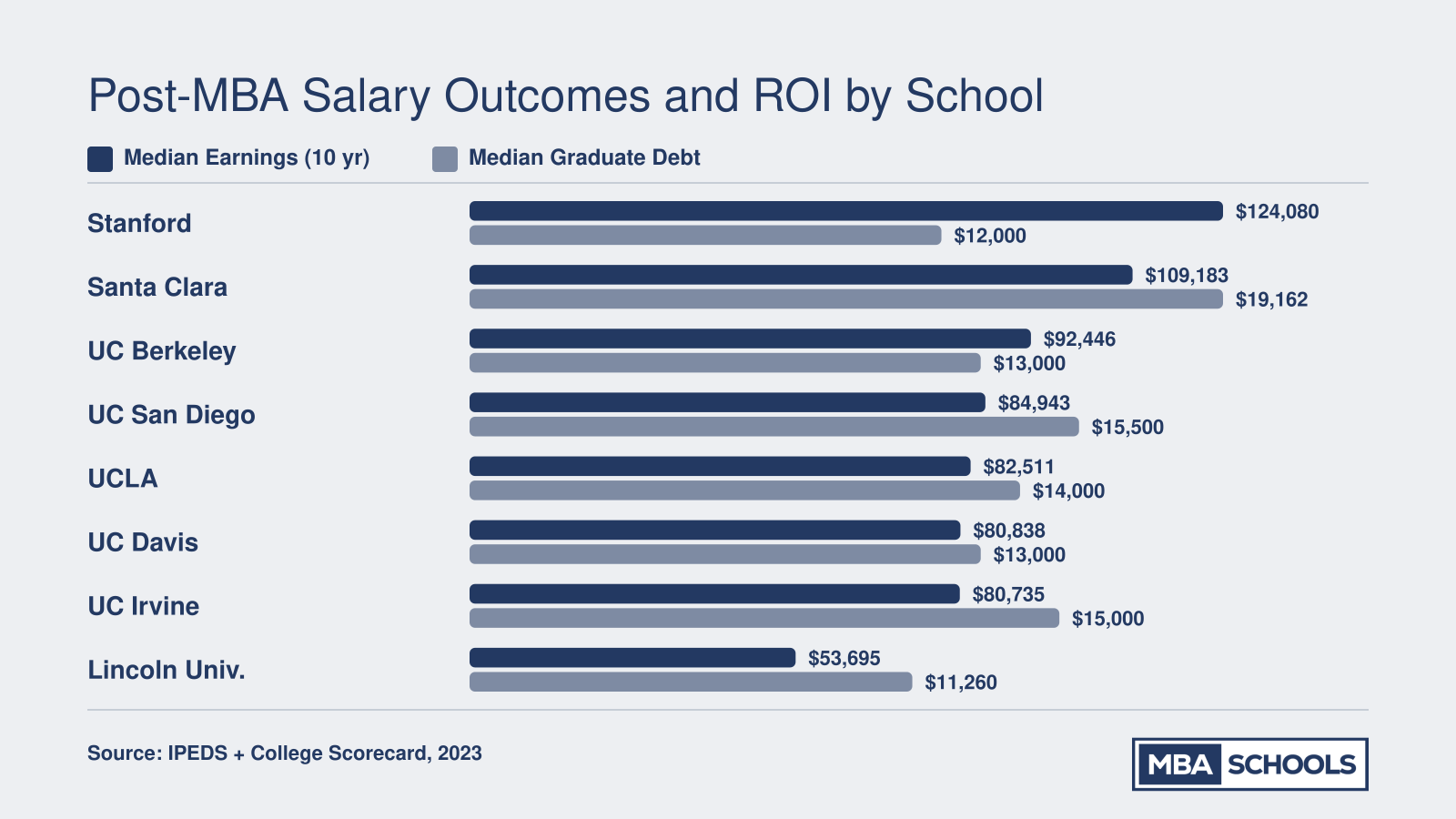
Post-MBA Salary Outcomes and ROI by School
When evaluating MBA programs, raw earnings tell only part of the story. The real question is how quickly your post-graduation salary outpaces the debt you took on. Program-level earnings at one and four years post-completion are not yet available for these schools, so we use institution-wide median earnings at ten years alongside median graduate debt to illustrate relative return on investment. Notably, the highest-ROI program in this group is not the most expensive or most prestigious: Lincoln University in Oakland delivers strong earnings relative to its low cost, proving that strategic program selection matters more than brand prestige alone.
Most Affordable Accredited MBA Programs in the Bay Area
You do not need to spend six figures to earn a respected MBA in the San Francisco Bay Area. Several public universities in the region offer AACSB-accredited programs at a fraction of what private institutions charge, making them compelling options for cost-conscious professionals who still want a rigorous, career-boosting credential.
Why AACSB Accreditation Matters at Every Price Point
AACSB International accredits fewer than 6% of business schools worldwide, and the designation signals that a program meets the highest standards for curriculum, faculty qualifications, and continuous improvement. Among the most affordable Bay Area options, San Francisco State University, San Jose State University, and California State University, East Bay all hold AACSB accreditation for their business programs.1 Employers in tech, finance, and consulting routinely recognize this mark of quality, so choosing a lower-cost AACSB school does not mean sacrificing credibility on your resume.
The Lowest-Cost Bay Area MBA Programs
California's public university system gives in-state residents a significant tuition advantage. Here are the programs that consistently rank among the most affordable accredited options in the region:
- San Francisco State University (SFSU): SFSU's Lam Family College of Business offers a full-time and part-time MBA with in-state tuition that typically falls well under $20,000 for the full program. The school holds AACSB accreditation and is located in the heart of San Francisco, providing direct access to city employers.
- San Jose State University (SJSU): The Lucas College and Graduate School of Business sits at the doorstep of Silicon Valley. In-state MBA tuition is comparably low among CSU campuses, and the school's AACSB-accredited program offers concentrations in areas like quantitative finance and marketing.
- California State University, East Bay: Cal State East Bay's College of Business and Economics is AACSB accredited and serves the broader East Bay corridor.1 In-state tuition here is among the lowest of any accredited MBA in the region, making it a strong value play for students in Hayward, Fremont, and surrounding communities.
Across these CSU campuses, annual in-state graduate tuition generally ranges from roughly $8,000 to $11,000, though actual out-of-pocket costs depend on unit loads, campus fees, and financial aid.
A Note on Net Price Figures
When comparing costs, you may encounter institution-wide average net price figures that reflect what undergraduates pay after financial aid across all programs. These averages are useful for a general sense of affordability but should not be treated as an exact MBA price tag. Graduate tuition structures, fee schedules, and aid eligibility differ from undergraduate programs. For the most accurate estimate, contact each school's financial aid office directly and ask about assistantships, graduate scholarships, and employer tuition reimbursement policies that may further reduce your costs. If you are weighing affordability beyond the Bay Area, our breakdown of online mba cost can help you benchmark prices nationally.
What Is the Cheapest Accredited MBA in the Bay Area?
Based on published in-state tuition rates, California State University, East Bay and San Francisco State University consistently emerge as the lowest-cost AACSB-accredited MBA options in the San Francisco Bay Area. Total program costs for in-state students at these schools can come in under $20,000, a stark contrast to the $150,000-plus sticker price at elite private programs like Stanford GSB. If affordability is your primary concern and you hold California residency, these CSU programs deserve serious consideration. Knowing how to choose the right MBA program for your career goals goes beyond sticker price, but these schools pair recognized accreditation with proximity to the Bay Area's unmatched professional ecosystem, giving you a credible degree without the burden of heavy student debt.
According to the 2024 GMAC Corporate Recruiters Survey, MBA graduates command a median starting salary of $120,000 nationally. In major tech hubs like the San Francisco Bay Area, starting compensation often runs significantly higher, thanks to intense demand from employers in technology, venture capital, and startups competing for top talent.
Online and Hybrid MBA Options in the San Francisco Bay Area
Yes, there are accredited online and hybrid MBA programs in the San Francisco Bay Area, and they are increasingly popular among working professionals who need flexibility without sacrificing proximity to the region's tech and venture capital ecosystem. The format you choose should reflect your career stage, learning style, and how much in-person interaction you value.
Understanding the Format Differences
Not every flexible MBA works the same way. The three main delivery models each serve a distinct learner profile.
- Asynchronous online: Coursework is delivered entirely through a digital platform with no fixed class times. This format suits remote learners, frequent travelers, or professionals with unpredictable schedules. California State University, Stanislaus offers a fully online MBA (AACSB-accredited) that can be completed in as little as 18 months, with concentrations including Finance.
- Hybrid with weekend residencies: Students complete most coursework online but attend periodic in-person sessions, often on weekends. San Francisco State University's MBA for Executives follows this model with a 13-month timeline and twice-monthly weekend classes in downtown San Francisco. Santa Clara University's Leavey School of Business runs an 18-month hybrid Executive MBA designed for professionals with 10 or more years of experience, including international immersion trips.
- Evening and cohort-based formats: Several Bay Area programs structure their MBA around evening or weekend cohorts, letting students maintain full-time employment. These are ideal for career advancers who want regular face-to-face engagement with classmates and faculty.
Bay Area Hybrid Programs at a Glance
Lincoln University in Oakland offers a hybrid MBA with a Management Information Systems concentration at an estimated total cost of roughly $23,600, one of the most affordable options in the region. Sonoma State University's hybrid Executive MBA in Wine Business targets a niche industry with an 18-month timeline and no GMAT requirement. University of the Pacific runs a hybrid MBA with San Francisco residencies and an AACSB-accredited Leadership concentration.
Tuition and Outcomes: Online vs. Campus
Flexible formats often come at a lower total cost than traditional full-time programs. Cal State Stanislaus charges under $10,000 per year for in-state students, while Lincoln University's hybrid MBA totals around $23,600. By comparison, full-time campus programs at Stanford GSB or UC Berkeley Haas carry annual tuition well above $60,000.
Program-level earnings data for most online and hybrid MBA offerings in the Bay Area are not yet available through federal reporting. That said, the practical advantage of hybrid formats is that students can apply classroom concepts in real time at their current employer, often earning promotions or transitioning roles before they even graduate.
Who Should Consider an Online or Hybrid MBA?
If you are a mid-career professional unable to step away from a full-time role, a hybrid Executive MBA at San Francisco State or Santa Clara offers structured flexibility with meaningful in-person networking. If geography is a constraint and you want an accredited California program you can complete from anywhere, the Cal State Stanislaus online MBA delivers AACSB-level rigor at a fraction of the cost of private alternatives. Before committing, it is worth weighing whether an MBA vs. master's degree better aligns with your long-term goals. Career switchers, on the other hand, may benefit more from the immersive recruiting pipelines and cohort culture that full-time campus programs provide.
The Silicon Valley Advantage: Bay Area MBA Career Networks
No other MBA market in the world puts you this close to the engine room of the global technology economy. The San Francisco Bay Area concentrates tech giants like Google, Apple, Meta, and Salesforce alongside elite venture capital firms such as Sequoia Capital, Andreessen Horowitz, and Kleiner Perkins, all within a short drive of campus. That proximity translates directly into recruiting pipelines, mentorship networks, and post-graduation career outcomes that are difficult to replicate anywhere else.
Where Stanford GSB and Haas Graduates Land
Stanford GSB's most recent employment data makes the Silicon Valley advantage tangible. Roughly 35% of the Class of 2025 entered technology roles, while 33% went into finance and 11% into consulting. Another 16% launched or joined startups, and a third of those entrepreneurs chose the tech sector specifically.1 The median starting salary reached approximately $185,000 to $190,000, with a $30,000 median signing bonus for the 51% of graduates who received one. Ninety percent of graduates held job offers within three months of commencement, and 81% had accepted a position.1
UC Berkeley Haas draws from a similar ecosystem. Its location in the East Bay gives students direct access to San Francisco's fintech corridor, Oakland's growing startup scene, and the South Bay's corporate campuses. Haas is well known for placing graduates into product management roles, strategy positions, and operations roles at major tech firms, while its entrepreneurship emphasis connects students to the UC Berkeley Startup Accelerator and a deep bench of Bay Area investors. For a closer look at how these two programs compare, see our Stanford vs Berkeley Haas MBA analysis.
Do Smaller Bay Area Programs Benefit from the Network?
This is one of the most common questions prospective students ask, and the honest answer is nuanced. Santa Clara University's Leavey School of Business, located in the heart of Silicon Valley, markets its Executive MBA as the top-ranked program in the region for seasoned professionals. Its 18-month hybrid format attracts students with an average of 17 years of work experience, many of whom already hold positions at local tech companies and bring their employer networks into the classroom.
Programs at the University of San Francisco and San Jose State University also tap into the regional economy, though their recruiting pipelines tend to be more regional than global. Graduates from these schools often find roles at mid-size Bay Area firms, high-growth startups, and corporate offices of larger companies that maintain a local presence. The network effect is real, but it scales with the program's brand recognition and alumni base.
Key factors that determine how much Silicon Valley access you actually get include:
- On-campus recruiting events: Elite programs host dedicated tech and VC career fairs; smaller schools may rely more on general career services.
- Alumni density: Stanford and Haas alumni hold senior positions across nearly every major Bay Area employer, creating warm introductions that are hard to match.
- Experiential learning: Programs offering consulting projects, startup incubators, or venture capital fellowships give students direct touchpoints with the ecosystem.
- Location specifics: Schools physically situated in San Jose, Santa Clara, or San Francisco place students closer to employer headquarters, reducing barriers to networking and internships.
The Bottom Line for Career-Focused Applicants
Program-level employment outcome data for many Bay Area MBA programs is not yet available at a granular level, making school-published employment reports the best source for comparing placement rates and industry breakdowns. What is clear across the board is that earning an MBA in the San Francisco Bay Area gives you a geographic advantage that compounds over time. The region's concentration of capital, talent, and innovation creates a feedback loop: companies recruit where top talent clusters, and top talent clusters where the best companies hire. Whether you attend a globally ranked program or a strong regional school, being embedded in this ecosystem during your MBA years opens doors that distance learning or programs in other metros simply cannot.
Frequently Asked Questions About SF Bay Area MBA Programs
Choosing the right MBA program in the San Francisco Bay Area means weighing cost, format, career outcomes, and fit. Below, we answer the most common questions prospective students ask when evaluating Bay Area programs. For deeper analysis, follow the references to the relevant sections of this guide.
More Bay Area MBA Programs to Consider
Beyond the top-ranked programs, the California MBA landscape offers a wealth of other options across the state. From flexible online programs to specialized executive MBAs, these schools cater to a variety of career goals and lifestyles. Explore the listings below to find a program that fits your needs.