
What you’ll learn in this article…
- In 2025-2026, one firm's clients got 245 M7 offers; 74 individuals (33%) landed H/S/W admits.
- Always ask consultants to clarify whether success rates track total offers or unique admitted clients.
- Avoid consultants who guarantee admission, lack transparency, or use high-pressure sales tactics.
Top MBA programs admit just 5 to 12 percent of applicants, so the choice of an admissions consultant is one of the highest-leverage decisions you will make. In 2025-2026, Admissions Gateway reported that 33 percent of its clients gained admission to Harvard, Stanford, or Wharton, a figure that underscores how dramatically consultant effectiveness can differ.
Discerning which consultant can deliver that edge requires evaluating success-rate claims, cost structures, and red flags, and matching the advisory model to your applicant profile and round. Understanding how to choose an MBA admissions consultant that reports individual admits, not total offers, remains the most reliable signal of a consultant who can truly shift your odds.
Why MBA Applicants Hire Admissions Consultants
The decision to work with an MBA admissions consultant is rarely about outsourcing effort. For most applicants, it reflects a strategic choice to gain an edge in an increasingly competitive and nuanced process. The best consultants function as narrative coaches, school selection strategists, interview coaches, and project managers, all rolled into one. They do not simply polish essays; they help candidates unearth the stories that matter, build cohesive applications, and navigate the psychological demands of applying to multiple elite programs.
The Rise of Holistic Admissions and the Power of Storytelling
Elite business schools have embraced holistic review processes that reward what one admissions firm founder calls 'distance traveled': the idea that life trajectory and personal growth now rival traditional markers of prestige. As schools increasingly seek candidates who bring diverse perspectives and resilience, the ability to craft a compelling narrative has become essential. Understanding what MBA admissions committees look for helps explain why this shift makes professional guidance more valuable than ever. A skilled consultant helps applicants connect the dots between past experiences, present motivations, and future goals, transforming a list of accomplishments into a coherent and memorable candidacy.
Who Gains the Most from an Admissions Consultant?
Not every applicant needs a consultant. Those who benefit most typically fall into three categories. Career switchers often struggle to articulate why their nontraditional path positions them for a pivot; a consultant can bridge that gap. Non-traditional backgrounds, including candidates from underrepresented industries, geographies, or academic disciplines, benefit from help translating unique strengths into the language of business school admissions. Reapplicants, too, find immense value in identifying prior weaknesses and repositioning their stories. On the other hand, candidates with legacy ties or insider access (such as alumni children or internal admits from feeder programs) may already receive institutional guidance that makes external consulting less critical. For most working professionals, however, the complexity of the process and the stakes involved justify a second set of expert eyes. Exploring MBA admissions consulting by applicant type can help you quickly identify where your profile fits and what kind of support is most likely to move the needle.
Are MBA Admissions Consultants Worth the Investment?
The question of worth hinges on three factors: profile complexity, school selectivity, and personal bandwidth. An applicant targeting Harvard, Stanford, or Wharton faces odds that demand every advantage, and the right consultant can meaningfully improve execution. Those aiming for less selective programs with straightforward career paths may achieve strong results independently. Budget is also a real consideration; MBA admissions consulting costs can range from a few thousand dollars for hourly coaching to over $10,000 for comprehensive support. Yet when viewed against the long-term earnings premium of a top MBA, many applicants conclude that professional guidance pays for itself, especially when it shortens the reapplicant cycle and improves scholarship outcomes.
What MBA Admissions Consultant Success Rates Really Mean
What do MBA admissions consultant success rates actually measure, and how can you be sure the numbers reflect genuine client outcomes?
A critical distinction: total offers vs. individuals admitted
Almost every consultant markets "acceptance rates", but the metric that matters is rarely the one they lead with. A single client may receive multiple offers from M7 schools. When a firm counts every offer , including waitlist conversions and multiple admits per person , the figure inflates dramatically. Admissions Gateway, one of the few firms that reports both metrics, received 245 total M7 offers in the 2025-2026 cycle. Yet the more honest number is 136 unique individuals admitted to at least one M7 school out of 221 clients. That means roughly 62% of their client base earned a spot at an M7, a far more grounded statistic than the raw offer tally. Always ask: "How many individual clients were admitted to my target schools, not how many offers were extended?" This distinction separates transparent firms from those padding results.
Admissions Gateway 2025-2026: a case study in transparent reporting
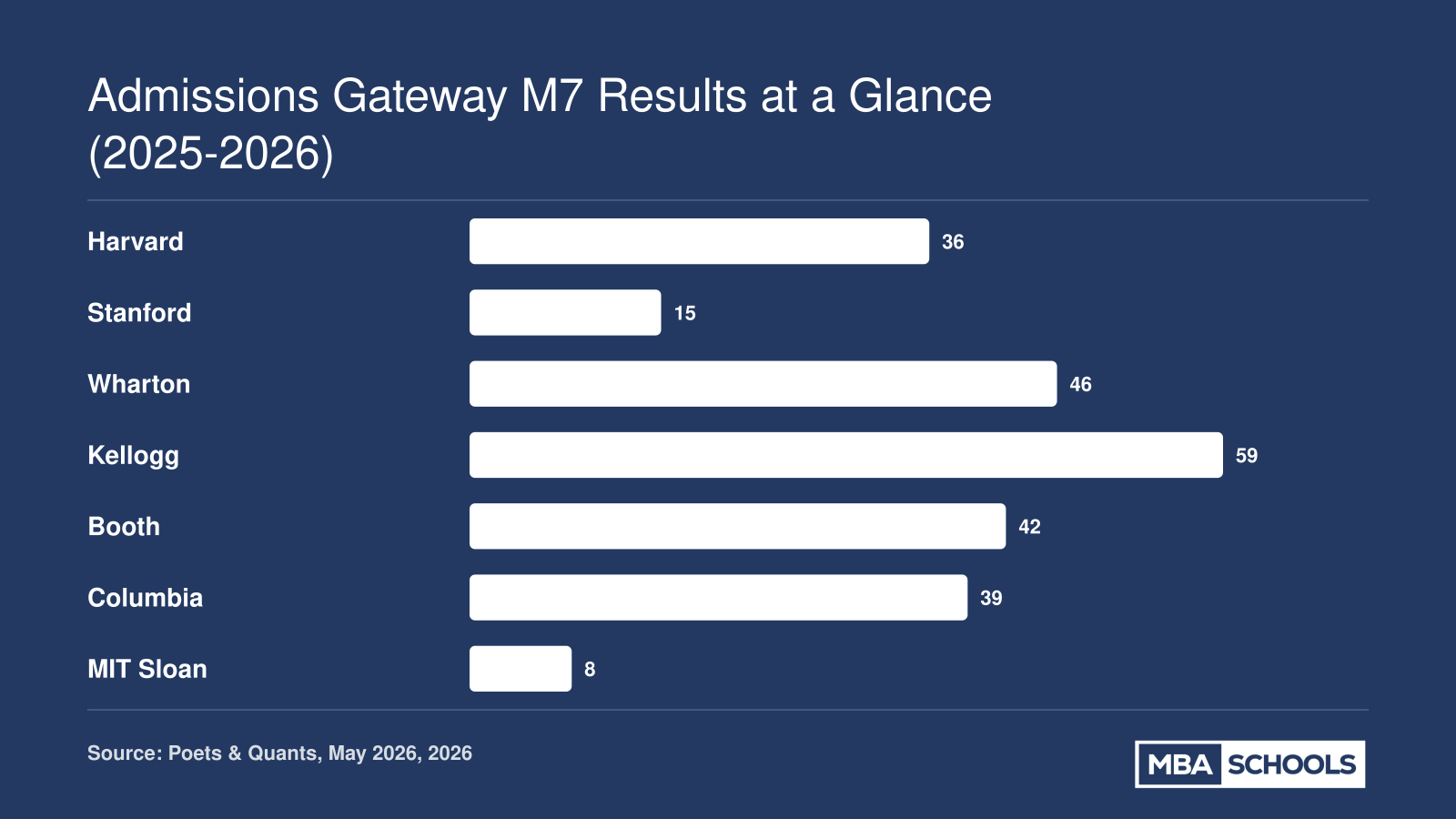
A May 2026 report from Poets and Quants provides a rare, detailed look at one firm's outcomes that applicants can use as a benchmark. Among Admissions Gateway's 221 clients, 74 , or one in three , gained admission to Harvard, Stanford, or Wharton (HSW). The school-by-school breakdown: Harvard (36), Stanford (15), Wharton (46), Kellogg (59), Booth (42), Columbia (39), MIT Sloan (8). Overall, 206 of 221 were admitted to at least one elite business school, a definition that extends beyond the M7. This level of granularity is precisely what you want when evaluating a consultant. If a firm cannot or will not break down admissions by school and individual, treat it as a red flag , one worth adding to your list alongside the MBA admissions consultant red flags that most applicants already know to watch for.
Year-over-year trends reveal firm maturity
A single cycle's results can be luck; sustained growth signals a consultant that consistently improves. Admissions Gateway's M7 offer trajectory from 2023 to 2026 , 156, 191, 226, and 245 , shows a steady upward climb, not a one-year anomaly. Similarly, the number of clients earning at least one M7 admit has grown in parallel. When comparing firms, ask for three to five years of data, not just the most recent cycle. This trend matters because it reflects deepening admissions expertise, stronger client selection, and increasingly effective strategies, not a sudden windfall of highly qualified applicants.
How to verify claims beyond the marketing numbers
You can pressure-test any consultant's success rate with three pointed questions. First, get the number of unique individuals admitted, as discussed. Second, ask whether waitlist conversions are included in the admit count, because a consultant who inflates figures with waitlist activity is misrepresenting the direct admit rate. Third, request interview-to-admit conversion data. Admissions Gateway reported that 134 clients interviewed at HSW, with 74 ultimately admitted, a conversion rate of roughly 55%. This metric tells you not just whether a consultant gets applicants in the door, but whether their MBA interview tips and preparation actually closes the deal. If a firm won't share these figures or deflects with vague percentages, their top-line success rate is likely misleading. Demanding this level of transparency is not just reasonable , it is your right as a prospective client.
Admissions Gateway M7 Results at a Glance (2025-2026)
In 2025-2026, Admissions Gateway worked with 221 clients, securing 245 total M7 offers. The breakdown of admits by school shows strong representation across all M7 programs.
Questions to Ask Yourself
Key Questions to Ask Before Hiring a Consultant
Investing in an MBA admissions consultant can give your candidacy a sharp edge or quietly undermine it. The difference often comes down to the questions you ask long before you sign a contract. Seasoned applicants know that a consultant's website and testimonial page tell only a fraction of the story. The real assessment happens during a candid conversation where you probe for transparency, fit, and ethical guardrails. Below are the high-signal questions organized into three buckets, each designed to surface the information that honest consultants readily share and less scrupulous ones dodge.
Credentials and Track Record
- Individual admits, not total offers: "Last cycle, how many individual clients gained admission to my target school, not how many total offers were received?" Aggregated offer counts can inflate results when one candidate gets multiple acceptances.
- Interview-to-admit conversion: "What is your clients' interview-to-admit conversion rate at M7 schools?" A strong rate signals effective MBA interview prep skills, not just application polish.
- Client references with similar profiles: "Can I speak with a past client whose background, goals, or demographic profile is similar to mine?" References reveal how the consultant navigated challenges parallel to yours.
- Repeat engagement and referrals: "What share of your clients return for additional services or refer others?" Loyalty data is a quieter, more honest metric than any star rating.
Process and Communication
- Consultant capacity: "How many clients do you take per round, and who actually reviews my essays, you or a junior staff member?" Some firms sell a named partner's brand but delegate day-to-day work to less experienced editors.
- Revision workflow: "Walk me through a typical essay revision. How many feedback rounds do you offer, what does a marked-up draft look like, and what's your usual turnaround?" This reveals whether the process is truly iterative or just a light polish.
- Crisis support: "How do you handle a panic moment, like a last-minute essay rewrite two days before a deadline?" Availability in real pressure tests matters as much as the planned timeline.
- Transparency artifacts: "Can you share an anonymized before-and-after editing sample from a past client?" Seeing a concrete edit, not a curated excerpt, grounds the consultant's promises in reality.
Ethics and Boundaries
- Authorship policy: "Do you ever write essay content for clients, or do you strictly coach them to produce their own work?" The line between editing and ghostwriting is the ethical core of admissions consulting.
- Honest school list feedback: "Will you tell me if my target school list is unrealistic, even if it means a smaller engagement?" A consultant who simply validates a flawed list is selling flattery, not strategy.
- Withdrawal counsel: "Have you ever advised a client to withdraw an application due to ethical concerns or a fundamental misalignment with a school's values?" This question tests whether the consultant puts integrity above contract value.
Evasive or vague answers to any of these inquiries are themselves a red flag. For a fuller catalog of warning signs, the MBA admissions consultant contract red flags resource covers the patterns most likely to cost you an acceptance. The best consultants welcome such scrutiny because it signals a serious, discerning client. If a conversation feels more like a sales pitch than a diagnostic dialogue, trust that instinct and keep interviewing until you find a partner with the expertise and candor your candidacy deserves.
Boutique Vs. Large Firms: Which Model Fits Your Needs?
The central tension in choosing an admissions consultant is between the high-touch, personalized attention of a boutique firm and the structured resources of a large organization. Each model excels in different areas, and your best fit depends on your budget, profile, and desired level of access.
Consultant Access and Continuity
Boutique firms, typically founder-led operations with one to three senior consultants, offer direct unfiltered access to the person shaping your story. You build a relationship with one expert who sees your application through from start to finish. Large firms with 20-plus consultants often use a team-based approach. A senior consultant may design the strategy while a junior consultant handles day-to-day edits and scheduling. This division can create consistency gaps: when your primary contact changes mid-process or you rarely interact with the strategist who defined your narrative, the result can feel disjointed.
Client Volume and Personalization
A boutique advisor's caseload is intentionally small, often fewer than 15 clients per round, which allows for deep customization of essays, recommender coaching, and interview preparation. This intensity is hard to replicate at scale. Large firms serve hundreds of applicants each year; even with rigorous project management, a consultant may juggle 30 or more clients simultaneously. Standardized playbooks and templated feedback become necessary, potentially diluting the distinctiveness of each application.
Success Rate Transparency
Transparency varies more by firm philosophy than size, but boutique firms often publish granular results, such as Admissions Gateway's detailed 2025-2026 report showing 33% of clients admitted to Harvard, Stanford, or Wharton. Large firms may report aggregate placement percentages or total offers, which can obscure whether a small group of applicants accounts for multiple admits. Data from the MBA admissions consultant reviews compiled in 2026 reveals a telling pattern: founder-led firms like Stacy Blackman Consulting (154 reviews, 98% five-star)1, Admissionado (47 reviews, 91% five-star)1, and Aringo (81 reviews, 91% five-star)1 maintain notably higher client satisfaction scores than PE-owned brands such as MBA Mission (103 reviews, 71% five-star)1, Accepted (73 reviews, 63% five-star)1, and Stratus Admissions (24 reviews, 63% five-star)1. While causation cannot be assumed, the correlation suggests that the boutique model, with its direct accountability and lower volume, tends to produce more satisfied clients.
Price and Flexibility
Boutique services often command a premium per hour but offer bespoke engagements: you may pay only for the specific components you need, such as a single-school package or interview prep. Large firms provide tiered, all-inclusive packages with clear scope scales. This predictability helps with budgeting, but you may end up paying for services you barely use. Flexibility can be a deciding factor for MBA admissions consulting for reapplicants or those targeting just one dream school.
Specialization Depth
Many boutique consultants specialize in particular school clusters, industries, or applicant profiles, for example, MBA admissions consulting for military veterans or candidates from overrepresented backgrounds. This depth can yield sharper positioning insights. Large firms cover the entire MBA landscape and can match you with a consultant who has relevant experience, but that match depends on the firm's roster and availability. If your profile requires niche expertise, verifying a firm's specialization before committing is essential.
The AI-Assisted Third Path
An emerging option for budget-conscious applicants is the AI-assisted platform, exemplified by ApplicantLab. These tools provide self-guided modules and algorithmic feedback at a fraction of the cost of human consultants. They work best for self-motivated applicants with straightforward profiles who need structural guidance rather than intensive narrative development. While they lack the personal advocacy of a consultant, they represent a viable middle ground between going it alone and a full-service engagement.
How Much Do MBA Admissions Consultants Cost?
What's the actual cost of hiring an MBA admissions consultant, and what do you get at each price point?
Current Pricing Tiers
The market for MBA admissions consulting spans a wide range, from targeted hourly help to premium, multi-school packages. Most firms organize their pricing into four broad tiers:
- Hourly rates: $150 to $500+ per hour. Fortuna Admissions charges $415 per hour for an expert coach and $495 for a senior coach, with a minimum three-hour booking.1 Other firms like Vantage Point MBA offer hourly packages of 6 to 12 hours.2
- Per-school packages: $1,500 to $6,000 for a single application, typically covering strategy, essay editing, and a defined number of reviews. Fortuna's comprehensive package starts at $5,900 for one school, scaling to $13,000 for five schools.3 Premium tiers at Fortuna, with higher-touch service, begin at $6,900 for one school and reach $15,200 for five.3
- Comprehensive packages: $5,000 to $15,000+ for end-to-end guidance on multiple schools. These often bundle interview prep, resume editing, and unlimited essay iterations. Some firms offer all-inclusive support for 2-3 schools in this range.
- Premium/unlimited packages: $10,000 to $25,000+. These cater to applicants targeting several top-tier programs, providing a dedicated coach, priority scheduling, and deep strategic planning. Highly specialized unlimited plans can exceed $25,000.
What Drives the Price Differences?
Several factors separate a $2,000 package from a $15,000 engagement:
- Consultant pedigree: Coaches who are former M7 admissions officers or have a record of high placement success command premium rates. A senior expert with a verified track record may charge double that of a less experienced consultant.
- Number of schools: Per-school cost often decreases when bundling multiple applications, but the total investment rises. A three-school package may cost 50% more than a single-school plan, not triple.
- Round of application: Some firms charge higher fees for rushed timelines, such as Round 3 or Round 2 with a compressed deadline.
- Bundled services: Comprehensive packages that include interview coaching, waitlist strategy, or ding analysis cost more. Fortuna charges $1,450 for a standalone waitlist strategy and $790 to $1,800 for a ding analysis.3
Cost Versus Value: The Return on Investment
When judging the price tag, measure it against the total cost of an MBA, which can run $150,000 to $250,000 in tuition and forgone income. The salary premium from attending an M7 school versus a T25 program often exceeds $30,000 annually. A $10,000 consulting investment that helps you land a spot at a higher-tier school can pay for itself in the first year of post-MBA compensation. Additionally, strong applications typically yield larger scholarships; a consultant who helps you negotiate a $20,000 scholarship more than offsets their fee. MBA admissions consulting for finance professionals offers a useful breakdown of how that calculus plays out for one of the most competitive applicant pools.
Partial and Targeted Packages
Not every applicant needs end-to-end handholding. Many firms offer a la carte services for those who need a boost in specific areas:
- Essay-only or resume reviews: Hourly coaching or fixed-price packages for polishing written materials.
- Interview prep bundles: Standalone mock interviews with feedback, often 2-4 sessions.
- Application strategy sessions: A one-time strategic roadmap, such as Fortuna's $1,580 Application Strategy package, provides a blueprint without full editing.3
- Hourly consulting: Book 3-10 hours to troubleshoot weaknesses, with discounts for multi-hour bundles. Fortuna offers a 5% discount on 10-hour blocks.1
Decide what level of support matches your candidacy gaps. A strong applicant may only need a final review, while career switchers pursuing an MBA might benefit from comprehensive guidance.
Comparing Consultant Packages and Services
MBA admissions consultant packages vary widely, but understanding the standard inclusions at each price tier helps you match investment to expected support. Most firms structure their offerings around three core tiers, with AI-powered platforms carving a fourth path for budget-conscious applicants.
What's Included at Each Tier
- Basic / Hourly: Essay proofreading, limited resume feedback, and a set number of editing rounds. Best for candidates who already have a clear narrative and school list.
- Standard / Mid-Tier: School selection strategy, resume review, two to three essay iterations, interview coaching, and access to a library of mock interview videos. This tier suits applicants targeting a balanced list of reach and realistic schools.
- Comprehensive / Premium: End-to-end support from profile discovery to post-submission waitlist strategy. Includes unlimited essay edits, multiple interview prep sessions, recommender guidance, and often scholarship negotiation. Premium packages may also bundle GMAT/GRE strategy and formal onboarding calls with former admissions officers.
Service bundles among established firms like Stacy Blackman Consulting, Fortuna Admissions, and Admissions Gateway generally follow this progression, though exact labels and price points differ.
Standard vs. Add-on Services
Not every listed feature comes baked into the base price. Services that require intensive one-on-one time are frequently priced as add-ons:
- Scholarship negotiation: Often a separate module, especially if it involves drafting formal letters or back-and-forth with schools.
- Reapplicant strategy: Some firms charge an incremental fee to review prior applications, diagnose weaknesses, and reframe the narrative.
- Ding analysis or ding reconsideration: A handful of consultants offer a single-session deep dive into rejection reasons for a flat fee.
- Crisis management: For time-sensitive issues like a technical glitch in submission or a late-breaking update, rush review fees may apply.
When comparing packages, ask explicitly which services are standard for the price quoted. A low baseline fee can inflate quickly once essential add-ons are tallied. Reviewing mba admissions consultant cost benchmarks before your first consultation gives you a sharper sense of where the market actually sits.
AI-Assisted Platforms: A Low-Cost Alternative
Platforms like ApplicantLab and Leland have carved a distinct niche by offering self-paced, software-driven admissions guidance at a fraction of full-service pricing. ApplicantLab, for example, charges between $300 and $500 for lifetime access to modules covering school selection, mba essay structure and narrative strategy, resume templates, and interview prep, all driven by prompts and examples rather than live coach calls. Leland adds features like on-demand feedback sessions and cohort-based support, still keeping total cost well under four figures.
These tools are not a substitute for human judgment on delicate narrative choices, but they excel at providing structured frameworks for candidates who need direction without the heavy price tag. Reported user satisfaction tends to be highest among applicants who are clear on their goals and primarily need tactical execution help.
Outcome data for AI-assisted platforms is sparse. While institutional AI tools report efficiency gains of up to 80% in administrative settings1, individual applicant success rates have not been independently tracked in the same way traditional firms report them. Candidates weighing this route should treat it as a guided DIY option rather than a full-service commitment.
Related Articles
Red Flags and Warning Signs to Avoid
In 2025-2026, a single admissions consulting firm transparently reported 74 out of 221 applicants gained admission to Harvard, Stanford, or Wharton, a 33% success rate published without caveats in Poets & Quants. That level of clarity is rare, and its absence is one of the earliest signs you are talking to the wrong consultant.
Guarantees and Inflated Claims
- Red flag: A consultant guarantees admission to a specific school or promises a money-back offer without realistic conditions. No legitimate advisor can control admissions decisions.
- Green flag: They share historical admit data for individual clients (not total offers) and set honest expectations about your target schools.
Watch for success rates that count "total offers" rather than unique admits. A single candidate holding three M7 offers can triple the firm's reported number. Ask directly: "Of your clients last year, how many individuals gained admission to my target schools?"
Transparency on Results
- Red flag: The firm refuses to provide school-specific admit figures, citing "confidentiality" or "client privacy." While individual names cannot be shared, aggregate numbers can and should be disclosed.
- Green flag: They publicly report per-school admit counts, ideally broken down by round or applicant profile, as Admissions Gateway does in partnership with independent media outlets.
If a consultant will not share data that could be verified against their marketing claims, consider it an immediate dealbreaker. The MBA admissions consultant success rate benchmarks in our broader red-flags guide can help you calibrate what credible reporting actually looks like.
Ghostwriting and Questionable Tactics
- Red flag: The consultant offers to write your essays for you or heavily rewrite your drafts until they no longer sound like you. Admissions committees routinely detect ghostwritten materials, and the repercussions include rejected applications or revoked offers.
- Green flag: They edit for clarity and structure while preserving your authentic voice, and they explicitly state they never write content from scratch.
High-Pressure Sales and Operational Sloppiness
- Red flag: You are pushed to sign a contract before a thorough consultation, or the free session rushes through your profile. If response times are slow during the sales process, they will only worsen once you have paid.
- Green flag: The initial conversation is unhurried, explores your unique background, and ends with a clear, written summary of how they would approach your candidacy, before you ever see a contract.
- Red flag: The consultant takes an unlimited number of clients per round. Even the most talented advisor can only manage a finite caseload without diluting attention.
- Green flag: They cap their round-by-round client load and tell you upfront if they are at capacity for your deadline.
Generic Feedback and Cookie-Cutter Advice
- Red flag: Your initial feedback sounds like it could apply to any applicant, with no mention of your specific industry, undergraduate record, or personal narrative.
- Green flag: Within minutes, the consultant identifies distinctive hooks in your background and suggests concrete ways to position them for your target programs.
A trustworthy consultant treats your application as an individual case, not a template to be filled in. Their track record of transparent reporting, not just glossy testimonials, is the single best indicator you have found the right partner. If you want to prepare before your first consultant conversation, reviewing MBA personal statement examples that earned real acceptances can sharpen your instincts for authentic, compelling storytelling.
The best consultants will tell you when your school list is unrealistic: that honesty is worth more than flattery.
How to Assess Consultant Fit by Round and School Tier
How do you assess whether a consultant is the right fit for your specific school targets and timing? The answer lies in matching their expertise to your application round and the tier of schools you're aiming for. With M7 business schools receiving a combined 48,545 applications for the Class of 2026, a 22% spike over the prior year, and admission rates falling to 18.7% from 21.8%, the stakes are higher than ever. A consultant who excels with top-25 programs may not have the nuanced understanding required for Harvard, Stanford, or Wharton. Here is a structured way to evaluate fit.
Aligning Consultant Expertise with Your Target Tier
Start by defining your school list tier. M7 schools demand intimate knowledge of each program's culture and evolving admissions philosophies. For instance, elite schools increasingly reward 'distance traveled' over traditional prestige credentials, a shift you can verify on official admissions blogs from Harvard Business School, Stanford GSB, and Wharton. A consultant worth their salt will reference these primary sources when shaping your narrative. Cross-check their insights against coverage that aggregates expert commentary on M7 trends. Ask a prospective consultant how they interpret the latest class profile data, such as GPA ranges and work experience benchmarks, that schools publish annually. A strong answer will weave in hard numbers from those profiles, not just anecdotes.
Matching Consultant Availability to Your Application Round
Consultant bandwidth is finite, and their attention often declines as the cycle progresses. Round 1 deadlines concentrate the most prepared applicants and consultant energy, but by Round 2 or 3, the same consultant may be managing a heavier client load. Inquire directly about their current client count and how they handle multiple rounds. A trustworthy consultant will honestly tell you if your target round is realistic given your starting point. If you are a Round 3 candidate targeting M7 schools, ensure the consultant has a track record of success in that compressed timeframe. Application volume often surges when job markets tighten, making timing and strategic planning even more critical.
Verifying Consultant Claims with Independent Data
Neutralize marketing hype by triangulating what a consultant tells you with publicly available data. For M7 programs, review each school's most recent class profile for admittee demographics, test score ranges, and industry backgrounds. Harvard alone received 9,000 applications in the 2023-2024 cycle, so a consultant should demonstrate awareness of such scale and selectivity. Checking Wharton MBA admissions data alongside profiles from peer schools can validate a consultant's advice on school selection and positioning. Finally, a consultant who ties your career goals to realistic labor market context shows the kind of strategic depth that separates genuine advisors from generalists.
Tailoring Fit to School-Specific Nuances
A final filter: ask the consultant to differentiate between your target schools. Can they articulate why Stanford GSB's emphasis on personal impact might suit your profile differently than Kellogg's collaborative ethos? A consultant who leans on official school communications and third-party research rather than generic praise signals genuine expertise. This depth matters most when applying across tiers: a consultant strong with M7 may lack insight for T15 safety schools, and vice versa. Align their specific knowledge with your actual list to avoid a mismatch that could weaken your applications.
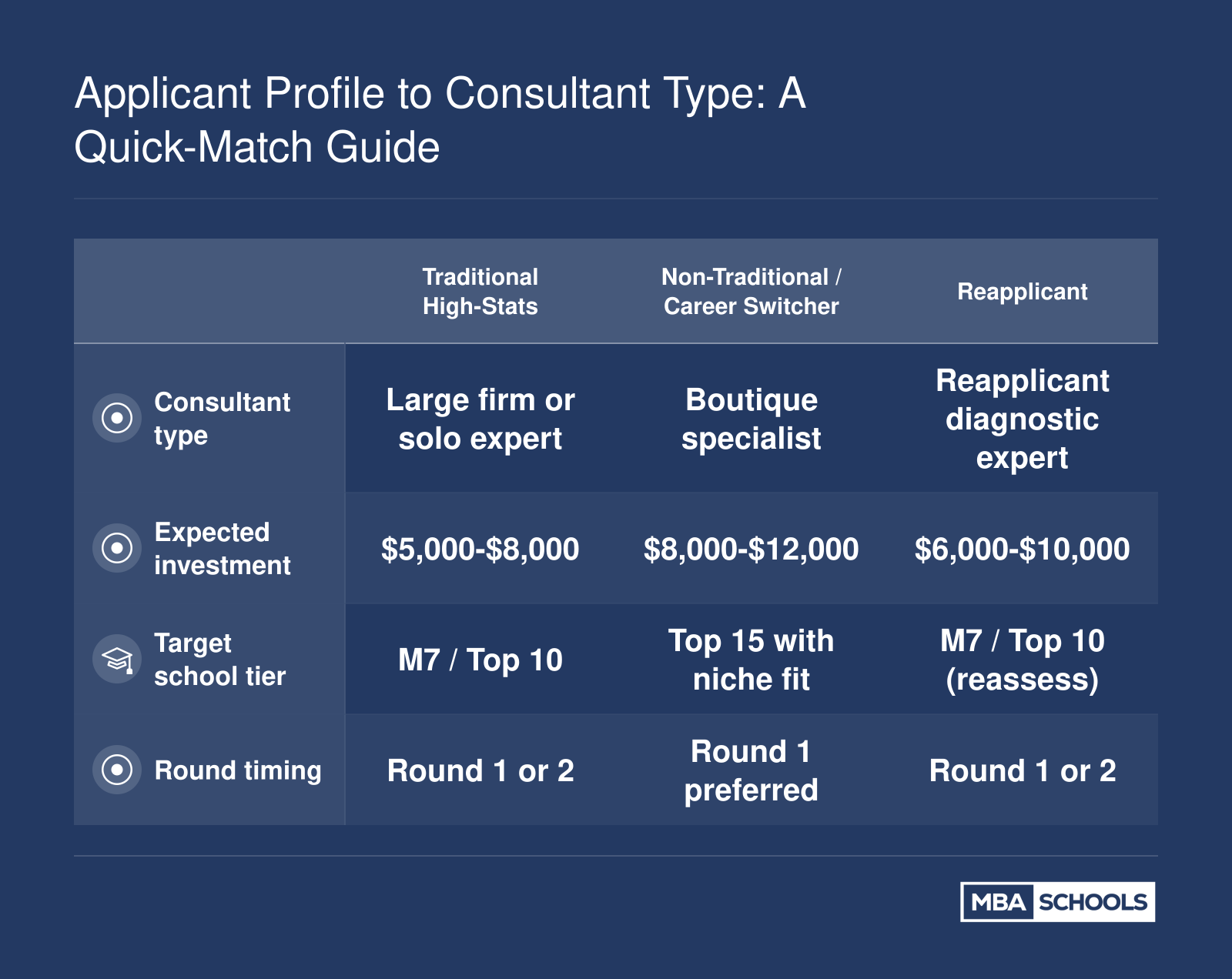
Applicant Profile to Consultant Type: A Quick-Match Guide
The consultant that fits a banker with a 750 GMAT may not serve a career switcher or reapplicant. Use this starting-point match, it illustrates typical pairings, not rigid rules, and adjust based on your story gaps and risk tolerance.
Frequently Asked Questions About MBA Admissions Consultants
Choosing an MBA admissions consultant is a major decision. Before you sign, get clarity on what to expect and how to evaluate claims. These answers address the most common concerns applicants have when selecting a consulting partner.