What you’ll learn in this article…
- Robert Morris University's online MBA embeds AI into nearly every course.
- No coding background is required, and students can finish in one year.
- AACSB accreditation is held by fewer than 6 percent of business schools.
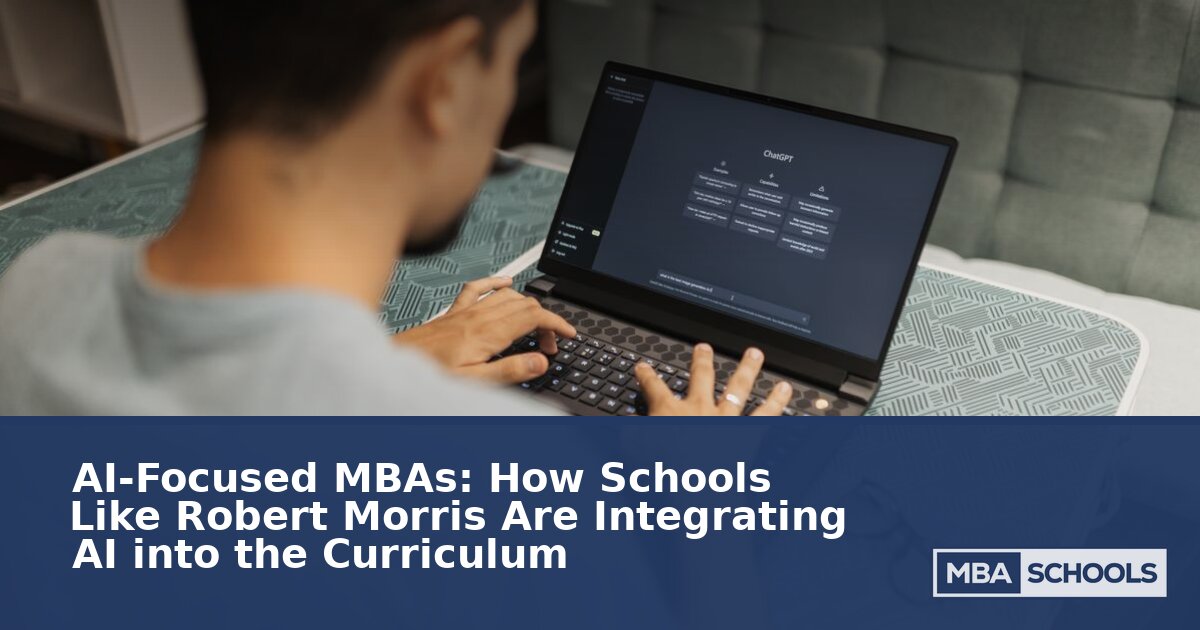
Employers now treat AI fluency as a management qualification, not a technical specialty, and it is central to the MBA soft skills AI curriculum. Robert Morris University's AACSB-accredited online MBA reflects that shift: the 30-credit program embeds AI into nearly every course, from finance and marketing to leadership and capstone work, with no coding prerequisite.
That structural choice raises a sharper question than "Which concentration?" Working professionals must weigh tuition, delivery format, and career signal against a market where schools are scrambling to integrate AI. AI is no longer a differentiating elective; it is becoming the price of admission in the MBA curriculum transformation.
What Is an AI-Focused MBA and How Is It Different?
The business school curriculum is undergoing a structural shift: AI is moving from a standalone topic to a core leadership competency. Robert Morris University's redesigned online MBA is one recent example, embedding AI into nearly every course rather than treating it as an elective.1
A working definition
An AI-focused MBA is a business degree that builds AI literacy and strategic AI decision-making across functional areas, not just in a technology MBA concentration. Students learn to apply AI in finance, marketing, analytics, leadership, innovation, and capstone projects.
How it differs from a general MBA
A general MBA often covers AI as one optional course or specialization. In an AI-focused program, AI is woven through the MBA core curriculum. Students repeatedly ask how AI changes forecasting, pricing, customer segmentation, and resource allocation.
How it differs from a master's in AI or data science
AI MBAs are designed for managers and executives, not engineers. Most require no coding background. The goal is to produce informed, responsible users who can judge the quality of AI outputs, ask the right questions, and lead AI initiatives with confidence. This distinction matters because employers are not asking MBA graduates to build algorithms; they are asking them to govern AI use and turn AI-generated insights into business decisions.
Inside Robert Morris University's AI-Infused Online MBA
Robert Morris University's online MBA in artificial intelligence is not a stand-alone technology concentration. It is a full curriculum redesign housed in the Rockwell School of Business and holds online MBA accreditation from AACSB. That accreditation is held by fewer than 6% of business schools worldwide and signals a rigorous standard for faculty, curriculum, and student outcomes. Dr. Daria Crawley, Dean of the Rockwell School of Business, described the redesign as a direct response to modern organizations' need for leaders who can strategically leverage emerging technologies.
Format and Pace
The program is delivered entirely online in asynchronous eight-week courses and totals 30 credits. Students can complete it in as little as one year, though many working professionals take about two years while balancing full-time jobs. There are no required campus visits, and the flexible pacing supports online MBA work-life balance by allowing students to schedule coursework around client meetings, travel, or family obligations.
What You Learn
AI competency runs through the whole program, including finance, marketing, analytics, leadership, innovation, and the capstone course. The goal is to create informed, responsible users of AI who can judge the quality of AI outputs rather than write code. No prior coding experience is required. Each course asks students to apply AI tools to realistic business decisions, not just study them in the abstract.
Applying for Fall 2026
Applications for the Fall 2026 cohort are open, and prospective students can apply free.1 The admission process is accessible: there is no coding prerequisite, and the program is designed for working professionals who want to build AI fluency without pausing their careers.
Related Articles
What an AI-Focused MBA Costs: Tuition and Fee Benchmarks
Tuition for AI-focused MBAs varies widely by school structure and delivery model. The figures below reflect published per-credit or total program costs for the 2025-2026 and 2026-2027 academic years, where available, and do not always include textbooks, simulations, or other course materials. Total cost will also depend on prior credits, program length, and whether you study part time or accelerate through asynchronous courses.
| Program / School | Estimated Tuition & Fees | Format | Notes |
|---|---|---|---|
| Robert Morris University Online MBA | $1,150 per credit (2025-2026) | Fully online, part-time MBA (general business) | Graduate tuition page specifies per-credit rates but does not list mandatory fees separately for MBA; pricing applies to Summer 2025, Fall 2025, Spring 2026. |
| University of Mount Union Online MBA in Artificial Intelligence | $695 per credit hour for the online MBA (2025-2026) | Online MBA with Artificial Intelligence concentration | Discounts are available; textbooks and other course materials are not included in the per-credit tuition figure. |
| Eastern University MBA with AI Business Strategy Concentration | $9,900 total tuition and fees for the general 30-credit MBA; $13,860 total program cost for the 42-credit MBA with AI Business Strategy concentration (2026-2027) | MBA with AI Business Strategy concentration; core curriculum plus 4 concentration courses (12 credits) | Total program cost figures exclude course materials; adding the AI concentration increases total credits from 30 to 42 unless advanced standing applies. |
| Messiah University MBA in Artificial Intelligence | $656 per credit hour (2026-2027, after 20% discount); original rate $820 per credit hour | Graduate MBA program with Artificial Intelligence concentration | 20% tuition discount applies to Business and Leadership students enrolling in 2026-2027; graduate certificate total cost is listed separately at $5,904. |
| Northeastern University AI MBA | $94,200 estimated total tuition based on 2025-2026 rates; fees and other expenses not included | AI-focused MBA program in graduate business format | Total cost of attendance depends on cost-per-credit pricing; estimated total tuition excludes fees and other expenses. |
| Southern Utah University Online MBA, Business Artificial Intelligence | $521 per credit hour (2026) | Online MBA with Business Artificial Intelligence focus; as few as 12 months | Tuition grid lists per-credit, per-course, and total program tuition; total tuition may be subject to calendar and institutional conditions. |
How Other Business Schools Are Weaving AI Into the MBA
AI offerings vary widely across top MBA programs. Some schools embed AI as an integrated pillar across core business decisions, while others offer concentrated technical tracks. The table below compares current AI-related MBA options by curriculum focus, credit requirements, and delivery format.
| School / Program | AI Curriculum Focus | Credit Requirements | Delivery Format |
|---|---|---|---|
| Wharton (MBA) | AI major requirements include AI-focused pillars covering machine learning, accountable AI and ethics, data science, deep learning, AI and negotiations, AI in digital marketing, and AI, business, and society electives. | 3.0 credit units | Not stated |
| Wharton Executive MBA | New AI major for business centers on skills to understand, work with, and evaluate AI systems. | Not stated | Modular elective courses, including intensive three-to-four-day block and week offerings |
| Chicago Booth (MBA) | Applied AI concentration includes courses such as Artificial Intelligence, Generative Thinking, AI and Financial Information, and Machine Learning in Finance. | 3 courses | Not stated |
| Villanova (Professional MBA) | Future of Work credits include AI/ML for Business, with additional options in data analytics and information technology; the specialization emphasizes practical AI use in business. | 1.5 credits | Online or hybrid |
| Rutgers (Full-Time MBA) | AI concentration includes foundational AI and machine learning plus application courses such as Leading with AI, AI Applications in Marketing, Supply Chain Artificial Intelligence, and AI in Accounting and Auditing. | 3 credits | Not stated |
What AI MBA Graduates Can Do: Roles, Skills, and Salary Ranges
The table maps common AI management roles to their responsibilities, curriculum connections, and published salary ranges. Salary figures are US annual amounts and may include base salary or total compensation. Direct evidence comparing AI-focused MBA salaries to general MBA salaries is limited; the ranges below are the best available benchmarks for AI management paths.
| Role | Key Responsibilities | AI MBA Curriculum Link | Typical Salary Range |
|---|---|---|---|
| AI Product Manager | Develop product strategy and roadmaps; conduct market research, competitive analysis, and user research; use data-driven decision making and analytics interpretation; lead cross-functional teams and stakeholders; manage go-to-market strategy and product launch. | AI-focused MBA coursework in product strategy, data and analytics, experimentation (A/B testing), and AI ethics maps to defining AI product requirements, collaborating with ML teams, and monitoring AI product metrics. | Entry level (1 to 3 years): $100,000 to $140,000; mid level (4 to 7 years): $150,000 to $250,000; senior level (8+ years): $200,000 to $320,000; Director/VP level: $300,000 to $500,000+ |
| Director of Analytics | Provide leadership on machine learning fluency; understand model architectures, training pipelines, and evaluation metrics to support product and business trade-offs; champion data literacy for reading experiment results, defining success metrics, and detecting model performance degradation. | AI-focused MBA curricula in machine learning for managers and data-driven decision making align with director-level analytics responsibilities such as ML fluency, success metric definition, and interpreting experiment results. | N/A |
| AI Governance Manager | Oversee AI governance programs; implement policies and controls for responsible AI use; coordinate compliance with internal standards for AI systems; support risk management and oversight of AI models and data. | AI-focused MBAs often include courses on responsible AI and data ethics, directly supporting responsible AI principles in product design and data use. | $130,000 to $175,000 annually; median around $148,000 |
| Head of AI Governance | Monitor AI product metrics including output quality, user trust, and safety; set evaluation criteria for AI outputs such as accuracy thresholds, safety requirements, and latency budgets; manage user feedback loops focused on trust and safety. | MBA coursework on regulatory environments, compliance management, and ethical AI provides a foundation for head of AI governance responsibilities in regulatory and ethical AI compliance and risk management. | Senior AI leadership roles for AI product and governance commonly reach total compensation of $190,000 to $300,000, aligned with senior AI product manager benchmarks |
Online Vs. On-Campus AI MBAs: Flexibility, Cost, and Tradeoffs
Online AI MBAs are not a single experience. Fully asynchronous formats such as Robert Morris University's redesigned 30-credit MBA offer maximum scheduling flexibility, while hybrid and cohort-based programs such as Indiana Kelley Direct or Washington Foster's hybrid MBA preserve more structured interaction. Both formats are evaluated under the same AACSB accreditation standards, because accreditation attaches to the business school rather than the delivery mode; major online MBA ranking systems, including U.S. News, GMAC, and Princeton Review, generally screen for AACSB accreditation, and Robert Morris University's online MBA ranked ninth among Pennsylvania online MBAs in U.S. News & World Report's 2025 list.
Pros
- Fully online, asynchronous courses such as Robert Morris University's eight-week format let working professionals study without relocating or pausing full-time employment.
- Online AI MBAs often cost less than elite residential programs; total tuition for AACSB-accredited online MBAs ranges from roughly $7,710 to $125,600.
- The University of Illinois iMBA is cohort-based and mostly online, preserving some live interaction for about $27,288 total program tuition.
- Hybrid options like Washington Foster's 21-month MBA combine online coursework with in-person networking and report a post-graduation salary near $151,322.
- Robert Morris University's online MBA ranked ninth in Pennsylvania in U.S. News & World Report's 2025 list, with Fall 2026 applications open and free.
- Some AI-infused programs require no prior coding experience, focusing instead on strategic judgment of AI outputs in finance, marketing, and analytics.
Cons
- Fully asynchronous online programs can reduce spontaneous networking and cohort bonding compared with on-campus and hybrid formats.
- Elite online MBAs are expensive: Penn Wharton's online offering is reported at $230,100 total with a 22-month duration.
- Indiana Kelley Direct's hybrid online MBA is reported around $94,944, above the $11,000 to $40,000 typical range for many regional AACSB online MBAs.
- AACSB accreditation is school level, so applicants must confirm the specific online MBA and campus are included rather than assuming delivery mode is automatically accredited.
- Not all online MBAs are fully asynchronous; some require synchronous sessions, short residencies, or cohort pacing that can complicate travel-heavy jobs.
- Access to on-campus AI labs, incubators, and experiential projects is typically more limited in fully online formats unless the program builds virtual equivalents.
- For Fall 2026, Robert Morris University says applications are open and free, but applicants must verify deadlines, tests, and materials directly with the school.
How to Evaluate an AI MBA Program: A Practical Checklist
Use this checklist to cut through marketing language and compare AI-focused MBA programs on the factors that matter most for your career.
- Verify AACSB accreditationConfirm the business school holds AACSB accreditation, which signals rigorous standards and is held by fewer than 6% of business schools worldwide.
- Assess AI coursework depthLook for required AI or machine learning modules, or AI integrated across core courses, rather than a single elective. The best programs build AI judgment into finance, marketing, analytics, and leadership.
- Check career support and alumni outcomesRequest employment reports, salary benchmarks, and alumni career trajectories to validate that the program's career services and network deliver measurable results.
- Confirm format and flexibilityCompare asynchronous vs. synchronous classes, eight-week terms, part-time pacing options, and realistic time-to-completion for working professionals.
- Calculate total costAdd tuition, fees, and any technology or residency components. Ask about hidden costs like software subscriptions or on-campus intensive weekends.
- Review application logisticsNote Fall 2026 deadlines and whether the application fee can be waived, especially if you are applying to multiple programs.