
What you’ll learn in this article…
- SFBU's $10,000 AI-enhanced MBA challenges the traditional $60,000 price point.
- 74% of employers demand AI skills in management hires.
- General managers earn a median annual salary of $102,950.
On July 17, 2026, San Francisco Bay University launched MBA Pro+, a $10,000 online MBA with AI tutoring and a pay-as-you-go model. The move marks a sharp departure from the $60,000 to $150,000 price tags common at established business schools.
An AI-enhanced MBA embeds artificial intelligence across core business functions, not just as electives. SFBU's program, for example, uses a proprietary AI tutor and a Think-Do-Create framework to align with 45 employer-demanded competencies.
For the 37% of prospective students who tell the Graduate Management Admission Council that affordability is their primary concern, this new breed of programs offers a direct rebuttal to the long-standing assumption that a credible MBA comes with a six-figure debt load.
What Sets AI-Enhanced MBAs Apart
Unlike a conventional MBA that tucks artificial intelligence into a single elective, AI-focused MBA programs weave machine learning, predictive analytics, and automation directly into finance, marketing, operations, and MBA in strategy. These degrees treat AI not as a peripheral tool but as a core business competency every graduate must possess.
Curriculum Designed Around AI, Not Adding It On
Data-driven decision-making threads through accounting, supply chain, customer segmentation, and risk management. At San Francisco Bay University, for instance, students learn to apply AI frameworks across 45 employer-demanded competencies, from interpreting algorithm outputs to designing data-aware strategies. This contrasts sharply with case-method programs where technology stays in the background.
AI-Driven Pedagogy and Skill Building
Another differentiator is the learning model. SFBU’s MBA Pro+ employs a proprietary AI tutor named Bayley that uses a Socratic question-answer approach, coaching students to think critically rather than just consume information. Its “Think → Do → Create” framework guides learners from concept to applied project, building a portfolio of real business challenges, replacing passive case discussion with AI-augmented problem-solving.
Built for Working Professionals
Most AI MBAs are structured as online MBA programs for career-changers and managers balancing full-time jobs. Self-paced, asynchronous coursework and one-on-one mentorship from tech veterans at firms like OpenAI, Google, and IBM ensure immediate workplace relevance.
AI MBA Curriculum Breakdown: 4 Programs Compared
What does an AI-focused MBA actually teach? The specifics vary widely, but the core goal is consistent: equipping managers with the skills to leverage artificial intelligence for business decisions, strategy, and ethical governance. Below is a side-by-side look at how four distinct programs structure their AI-related offerings.
| Program Name | AI Courses / Concentration | Total Credits | Notable Features |
|---|---|---|---|
| San Francisco Bay University MBA Pro+ | AI-enhanced delivery throughout; no separate AI concentration. AI is woven into all courses via the Bayley system. | 36 credits | AI avatars replace live lectures; AI negotiation simulation; 24/7 AI tutor; portfolio assessment; community projects. |
| Notre Dame de Namur University Online MBA with AI Concentration | 4-course AI concentration: Building AI Application for Business Leaders, Business Use Cases for AI, AI Governance and Ethics, Managing AI Projects. | 12 concentration credits (within 36-credit MBA) | Python-based predictive and prescriptive modeling; dedicated ethics course; project-oriented; application-centric design.1 |
| Sacred Heart University Updated MBA | Required course in AI or cybersecurity for all students; expanded AI integration across the curriculum. | Not specified (traditional MBA length) | Flexibility to choose AI or cybersecurity; AI concepts embedded in core courses; multiple paths to meet the requirement.2 |
| University of Illinois Gies iMBA | AI and Machine Learning for Business specialization: 4 courses including AI and Machine Learning for Business, Data Analytics and Modeling, plus a capstone project. | Specialization totals 16 credits (within 72-credit iMBA) | Stackable certificate; hands-on projects; access to Illinois AI research; asynchronous online delivery. |
These common threads of hands-on projects, ethical considerations, and real-world application reflect how MBA programs are rewriting their curriculum for the AI era and why soft skills take center stage. Whether you choose a fully AI-embedded degree like SFBU’s MBA Pro+ or a dedicated concentration, the aim is to make AI a practical management tool.
How Much Do AI MBAs Cost? A Program-By-Program Comparison
Choosing an AI-enhanced MBA forces a practical question: can you get the skills and credential you need without overspending? The sticker price varies dramatically depending on the school's format, prestige, and embedded support systems. For 2026, here is how tuition figures break down across a range of programs, from budget-conscious online options to a high-touch hybrid experience.
What the Numbers Show for 2026
Based on published tuition rates for the current year, total program costs fall into several tiers. All figures represent tuition only unless additional fees are noted.
- San Francisco Bay University MBA Pro+: $10,000 total, fully online, pay-as-you-go model. This 36-credit asynchronous program is among the most affordable MBA programs, with no separate technology fees.
- Eastern University MBA in AI Business Strategy: $13,860 total, online.1 Course materials such as textbooks and simulations cost extra.
- University of South Carolina Aiken Online MBA in AI for Business: $13,948 total ($467 per credit), online.2 Additional costs may include course materials and proctoring fees.
- Southern Utah University Online MBA in Business Artificial Intelligence: $17,193 total ($521 per credit), online.3 No mandatory technology or materials fees are listed beyond tuition.
- University of Mount Union MBA in Artificial Intelligence: $25,020 total ($695 per credit x 36 credits), online.4 All-inclusive pricing for tuition; no separate fees mentioned.
- UC Irvine Flex MBA with AI-Integrated Curriculum: $99,000 total, hybrid.5 This California-based program carries a premium for in-person networking and brand recognition.
Understanding Additional Fees
Beyond base tuition, prospective students should ask about: - Textbooks, simulations, and case-study access (often $200, $600 per term) - Online proctoring or technology platform fees - Residency or immersion travel costs for hybrid programs Programs like SFBU's MBA Pro+ roll everything into one flat price, while others list a low per-credit rate that can climb once materials and services are added. When comparing, always request a fee-inclusive total for the full degree.
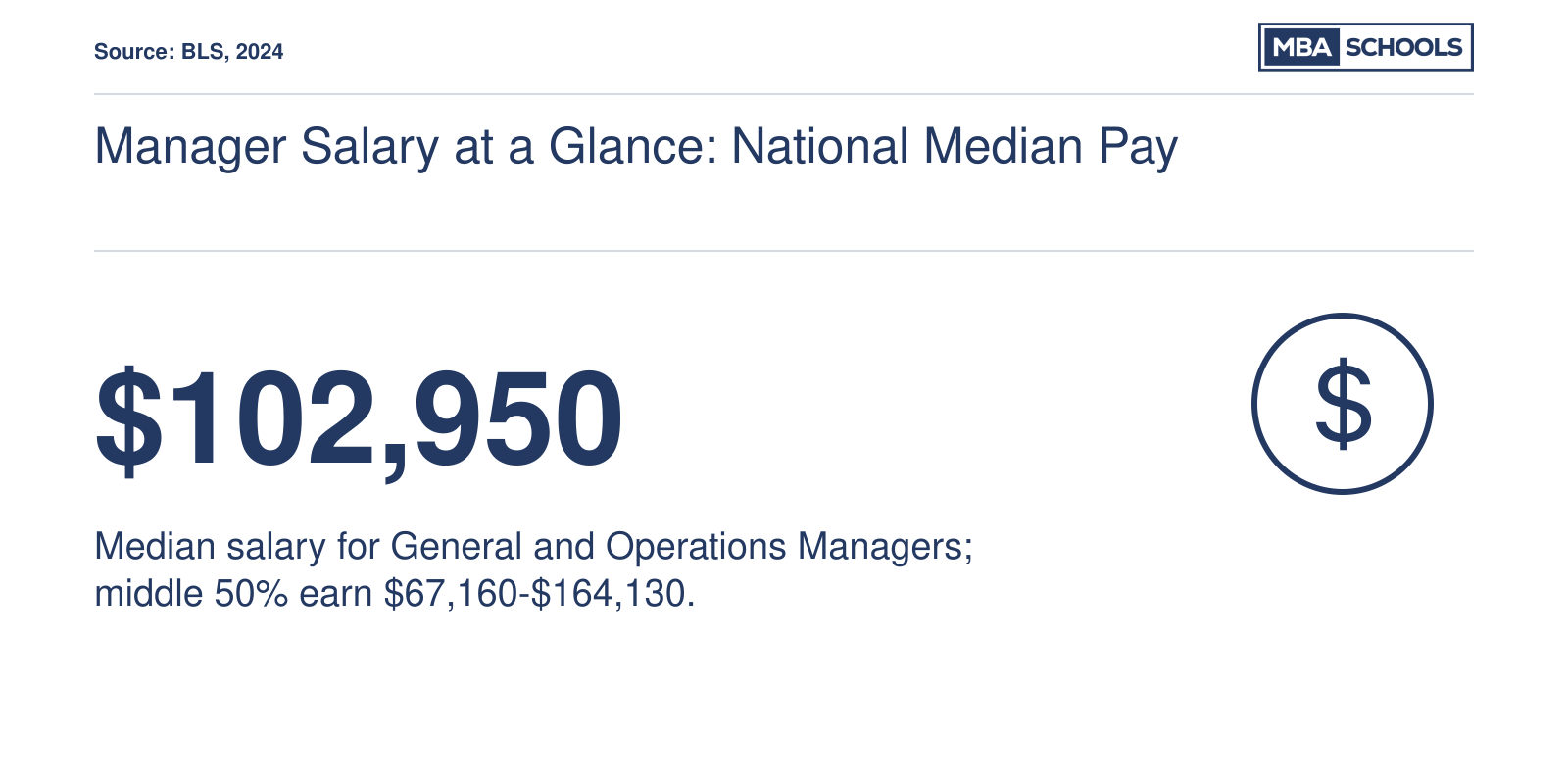
Manager Salary at a Glance: National Median Pay
The Bureau of Labor Statistics reports a median annual wage of $102,950 for General and Operations Managers. The role spans a wide range, with the lowest 25% earning $67,160 and the highest 25% earning $164,130, reflecting the high ceiling for experienced managers.
Related Articles
Career Paths and ROI: What AI MBA Graduates Actually Earn
What does an AI-enhanced MBA actually mean for your paycheck, and how fast will it pay for itself?
Job Titles Fueled by AI Skills
AI-focused MBA career paths open doors to roles that blend business strategy with technical fluency. Common titles include AI Product Manager, Chief AI Officer, Digital Transformation Director, and Operations Manager , all of which are among the best jobs for MBA graduates and command premium salaries. AI Product Managers, for example, earn a mean annual wage of $159,4051, with total compensation at top tech firms reaching $240,000 to $300,000 when signing bonuses are included3. These figures far outstrip the national median MBA salary of $125,0001, reflecting the demand for leaders who can translate AI capabilities into business value.
Salary Premiums and Ranges
Graduates from AI or technology-focused MBA programs typically see a 30 to 60 percent salary premium over their non-AI peers2. The median annual wage for an AI and data analytics MBA specialization stands at $150,000, while top-five AI/analytics programs report median total compensation of $200,0003. For context, Computer and Information Systems Managers, a common career trajectory, had a national median of $171,200 in 20241, underscoring that AI-skilled managers consistently out-earn general management benchmarks. Even MBA graduates in California, a major tech hub, average $163,2075, with the 90th percentile hitting $237,4005.
ROI: Payback Periods in Context
The return on investment is exceptionally strong. A typical AI MBA scenario, where a professional moves from an $85,000 pre-program salary to $130,000 after graduation, recoups a $63,000 program cost in 1.5 to 2 years6. Mid-tier programs with AI tracks take 5 to 7 years1, but ultra-affordable options like San Francisco Bay University's $10,000 AI-enhanced MBA7 reset the benchmark. Even a modest post-MBA salary of $100,000 would cover tuition in a matter of months, making the ROI nearly instantaneous compared to traditional top-tier programs that require 3 to 4 years of payback1.
Accreditation and Quality: How to Spot a Legitimate AI MBA Program
The rise of AI-specialized MBAs has brought a flood of new programs, but not all are created equal. Employers and licensing bodies look for degrees from recognized institutions, and in business education, MBA program accreditation is the baseline signal of quality, transferability, and rigor.
Why Accreditation Matters for an AI MBA
Accreditation confirms that a program meets independent standards for curriculum, faculty qualifications, and student support. The gold standards for business schools are AACSB, EQUIS, and AMBA. A program that holds one or more of these designations has undergone thorough peer review. For AI-enhanced MBAs, this is especially important because the field is new and unregulated. An accredited program assures students that the AI coursework is grounded in a legitimate business education, not just a collection of tech buzzwords.
Accreditation Status of Top AI MBA Programs
Many established universities offer AI MBAs through their AACSB-accredited MBA programs. The University of Southern Indiana’s Online MBA in Artificial Intelligence, for example, is housed in the AACSB-accredited Romain College of Business. Similarly, the University of Illinois Springfield, Texas State University, Southern Illinois University Edwardsville, and the University of North Carolina Wilmington all offer AI-focused online MBAs with AACSB accreditation.1 Jindal Global Business School’s MBA in Business Analytics is also AACSB-accredited, while Robert Morris University’s recently enhanced MBA holds the same distinction3. In addition to business school accreditation, institution-level recognition matters. San Francisco Bay University’s MBA Pro+, an AI-enhanced program launched in 2026, holds WASC accreditation, a regional accreditation that validates the entire university. Regional accreditation like WASC or the Higher Learning Commission ensures that credits are transferable and the school meets broad academic standards.
How to Verify a Program’s Claims
Before enrolling, look up the program’s accreditation on official databases. For AACSB, visit aacsb.edu; for WASC, check wascsenior.org. Be wary of programs that boast “industry recognition” or “certification” without a recognized accreditor. Some AI-focused programs, particularly from newer for-profit or bootcamp-style providers, may lack any third-party validation. Without recognized accreditation, your degree could carry less weight with employers and may not be eligible for federal financial aid. Always cross-reference claims with the accreditor’s own list of accredited institutions to ensure you pursue an online MBA respected by employers.
Do You Need a Tech Background? AI MBA Admissions Requirements
A technical background is not a universal prerequisite for AI-enhanced MBA programs, but it can open doors to more quantitative and specialized curricula. Most programs welcome professionals from non-tech fields and provide foundational support, even as they elevate the importance of data literacy.
Typical Admissions Criteria
Admissions standards for AI MBAs largely mirror traditional MBA programs, with a few twists. Common requirements include: - Degree: A four-year bachelor's degree is the baseline, with a minimum GPA ranging from 2.5 (as at Notre Dame de Namur University) to 3.25 (St. John's University). - Work experience: Programs generally expect 2–5 years of professional experience, though some, like IIM Sirmaur's EMBA, accept up to 15 years. - Standardized tests: Many schools have adopted test-optional policies. GMAT or GRE scores may be waived at Penn State Great Valley, NYU Stern, and St. John's (where they're recommended if your GPA falls below 3.25). Others, like IIM Ahmedabad's blended MBA, still require CAT, GMAT, or GRE.
Technical Prerequisites and Bridge Courses
While prior coding or advanced math is rarely required, some programs encourage, or require, comfort with quantitative reasoning. For instance, Penn State Great Valley's MBA in AI mandates foundational knowledge in programming, calculus, linear algebra, and statistics, but it offers bridge courses for those who need them. NDNU's online MBA expects coursework in accounting, economics, statistics, and math, yet introduces basic Python within the curriculum, so no advanced programming is needed at entry.
Examples from Leading Programs
- IIM Sirmaur (EMBA with AI): No specific tech prerequisites; the program offers a bridge course and waives the GRE, relying on an online pre-screening test.
- Penn State Great Valley (MBA in AI): Open to all majors, but bridge courses in programming and math are available to close any technical gaps.
- NDNU (Online MBA in AI): Accepts students with a bachelor's degree and prerequisite coursework; Python is taught during the program.
- NYU Stern (MS in Business Analytics & AI): No GMAT/GRE required, and it attracts students from diverse backgrounds, with foundational modules integrated into the curriculum.
Overall, non-tech professionals can confidently apply to AI MBAs, provided they are ready to engage with quantitative material, often with the help of built-in bootcamps or bridge courses.
Seventy-four percent of employers now say AI skills are critical for management hires, according to the Graduate Management Admission Council's 2026 Corporate Recruiters Survey, making AI literacy one of the most in-demand competencies in the job market today.
How to Choose the Right AI-Enhanced MBA for Your Career
A 2026 GMAC survey found that 37% of prospective students prioritize affordability and 37% focus on return on investment when choosing an MBA program. These concerns should anchor your evaluation of AI-enhanced programs.
Online vs. On-Campus Delivery
Online AI MBAs, such as San Francisco Bay University’s $10,000 MBA Pro+, deliver asynchronous, self-paced coursework that fits around a full-time job, and the pay-as-you-go model reduces financial risk. The trade-off is fewer spontaneous networking opportunities. Traditional on-campus programs offer richer cohort connections and in-person career events but typically come with higher tuition and less scheduling flexibility. If you need to maintain your income while studying, an accredited online format may be the stronger choice, but it’s wise to carefully weigh the online MBA vs. in-person MBA trade-offs.
Depth of AI Integration
Not all AI MBAs are built alike. Some schools add a single AI elective to a standard curriculum; others embed AI tools and thinking across every course. Look for a program where artificial intelligence is woven into the core, not siloed. For example, SFBU’s proprietary Bayley system uses a Socratic learning approach throughout its MBA, adapting to each student’s pace. Verify whether AI drives personalized tutoring, curriculum delivery, and skill assessment, rather than serving as a marketing label.
Your Decision Framework
Build a simple weighted matrix using these four criteria:
- Total cost: Compare published tuition and fees; favor programs with transparent, pay-as-you-go structures.
- Accreditation: Confirm regional accreditation (e.g., WASC) to ensure credit transfer and employer recognition.
- Curriculum alignment: Map the program’s competencies to your career goals and confirm they align with the MBA skills employers want. Programs citing 45 employer-demanded skills, like MBA Pro+, signal practical relevance.
- Career services: Assess employer connections, portfolio-building opportunities, and mentorship from faculty with industry experience (OpenAI, Google, IBM).
This framework helps you balance affordability, flexibility, AI depth, and career outcomes in a single, actionable view.
The Future of AI-Infused Business Education
The biggest question facing prospective students isn't whether AI belongs in business school; it's whether the high-cost, high-prestige programs can adapt before lower-cost, AI-native challengers redefine the market. The SFBU model signals a future where affordability and employer-aligned competencies coexist, potentially forcing a broader rethink of what an MBA delivers.
Emerging trends
- AI-first design: More schools will launch programs built around AI from day one, not bolted on as electives. AI tutoring, adaptive learning paths, and real-time curriculum updates will become standard, not experimental.
- Continuous curriculum refresh: The half-life of AI skills is short. Programs will need to update content every cycle, not every few years, to stay relevant: a defining trait of MBA innovation.
- Ethics and governance grow: As AI permeates strategy, operations, and marketing, courses on responsible AI, bias mitigation, and regulatory compliance will shift from optional to core.
The affordability-innovation tension
Low-cost AI MBAs like SFBU's demonstrate that cutting-edge tools and personalized support don't require a $100,000+ tuition tag. But established programs still hold brand cachet and alumni networks that many employers value, often translating into stronger MBA career paths. The tension for applicants becomes: do you bet on a forward-leaning, lower-cost degree that may lack name recognition, or pay a premium for a legacy brand that might be slower to evolve?
A new baseline for business education
The SFBU program, with its pay-as-you-go model and 45 employer-demanded competencies, suggests a future where MBA pricing aligns more closely with immediate career returns. If more nonprofits and public universities follow suit, the market could bifurcate: ultra-premium traditional programs and a growing tier of accessible, AI-native options that challenge the ROI assumptions of the past.