
What you’ll learn in this article…
- Georgetown McDonough leads DC MBA selectivity with a 700 average GMAT and strong national rankings across U.S. News, FT, and QS.
- DC is one of the few metros where public sector MBA careers at federal agencies and the World Bank rival private sector pay.
- George Mason and UMD Smith offer the strongest tuition to earnings value among DC area programs for cost conscious professionals.
- Part time and online formats dominate the DC market, reflecting the metro's concentration of mid career federal and consulting professionals.
Washington DC hosts the headquarters of the World Bank, IMF, and more than 100 federal agencies, giving local MBA graduates a hiring pipeline that no other U.S. metro can replicate. The region also ranks among the top three markets for management consulting employment, with Deloitte, Booz Allen Hamilton, and McKinsey all maintaining major offices within ten miles of Capitol Hill.
Six programs anchor the mba programs in washington dc market: Georgetown McDonough, George Washington, Howard, American Kogod, University of Maryland Smith, and George Mason. They span a tuition range from roughly $60,000 to over $160,000, with median GMAT scores stretching from the mid-500s to 700. That spread means the real challenge is not finding a program but matching cost, format, and employer access to a specific career outcome.
Best MBA Programs in Washington DC: 2026 Rankings
Washington DC offers a distinctive MBA landscape shaped by proximity to federal agencies, global organizations, and a thriving consulting sector. The programs below range from elite private institutions with nationally ranked full-time and executive MBAs to affordable online options designed for working professionals. All six schools are private, but tuition spans from under $7,000 to nearly $68,000, so understanding each school's value proposition is essential before you apply.
- Institutional graduation and retention rates
- Graduate earnings after completion
- Tuition affordability and net price
- Program breadth and format flexibility
- Student to faculty ratio
- College Scorecard graduate earnings — collegescorecard.ed.gov
- Internal program database
- NCES-IPEDS federal institutional data — nces.ed.gov
- Independent program research

Georgetown University
Georgetown University's McDonough School of Business is the flagship MBA program in the DC metro, with a school-wide graduation rate of 94.8% and median earnings of $103,494 ten years after enrollment. A sweeping program redesign launching in Fall 2026 embeds AI fluency, ethical leadership projects with DC-area organizations, and a customizable core into every MBA track. Georgetown offers full-time, part-time, online flex, and executive MBA formats, plus dual degrees with the Law Center (J.D./M.B.A.) and School of Medicine (MBA/MD), giving students unmatched flexibility to tailor their graduate experience from a campus minutes from the White House.
MBA, Entrepreneurship — On-Campus
Executive MBA — Hybrid
J.D./M.B.A. — On-Campus
MBA/MD — On-Campus

George Washington University
George Washington University's School of Business sits in the heart of Foggy Bottom and serves DC professionals through a diverse MBA portfolio that includes an AACSB-accredited online Health Care MBA, an Executive MBA with weekend intensives, STEM-designated dual MBA/MS programs, and a unique MBA/Sport Management dual degree. The school offering these programs has an 84% graduation rate, and graduates report median earnings of $90,873 ten years after enrollment. GW's tuition of roughly $36,414 per year (net price) and its nine consecutive Military Friendly designations make it a strong mid-tier value play in the capital.
- Up to 21 credits shared between the MBA and MSSM
- 12 MSSM credits count toward the MBA requirements
- Six MBA credits count toward the MSSM degree
- Campus-based program in downtown Washington DC
- Prepares graduates for leadership in the sports industry
- Combines core business strategy with sport management expertise
- Fully online with synchronous and asynchronous options
- AACSB accredited with 15+ years of program history
- Full-time and part-time pacing available
- Ranked among top 33 online MBA programs nationally
- Military benefits accepted; Military Friendly nine years running
- Option to add a graduate certificate to the MBA
- Study abroad opportunities included
- 46.5-credit program with weekend intensive format
- Cohorts of 25 to 30 experienced professionals
- Technology, analytics, and global business focus
- 12 elective credits for personalized specialization
- Short-term study abroad option available
- Located in Washington DC with experiential learning
- Combines MBA and JD with 12 shared credits
- Separate admissions to business and law schools required
- First year dedicated to the JD curriculum
- Both degrees awarded simultaneously upon completion
- Campus-based program ideal for law and business careers
- Leverages DC location for government and policy networking
- STEM-designated dual MBA and MS degree
- Up to 21 credits shared across both programs
- 12 MS credits count toward the MBA
- Nine MBA electives count toward the MS
- Campus-based program through GW School of Business
- Information systems technology and analytics focus
Dual Master of Business Administration and Master of Science in Sport Management — On-Campus
Health Care MBA — Online
Executive Master of Business Administration — On-Campus
Joint Master of Business Administration and Juris Doctor — On-Campus
Dual Master of Business Administration and Master of Science in the Field of Information Systems Technology — On-Campus
Dual Master of Business Administration (STEM) and Master of Science in the Field of Information Systems Technology — On-Campus

American University
American University's Kogod School of Business delivers a tightly focused MBA experience with a 10:1 student-to-faculty ratio, one of the lowest in the DC metro. Kogod's JD/MBA dual degree, offered jointly with the Washington College of Law, allows students to earn two professional degrees in four years with access to more than 150 business law courses. The school offering this program has a 75.5% graduation rate, and the university reports median earnings of $77,370 ten years after enrollment. Tuition of approximately $36,754 and the school's DC location provide direct pipelines to investment banking, venture capital, and federal policy roles.
- Four-year dual degree combining JD and MBA
- 31 MBA course credits within the integrated curriculum
- Access to over 150 business law courses
- Global Project Experience with international consulting
- Internship opportunities across DC institutions
- Business leadership luncheons and networking events
- Experiential learning with a diverse student cohort
JD/MBA — On-Campus

University of the Potomac-Washington DC Campus
University of the Potomac offers one of the most affordable MBA options in Washington DC, with tuition of roughly $5,850 per year. The program accepts up to 15 transfer credits and does not require the GMAT for applicants with a business background, lowering barriers for working adults. Available online and on campus, the 36-credit MBA includes a Human Resources Management concentration taught by practitioners. Note that the school offering this program has a 33.3% graduation rate and median earnings of $34,961 ten years after enrollment, so prospective students should weigh affordability against long-term outcomes carefully.
Master of Business Administration, Human Resources Management — Online

Howard University
Howard University, the nation's preeminent HBCU, offers a distinctive MBA portfolio through its School of Business. The campus-based MBA with a Supply Chain Management concentration is the first HBCU graduate program in the field and is consistently ranked by Gartner. Howard also delivers an 18-month Online Executive MBA that requires no GMAT or GRE and is built for professionals targeting C-suite roles. The school offering these programs has a 70% graduation rate and reports median earnings of $63,066 ten years after enrollment. Tuition is approximately $39,178 per year, and partnerships with more than 50 major companies support career placement.
MBA, Supply Chain Management — On-Campus
Online Executive MBA — Online
JD/MBA — On-Campus
Master of Social Work/Master of Business Administration (MBA), Direct Practice, Community Administration Policy Practice — On-Campus

Strayer University-Global Region
Strayer University provides a fully online MBA with a Human Resource Management concentration designed for working adults seeking flexible scheduling and lower per-course costs. At roughly $2,985 per course across 12 courses (11 weeks each), the total program cost is significantly below traditional DC MBA programs. However, the school offering this program has a 14.3% graduation rate and median graduate debt of $40,621, while median earnings reach $40,092 ten years after enrollment. Prospective students should carefully assess whether the program's convenience and price point translate into sufficient return on investment for their career goals.
Master of Business Administration, Human Resource Management — Online
How DC MBA Programs Rank Nationally (U.S. News, FT, QS)
Washington DC is home to a handful of MBA programs that hold their own against nationally and globally recognized business schools. Understanding where each program lands in major rankings helps you gauge academic reputation, employer perception, and post-graduation outcomes, all factors that can shape your return on investment.
Georgetown McDonough: The DC Flagship
Georgetown University's McDonough School of Business is the highest-ranked MBA program in the District and the only DC school that consistently appears across all three major ranking systems. In the 2026 U.S. News Best Business Schools list, Georgetown McDonough MBA holds the 31st spot nationally.1 On the Financial Times side, it performs even stronger: 23rd among U.S. programs and 49th globally.1 Perhaps most notable for career-focused applicants, Georgetown ranks 5th globally for salary increase among Financial Times-ranked programs, a signal that graduates see meaningful earnings growth relative to their pre-MBA compensation. The school also lands in the top 10 globally for class diversity, reflecting its international student body and connections to DC's diplomatic and policy communities.
UMD Smith: A Strong Public-School Contender
The University of Maryland's Robert H. Smith School of Business sits just outside the top 25 in U.S. News, generally placing in the 25 to 30 range for 2026.2 That positioning makes Smith one of the stronger public university MBA options on the East Coast. For applicants weighing the cost difference between a private school like Georgetown and a public flagship, Smith's ranking proximity at a lower tuition price point is worth serious consideration. You can explore our Georgetown vs GW MBA comparison to see how the District's private programs stack up against each other as well.
The Rest of the DC Metro Field
The George Washington University MBA program, Howard University, American University's Kogod School of Business, and George Mason University each serve distinct student populations and career goals, but none currently appear in the top 50 of U.S. News or the Financial Times global list. That does not diminish their value, particularly for part-time and working professionals in the DC area, but it does mean their brand recognition may carry more weight regionally than nationally.
Howard University's MBA program, for instance, offers deep alumni networks in government agencies and Fortune 500 diversity pipelines, a form of career capital that rankings do not always capture. George Mason, meanwhile, has been expanding its business programs to serve Northern Virginia's fast-growing technology and defense contracting corridors.
Why Ranking Differences Matter for You
Different ranking systems emphasize different outcomes. U.S. News leans heavily on employment statistics and peer assessment, while the Financial Times places greater weight on salary outcomes and research output. QS incorporates employer reputation surveys and alumni network strength. This means a school can rank higher in one system and lower in another depending on whether it excels at placing graduates quickly versus delivering long-term salary growth.
For DC-area applicants, the practical takeaway is this: if you plan to stay in the metro for a career in consulting, government, or international organizations, regional employer perception and alumni networks can matter as much as a national rank number. If you are targeting a post-MBA move to New York, San Francisco, or an overseas market, a program's global ranking and recruiter reach become more important.
- Top 25 nationally: Georgetown McDonough (Financial Times U.S. ranking)
- Top 30 nationally: Georgetown McDonough and UMD Smith (U.S. News)
- Top 50 globally: Georgetown McDonough (Financial Times Global)
- Regional strength: GWU, Howard, American Kogod, George Mason
Tuition, Financial Aid & ROI: Which DC MBA Delivers the Best Value?
Choosing an MBA program in Washington DC means weighing sticker-price tuition against real financial aid, expected debt, and long-term earnings. The table below compares published tuition, institution-wide average net price (which reflects all aid sources across the university, not a personalized MBA quote), median graduate debt, and median earnings ten years after enrollment for the major DC-area schools. Georgetown leads the value conversation with the highest earnings-to-cost ratio among DC programs, partly because 53% of its full-time MBA class receives merit aid averaging $25,000 per student, and the school commits at least $3 million annually in merit scholarships. GW and American Kogod also offer competitive net prices for private institutions, while Howard provides strong mission-driven aid for its MBA students. Many DC-area MBA candidates further offset costs through employer tuition reimbursement, a benefit especially common among federal government employees, defense contractors such as Booz Allen Hamilton and Deloitte, and consulting firms that maintain formal sponsorship programs for part-time and executive MBA students.
| School | Published Tuition (Annual) | Avg. Net Price (Institution-Wide) | Median Graduate Debt | Median Earnings (10 Yr Post-Enrollment) | Institutional ROI Ratio |
|---|---|---|---|---|---|
| Georgetown University (McDonough) | $68,017 | $40,815 | $15,500 | $103,494 | 6.7 |
| George Washington University | $67,710 | $36,586 | $20,449 | $90,873 | 4.4 |
| American University (Kogod) | $58,771 | $41,943 | $22,750 | $77,370 | 3.4 |
| Howard University | $35,810 | $50,539 | $24,500 | $63,066 | 2.6 |
| Strayer University (Global Region) | $13,920 | $17,833 | $40,621 | $40,092 | 1.0 |
Questions to Ask Yourself
Average GMAT Scores & Acceptance Rates for DC MBA Programs
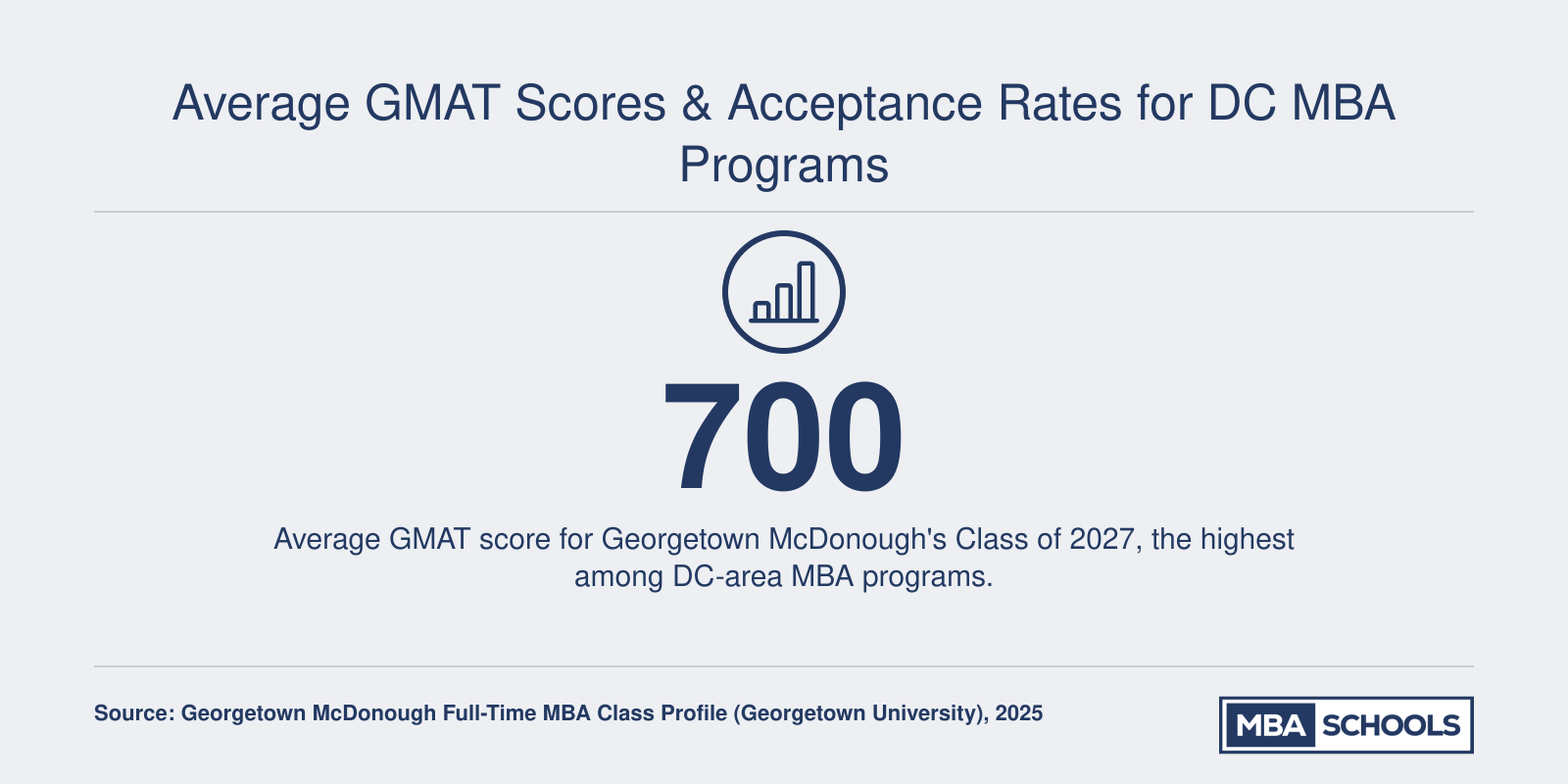
GMAT scores and acceptance rates are two of the most telling indicators of a program's selectivity, yet most competitor guides omit side-by-side comparisons for the DC metro. Georgetown McDonough leads the pack with a 700 average GMAT for the Class of 2027 and a middle-80% range of 660 to 740. Roughly 39% of the incoming class submitted GRE scores instead, reflecting a broader industry shift toward test flexibility. While verified class-profile data for GWU, Howard, American Kogod, George Mason, and Maryland Smith have not yet been published for the most recent cycle, Georgetown's published figures provide a reliable benchmark: programs with averages in the mid-600s or below tend to accept a larger share of applicants, making schools like American Kogod and George Mason more accessible entry points for candidates still building their test scores. All six DC-area programs accept the GRE alongside the GMAT, and several have adopted GMAT Focus Edition scores as well. None of the major full-time MBA programs in the metro currently operate on a fully test-optional basis, though applicants should verify each school's latest admissions policy directly.
Post-MBA Salary & Career Outcomes in the DC Metro
Washington DC is one of the highest-paying metro areas in the country for MBA-typical roles, and graduates from local programs benefit from that salary premium immediately. If you have been wondering, "How much does an MBA make in Washington DC?", the short answer is: considerably more than the national average, with median salaries ranging from roughly $120,000 to over $175,000 depending on your role, employer, and years of experience.
DC Metro Salaries for MBA-Typical Occupations
Bureau of Labor Statistics data for the Washington-Arlington-Alexandria metro area paints a compelling picture for MBA holders. As of May 2023:
- Management Analysts: Median annual wage of $119,475, with a mean annual wage of $167,190, reflecting the high ceiling in consulting and advisory roles. Over 71,000 professionals hold these positions in the metro, making it one of the densest markets in the nation for this occupation.1
- General and Operations Managers: Median annual wage of $142,730, with a mean of $157,520. More than 105,000 of these roles exist across the DC metro, spanning government agencies, federal contractors, nonprofits, and private-sector firms.2
These figures sit well above national medians for both occupations, driven by the concentration of federal agencies, defense contractors, consulting firms, and international organizations headquartered in the capital region.
Program-Level Earnings: What the Data Shows
Program-specific post-graduation earnings for the MBA programs featured in our rankings are not yet reported at the granular level needed for direct school-to-school salary comparisons. Federal data collection for program-level outcomes at the master's degree level is still catching up to what is available for undergraduate programs. As this data becomes available, mbaschools.org will incorporate it into our program profiles.
In the meantime, institutional earnings data at the university level offers useful context. Georgetown University graduates report median earnings of $103,494 ten years after enrollment across all programs, while George Washington University graduates report $90,873. These figures encompass all degree levels and fields, so MBA-specific outcomes are likely higher, particularly for graduates entering consulting, finance, or senior government roles. For a broader look at how these numbers compare across industries and experience levels, see our guide to mba career paths and salaries.
What This Means for Your MBA Investment
The DC metro's overall mean hourly wage of $43.47 (May 2024 BLS data) is among the highest of any U.S. metro, and MBA holders consistently earn well above that average.3 The combination of a local job market with deep demand for management talent and salaries that outpace most other cities makes the return on a DC-area MBA particularly strong. You can explore national benchmarks in more detail in our average salary for mba graduates resource.
For practical planning purposes, a reasonable post-MBA salary expectation in the DC metro falls between $120,000 and $170,000 in your first few years, depending on whether you enter consulting, financial management, operations leadership, or public-sector management. Graduates who land at top-tier consulting firms or in senior federal roles often exceed these ranges. The metro's cost of living is high, but salaries here are calibrated to match, and the career network effects of working in the nation's capital compound over time.
DC MBA Earnings at a Glance: 1-Year vs 4-Year Post-Graduation
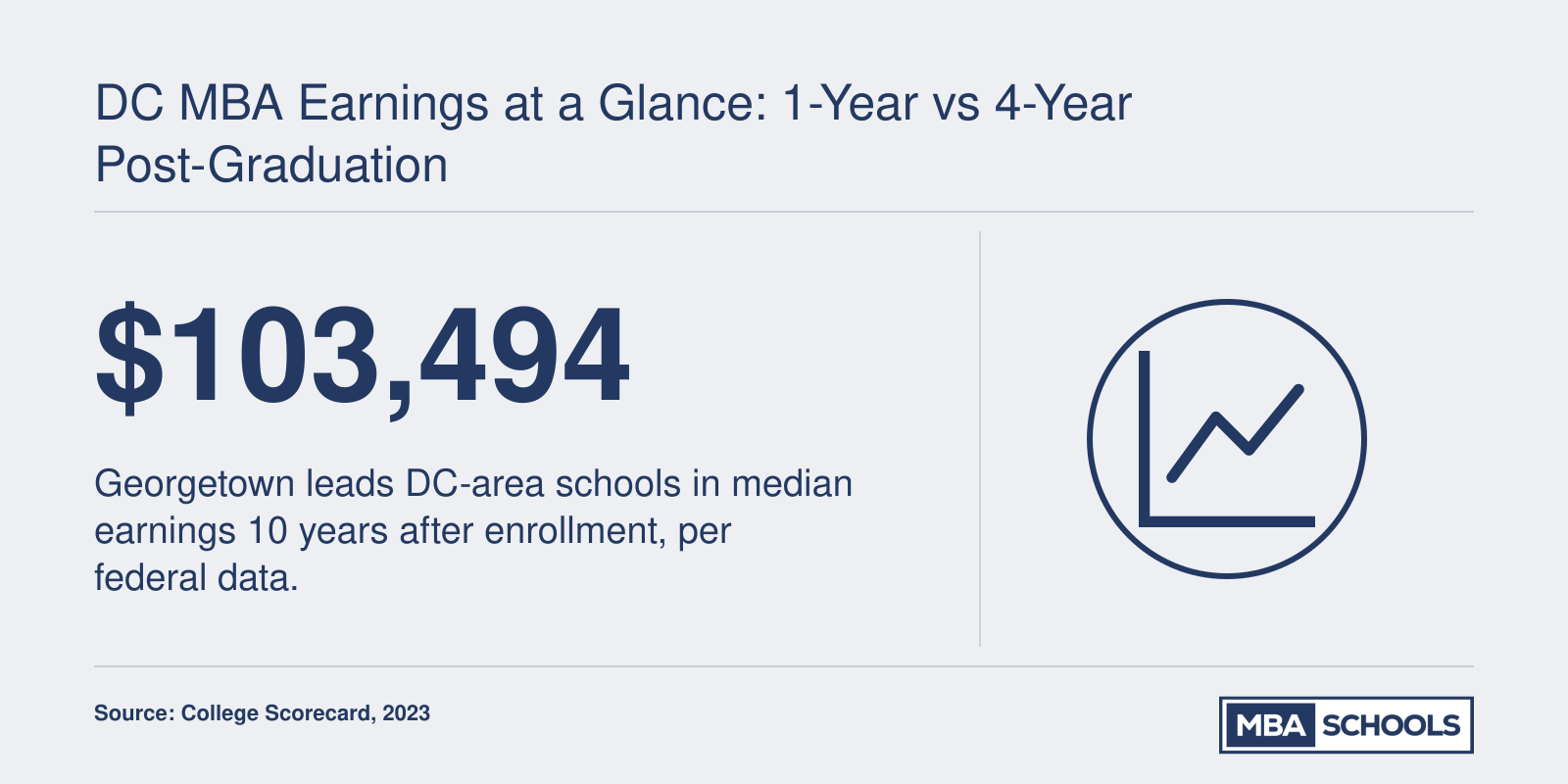
Program-level earnings data for one year and four years after graduation are not yet available for DC-area MBA programs in the current federal reporting cycle. While institution-wide median earnings at 10 years post-enrollment offer a useful proxy, granular MBA-specific salary growth trajectories cannot be charted until updated program-level outcomes are published. Among DC schools, Georgetown graduates report the highest institution-wide median earnings at 10 years ($103,494), followed by George Washington University ($90,873) and American University Kogod ($77,370).
Full-Time vs Part-Time vs Online MBA Programs in DC
Washington DC's MBA landscape is uniquely shaped by the city's concentration of federal agencies, consulting firms, and international organizations. Many MBA students here are already mid-career professionals who need flexible scheduling, which means choosing between full-time, part-time, and online formats is one of the most consequential decisions you'll make. Unlike most competitor guides that focus on a single format, the comparison below evaluates DC programs across cost, flexibility, networking access, and career services so you can find the right fit for your professional life.
| Dimension | Full-Time Campus (e.g., Georgetown, Howard) | Part-Time Campus (e.g., GW, American Kogod) | Online or Hybrid (e.g., University of the Potomac, Strayer) |
|---|---|---|---|
| Annual Tuition Range | Approximately $39,178 to $61,670 per year at Georgetown and Howard | Approximately $36,414 to $36,754 per year at GW and American University | Approximately $5,850 to $15,135 per year at University of the Potomac and Strayer |
| Program Duration | Typically 2 years of full-time study | 2.5 to 3 years, designed for working professionals | 1.5 to 3 years depending on course load; self-paced options available |
| Schedule Flexibility | Weekday daytime classes; limited ability to hold a full-time job | Evening and weekend classes accommodate government and consulting schedules | Fully asynchronous or hybrid; ideal for professionals with unpredictable travel or shift schedules |
| In-Person Networking Access | Strong: daily peer interaction, club events, on-campus recruiting by top consulting and policy firms | Moderate: evening cohort bonds form over time, with access to campus career fairs and alumni events | Limited on-campus interaction; some hybrid programs (University of the Potomac) offer optional in-person sessions in DC |
| Career Services and Recruiting | Dedicated career coaches, employer site visits, and structured internship pipelines at Georgetown McDonough and Howard | Access to the same career centers as full-time students; GW and Kogod host government and nonprofit employer panels | Online career advising and resume support; fewer direct employer partnerships compared to campus programs |
| Median Institutional Earnings (10 Years Post-Enrollment) | Approximately $63,066 (Howard) to $103,494 (Georgetown) | Approximately $77,370 (American) to $90,873 (GW) | Approximately $34,961 (University of the Potomac) to $40,092 (Strayer) |
| Best Suited For | Career switchers and early-career professionals seeking immersive skill-building and internship access | DC-based professionals in government, consulting, or contracting who want to earn while they learn | Budget-conscious professionals, military personnel, or remote workers prioritizing affordability and maximum scheduling freedom |
| Top Online or Hybrid Options in DC | Not applicable (campus only) | Not applicable (campus only) | University of the Potomac offers an online MBA with optional DC campus sessions starting at roughly $5,850 per year; Strayer University provides a fully online MBA at approximately $15,135 per year with multiple concentrations |
Top DC MBA Career Paths: Government, Consulting & International Organizations
Washington DC is not just the nation's capital. It is the rare city where an MBA opens doors to mba career paths that simply do not exist elsewhere. From shaping federal policy to advising multilateral development banks, DC MBA graduates move into roles that blend business acumen with public impact. Understanding which programs feed which sectors is essential to making a smart investment.
Federal Government and Policy
The federal government is the largest employer in the DC metro area, and agencies like the Department of Defense, Department of Commerce, and the Office of Management and Budget actively recruit MBAs for leadership and analytical roles. George Washington University has long maintained one of the strongest pipelines into federal service, thanks to its proximity to the White House and deep alumni networks across cabinet-level agencies. Howard University's MBA program also stands out for graduates pursuing public service careers, particularly in agencies focused on housing, urban development, and health equity. As one of the best HBCU MBA programs in the country, Howard brings a distinctive mission-driven network to federal service. Federal roles often come with structured pay scales, but the benefits packages, loan forgiveness programs, and long-term stability can make total compensation highly competitive.
Management Consulting
DC is home to major offices of McKinsey, BCG, Bain, and Deloitte, alongside firms with deep government roots like Booz Allen Hamilton. Georgetown McDonough dominates this lane. The school consistently places a significant share of its graduating class into consulting, aided by on-campus recruiting events and a location that puts students minutes from firm headquarters in Tysons Corner and downtown DC. For candidates who want to learn how to become a management consultant with an MBA, the intersection of private-sector strategy skills and public-sector domain knowledge makes DC-trained consultants especially valuable.
International Organizations
Few cities can rival DC's concentration of international institutions. The World Bank, International Monetary Fund, Inter-American Development Bank, and dozens of UN agencies and NGOs are headquartered here. Georgetown McDonough again leads in this area, with dedicated programming in international business and strong ties to the diplomatic community. American University's Kogod School of Business also leverages the university's School of International Service to give MBA students cross-disciplinary access to global policy expertise. Careers in these institutions often require multilingual skills and international experience, so candidates should evaluate whether a program's cohort and curriculum support that profile.
Government Contracting and Defense
The DC metro area, stretching into Northern Virginia and Maryland, is the epicenter of government contracting. Firms like Lockheed Martin, Raytheon, SAIC, and Leidos recruit MBAs for program management, business development, and strategy roles. The University of Maryland's Smith School of Business and George Mason University both benefit from their geographic proximity to contractor headquarters along the I-495 and I-66 corridors. These programs tend to attract students already working in the defense and intelligence communities who want to move into leadership positions without relocating.
Matching Your Career Goals to the Right Program
The question many prospective students ask is how DC MBA programs compare for government and consulting careers. The answer depends on which sector you are targeting:
- Consulting (private sector): Georgetown McDonough offers the strongest recruiting relationships with top-tier firms.
- Federal government and policy: GWU and Howard provide the deepest institutional connections to agencies and public service employers.
- International organizations: Georgetown and American Kogod offer the most relevant coursework and alumni networks.
- Government contracting and defense: UMD Smith and George Mason serve students already embedded in the Northern Virginia and Maryland contractor ecosystem.
DC is one of the few metro areas where your MBA career strategy should start with sector, not just school prestige. Choosing the program with the strongest pipeline to your target industry will shape your network, your internship options, and ultimately your post-graduation trajectory.
How to Choose the Right DC MBA Program
Choosing among Washington DC's MBA programs is less about picking the "best" school on a list and more about aligning a program's strengths with the career you want to build. The DC metro offers an unusually diverse set of MBA pathways, so the decision framework starts with your end goal and works backward. For a broader look at the key factors to consider when choosing an MBA program, our full decision guide walks through the process step by step.
Match Your Career Goal to a Program's Core Strength
Each DC-area school has carved out a distinct identity, and the differences matter more than marginal ranking gaps.
- Consulting or finance: Georgetown McDonough has the deepest consulting pipelines and the strongest Wall Street connections in the region, backed by elite brand recognition.
- Government, policy, or international development: GWU's proximity to the World Bank, IMF, and federal agencies gives its MBA students unmatched access to public-sector leaders and policy networks.
- Entrepreneurship or sustainability: American University's Kogod School of Business leans into mission-driven ventures and sustainable business, a niche that resonates in DC's growing impact economy.
- Diversity and social impact: Howard University's School of Business carries a historic mission and a powerful alumni network, particularly in industries and organizations that prioritize inclusive leadership.
- Large-school resources on a public-school budget: UMD Smith and George Mason both offer strong analytics and supply chain programs at in-state tuition rates that dramatically change the ROI equation.
Navigate the Key Trade-Offs
Once you have a career direction, weigh three sets of trade-offs honestly.
- Prestige vs. affordability: Georgetown commands the highest tuition in the market but also the highest median starting salaries. A public option like UMD Smith can deliver a comparable salary bump with far less debt, especially for Virginia or Maryland residents.
- Full-time immersion vs. part-time flexibility: A full-time program accelerates career switching through internships, recruiting cycles, and cohort bonding. A part-time or evening format lets you keep earning, which matters if you already hold a mid-career government or contracting role you do not want to leave.
- Campus network vs. online convenience: Several DC schools now offer online MBA tracks, but the city's greatest asset is face-to-face access to policymakers, lobbyists, and agency heads. If you live in the metro area, an in-person or hybrid format lets you tap that advantage directly.
Is an MBA Worth It in Washington DC?
The short answer: yes, for most professionals, but the math depends on your starting point. DC's median post-MBA salaries are among the highest in the country, driven by consulting firms, federal contractors, and international organizations that treat the degree as a baseline credential for leadership roles. If you are targeting a GS-14 or GS-15 position, a senior role at a Beltway consulting firm, or a management track at an organization like the World Bank, the MBA opens doors that experience alone often cannot.
The calculus shifts if you are already earning a strong salary and would need to leave the workforce for two years. In that case, a part-time program that lets you keep your income and clearance may deliver a better net return than a full-time immersion, even at a slightly lower-ranked school.
Concrete Next Steps
Do not make this decision from behind a screen alone. DC's programs are compact enough that you can visit multiple campuses in a single weekend. The importance of alumni network in choosing MBA programs cannot be overstated, so make alumni outreach a priority alongside campus visits.
- Attend at least two information sessions, one at your top-choice school and one at a program you had not considered, to calibrate your expectations.
- Request a class visit or sit in on an elective in your area of interest. The energy in the room tells you more than any brochure.
- Talk to alumni who work in your target sector. Ask them specifically what the degree unlocked that they could not have achieved without it.
- Run a personal ROI calculation: total cost of the program (tuition, fees, lost wages) versus the salary increase you can reasonably expect within three to five years, factoring in the career paths discussed elsewhere in this guide.
The right DC MBA program is the one where career outcomes, cost, and format intersect with where you actually want to be in five years. Start there, and the rest of the decision simplifies.
Frequently Asked Questions About MBA Programs in Washington DC
Prospective MBA students in the Washington DC metro area often have questions about admissions requirements, salary expectations, and how local programs stack up for specialized career paths. Below, we answer the most common questions using the latest available data to help you make an informed decision.