
What you’ll learn in this article…
- Oregon MBA tuition ranges from roughly $16,200 to nearly $40,000 per year depending on residency and institution type.
- Portland State University offers the lowest effective net price among the state's most affordable MBA programs.
- MBA graduates earn approximately 1.75 times the salary of bachelor's degree holders according to the 2024 GMAC Corporate Recruiters Survey.
- Oregon's top employers span tech, advanced manufacturing, and healthcare, aligning closely with popular MBA specializations.
Oregon is home to Nike, Intel, and a fast-growing corridor of tech and clean-energy firms that collectively drive steady demand for MBA-trained managers. For working professionals weighing a return to school, the core tension is real: AACSB-accredited programs at the state's flagship universities carry strong brand recognition but higher price tags, while regional options can cut tuition nearly in half with less employer visibility.
Online and hybrid formats now span the full spectrum, from the University of Oregon's Lundquist College to Portland State and Oregon State, each calibrated for different career stages and budgets. In-state MBA tuition ranges from roughly $16,200 to nearly $40,000 per year, a spread wide enough that program selection has direct financial consequences well beyond graduation. Prospective students in neighboring states may also want to compare best online mba programs for montana students or mba programs idaho cost as part of a broader Pacific Northwest search.
Best Online MBA Programs in Oregon: Our Rankings
Our ranking of the best online MBA programs in Oregon weighs institutional quality signals, including graduation rates, net price, and post-completion earnings, alongside online and hybrid delivery availability. The result is a composite quality ranking, not one driven solely by cost or speed. Each school below offers at least one program accessible to remote learners, giving working professionals across the state (and beyond) a clear path to an MBA without relocating.
- Online and hybrid availability
- Institution graduation rates
- Net price after aid
- Post-completion graduate earnings
- Program breadth and accreditation
- College Scorecard graduate earnings — collegescorecard.ed.gov
- NCES-IPEDS federal institutional data — nces.ed.gov
- Independent program research
- Internal program database

Oregon State University
Oregon State University's College of Business holds AACSB accreditation and offers one of the most flexible MBA portfolios in the state, with both a 60-credit Business Analytics MBA (delivered hybrid in Corvallis or Portland evenings) and a 45-credit online MBA with eight concentration tracks. The online MBA charges $965 per credit with no additional fee for out-of-state students, and the program reports a 97% job placement rate. An institution-wide graduation rate of 70.1% and median alumni earnings of $64,010 at the ten-year mark reinforce the school's strong outcomes profile.
- AACSB-accredited, cohort-based program
- 60 total credit hours with capstone project
- Hybrid delivery: online, in-person, or Portland evenings
- Synchronous and asynchronous class options
- Sponsored corporate projects with industry leaders
- Full-time and part-time enrollment paths
- Starts fall, spring, summer, or rolling
- 45 credit hours at $965 per credit
- Fully online with hybrid Portland option
- No additional charge for nonresident students
- Eight concentration options within the MBA
- 11-week class terms with four annual start dates
- Synchronous and asynchronous delivery
Business Analytics MBA — Hybrid
MBA in Human Resources Management — Online

University of Oregon
The University of Oregon's Lundquist College of Business delivers a Portland-based Executive MBA ranked #31 nationally among executive programs. Built for accomplished mid-to-senior leaders averaging 15 years of work experience, this 20-month hybrid program uses a weekend format that fits around demanding schedules. Cohorts of roughly 50 professionals, 51% of whom are women, gain access to global study trips and executive immersion activities. The institution posts a 71.7% graduation rate and $61,324 in median earnings ten years after enrollment.
- Portland weekend format over 20 months
- Ranked #31 nationally among Executive MBAs
- Cohorts of ~50 experienced professionals
- Average participant has 15 years of experience
- Global study trip opportunities included
- Executive immersion and career development support
- 51% women participants in recent cohorts
Oregon Executive MBA — Hybrid

Portland State University
Portland State University's School of Business, AACSB-accredited and recognized by U.S. News & World Report as a Best Online MBA, focuses its graduate business programming squarely on healthcare. The 63-credit Healthcare MBA uses an 80% asynchronous, 20% synchronous hybrid model that lets working clinicians and administrators earn their degree over 21 months. A partnership with Oregon Health & Science University deepens the healthcare curriculum, and the school's Ashoka U Changemaker designation reflects a mission-driven approach to business education. The institution-wide graduation rate is 52.7%, and the net price of $9,552 is the lowest among ranked schools here.
- AACSB-accredited, top 1% of business schools globally
- 63 credit hours completed in 21 months
- 80% asynchronous, 20% synchronous hybrid delivery
- Cohort-based with fellow healthcare professionals
- Partnership with Oregon Health & Science University
- U.S. News Best Online MBA recognition
- Capstone project required
- Five healthcare-focused concentration areas
The Healthcare MBA — Hybrid

Southern Oregon University
Southern Oregon University offers one of the most affordable fully online MBAs in the state at $430 per credit ($19,350 total for 45 credits), with the same flat tuition rate for in-state and out-of-state students. Asynchronous seven-week course terms and three annual start dates make the program highly accessible, and students can finish in as few as 16 months. Six concentration tracks span Business Analytics, Accounting, Finance, Healthcare Administration, Marketing, and Nonprofit Management. The ACBSP-accredited on-campus track adds evening and Saturday classes with small cohorts and even an international dual-degree option. No GMAT or GRE is required for admission. The institution-wide graduation rate is 42.5%.
- $19,350 total tuition, $430 per credit
- 45 credit hours completable in 16 months
- 100% asynchronous online delivery
- Same tuition for in-state and out-of-state students
- No GMAT or GRE required for admission
- Seven-week accelerated course terms
- Six concentration options including Analytics and Finance
- Capstone project required
- $19,350 total tuition, $430 per credit
- 45 credit hours completable in 16 months
- 100% asynchronous online delivery
- Same tuition for in-state and out-of-state students
- No GMAT or GRE required for admission
- Seven-week accelerated course terms
- Six concentration options including Analytics and Finance
- Capstone project required
- $19,350 total tuition, $430 per credit
- 45 credit hours completable in 16 months
- 100% asynchronous online delivery
- Same tuition for in-state and out-of-state students
- No GMAT or GRE required for admission
- Seven-week accelerated course terms
- Six concentration options including Analytics and Finance
- Capstone project required
- $19,350 total tuition, $430 per credit
- 45 credit hours completable in 16 months
- 100% asynchronous online delivery
- Same tuition for in-state and out-of-state students
- No GMAT or GRE required for admission
- Seven-week accelerated course terms
- Six concentration options including Analytics and Finance
- Capstone project required
- $19,350 total tuition, $430 per credit
- 45 credit hours completable in 16 months
- 100% asynchronous online delivery
- Same tuition for in-state and out-of-state students
- No GMAT or GRE required for admission
- Seven-week accelerated course terms
- Six concentration options including Analytics and Finance
- Capstone project required
- $19,350 total tuition, $430 per credit
- 45 credit hours completable in 16 months
- 100% asynchronous online delivery
- Same tuition for in-state and out-of-state students
- No GMAT or GRE required for admission
- Seven-week accelerated course terms
- Six concentration options including Analytics and Finance
- Capstone project required
Master of Business Administration, Business Analytics — Online
Master of Business Administration, Nonprofit Management — Hybrid
Master of Business Administration, Accounting — Online
Master of Business Administration with a Concentration in Finance, Finance — Online
Master of Business Administration, Healthcare Administration — Online
Master of Business Administration, Marketing — Online

Pacific University
Pacific University, a private institution in Forest Grove, pairs a compact 36-credit MBA with a healthcare management track that prepares graduates for administration roles across the health sector. Hybrid delivery, optional international seminars, and corporate landscape tours with executives enrich the experience beyond the classroom. A dual-degree option allows students to combine the MBA with other healthcare graduate programs. With a 10:1 student-to-faculty ratio and institution-wide graduation rate of 67%, Pacific offers a personalized learning environment, though its tuition of $39,938 reflects its private-school positioning.
- 36 credit hours across 12 courses
- Healthcare Management or General Management track
- Hybrid delivery format
- Optional international seminar abroad
- Corporate landscape tours with executives
- Dual degree with healthcare graduate programs
- Financial aid and scholarships available
Master of Business Administration, Healthcare Management — Hybrid

Oregon Health & Science University
Oregon Health & Science University's M.B.A. in Healthcare Management is designed for experienced professionals pursuing C-suite and senior strategy roles. The 63-credit hybrid program blends asynchronous coursework with team-based capstone consulting projects (over 150 completed to date with real healthcare organizations). Tuition is the same for in-state and out-of-state students, and the institution reports the highest median alumni earnings among all schools in this ranking at $101,028 ten years after enrollment. A 5:1 student-to-faculty ratio and dedicated educational debt counseling services reflect OHSU's intensive, support-rich approach.
- 63 credit hours with full-time or part-time pacing
- Asynchronous online classes with hybrid capstone
- 150+ team-based consulting projects completed
- Same tuition for in-state and out-of-state students
- Financial aid, scholarships, and debt counseling
- Prepares for CFO, strategist, and consultant roles
- 5:1 student-to-faculty ratio
M.B.A. in Healthcare Management — Hybrid
Oregon MBA Tuition and Cost Comparison
How much does an MBA cost in Oregon? Based on reported tuition figures, MBA program costs in Oregon range from roughly $16,200 to nearly $40,000 per year, depending on residency status and whether you attend a public or private institution. Four of the five ranked programs are housed at public universities, which generally offer significantly lower tuition for Oregon residents. Southern Oregon University, notably, charges nearly the same rate for in-state and out-of-state students, making it an appealing option for online learners outside Oregon. Pacific University, the only private institution on this list, has a single tuition rate regardless of residency. Keep in mind that the average net price figures shown below reflect institution-level averages across all students and programs, not MBA-specific costs. Program-level debt and repayment data are not yet available for these MBA programs.
| School | Type | In-State Tuition | Out-of-State Tuition | Avg. Net Price (Institution Level) | Median Graduate Debt |
|---|---|---|---|---|---|
| Oregon State University | Public | $16,206 | $33,351 | $19,604 | $21,221 |
| Portland State University | Public | $17,745 | $23,334 | $9,552 | $20,500 |
| Southern Oregon University | Public | $17,874 | $20,601 | $16,732 | $20,332 |
| University of Oregon | Public | $19,474 | $33,379 | $22,182 | $20,139 |
| Pacific University | Private | $39,938 | $39,938 | $35,273 | $23,223 |
Questions to Ask Yourself
Oregon MBA Career Outcomes and ROI
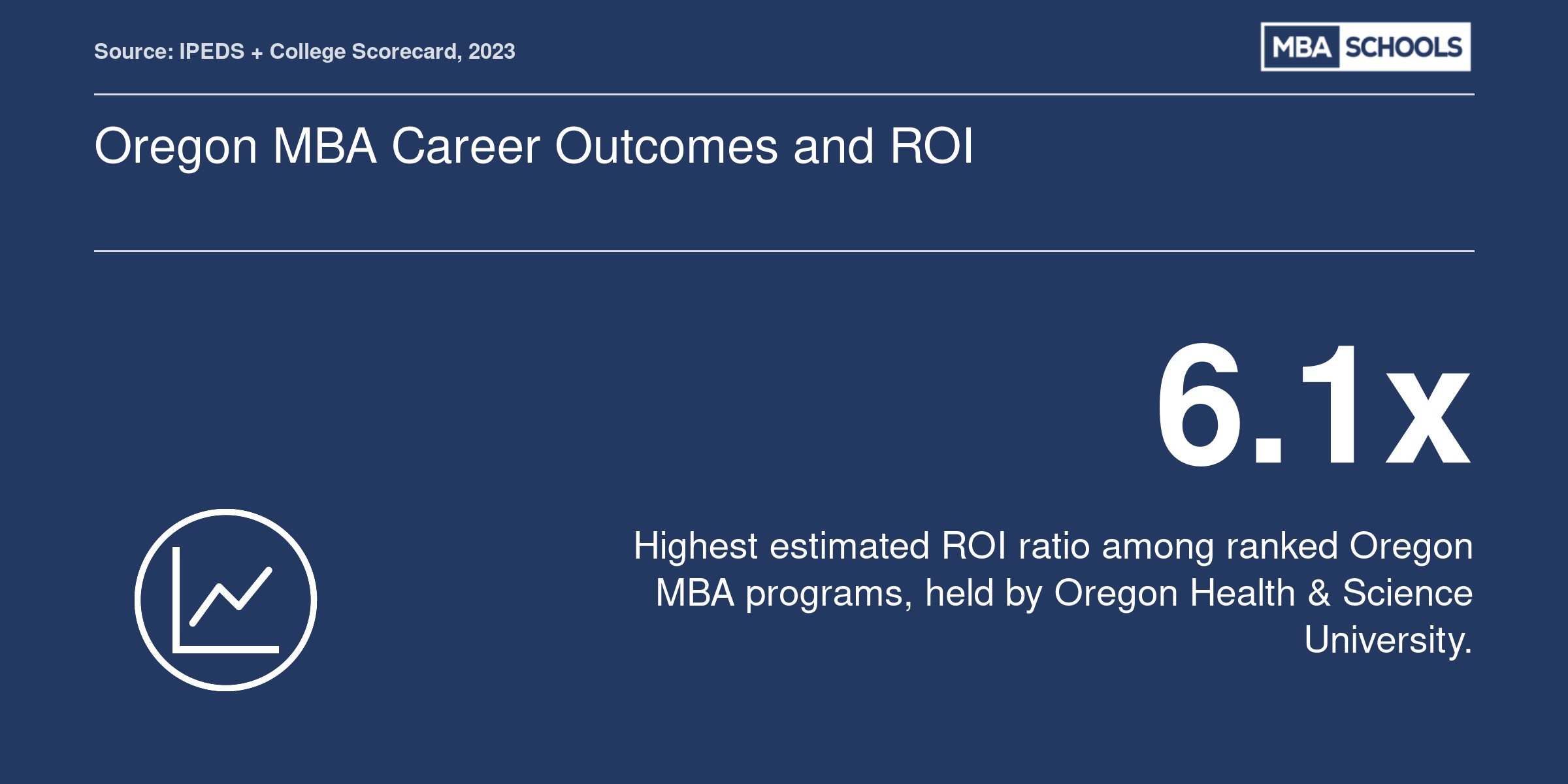
Program-level earnings data for MBA completers at one year and four years after graduation are not yet available for Oregon's ranked MBA programs. While institution-wide median earnings at ten years post-enrollment provide a useful benchmark, granular post-MBA salary figures and shares of graduates earning above poverty thresholds have not been published for these specific programs. Among the schools we evaluated, ROI ratios range from roughly 2.4 to 6.1, with Oregon Health & Science University delivering the strongest estimated return relative to debt, followed by Oregon State University and the University of Oregon.
Oregon MBA Employer Recruitment and Job Placement
Oregon's employer landscape offers MBA graduates a distinctive mix of global brands, advanced manufacturing, healthcare systems, and a fast-growing tech corridor. Understanding which companies recruit from the state's business schools, and how Oregon's industry mix aligns with popular MBA specializations, can help you target programs that lead directly to the roles you want.
Major Employers Recruiting Oregon MBAs
Several Fortune 500 companies and large regional employers maintain deep recruitment pipelines with Oregon business schools:
- Nike (Beaverton): Ranked the sixth most attractive employer for MBA graduates nationally in 2025, Nike actively recruits for brand management, supply chain, finance, and sustainability roles.1 Its global headquarters sits just minutes from Portland, making Oregon MBAs especially competitive for internships and full-time positions.
- Intel (Hillsboro): Oregon's largest private employer runs major semiconductor fabrication facilities in the Portland metro. MBA graduates with operations, analytics, or supply chain concentrations find strong demand here.
- Providence Health & Services: One of the largest healthcare systems in the Pacific Northwest, Providence recruits MBA holders for administrative leadership, strategy, and healthcare management positions across its Oregon network.
- Columbia Sportswear and Adidas: Portland's reputation as the sportswear capital of the world is well earned. Both companies hire MBAs for marketing, product management, and global operations.
- Daimler Trucks North America: Headquartered in Portland, Daimler brings demand for MBAs skilled in operations, logistics, and clean energy strategy as the company invests in electric commercial vehicles.
University of Oregon's Lundquist College reports placement at employers including Amazon, Wells Fargo, PricewaterhouseCoopers, KPMG, Deloitte, EY, and Fisher Investments.2 Oregon State University's College of Business places the majority of its graduates in-state and reports an 85% placement rate overall.3
Portland's Tech and Startup Ecosystem
Beyond legacy employers, Portland's tech corridor continues to expand. The metro area hosts satellite offices for companies like Google and Amazon alongside a growing roster of startups in software, clean energy, and food technology. As of spring 2026, Glassdoor listed roughly 346 open MBA-level positions across Oregon4, and survey data from the GMAC Corporate Recruiters Survey shows that 26% of employers in the region planned to increase MBA hiring, with another 29% looking to boost hiring of experienced MBA professionals.
How Oregon's Industries Map to MBA Specializations
Oregon's economic base creates natural alignment between local industries and in-demand MBA concentrations. For a broader look at how different specializations translate into earnings, see our guide to mba career paths and salaries.
- Supply chain and operations: Nike, Intel, Columbia Sportswear, and Daimler all run complex global supply networks rooted in Oregon.
- Marketing and brand management: The sportswear and apparel cluster makes Portland one of the top metros for consumer brand careers.
- Healthcare management: Providence Health, Oregon Health & Science University, and a growing network of regional health systems fuel demand for MBA-trained administrators.
- Sustainability and clean energy: Oregon's policy environment and employer commitments to decarbonization create openings for graduates with sustainability concentrations.
- Business analytics: Intel and the broader tech ecosystem need analysts who can bridge data science and business strategy.
Cost-of-Living Advantage
One factor that often gets overlooked in MBA return-on-investment calculations is where you live after graduation. Portland's cost of living remains meaningfully lower than Seattle or San Francisco, which means your post-MBA salary stretches further and your debt-to-income ratio improves faster. Our ranking of the best states for MBA graduates provides additional context on how Oregon stacks up. Program-level employment share data for Oregon MBA completers is not yet published at the granular level, but the combination of competitive mba salaries and moderate living costs positions Oregon graduates favorably compared to peers in higher-cost West Coast metros.
For working professionals weighing where an MBA will deliver the strongest career return, Oregon's concentrated employer base, expanding tech scene, and livable metro areas create a compelling case for earning and using your degree in-state.
Related Articles
Online MBA Programs in Oregon: Format, Flexibility, and Outcomes
Choosing between an online MBA in Oregon and a hybrid format is one of the most consequential decisions you will make during your search. The distinction affects your weekly schedule, your ability to continue working full-time, and how you build professional relationships with classmates and faculty. Here is how Oregon's ranked programs break down by delivery format, along with what each model means for your day-to-day experience.
Fully Online MBA Programs in Oregon
Among the programs featured in our rankings, Southern Oregon University stands out as the only fully online option. Its MBA program is delivered entirely asynchronously, meaning there are no required login times or live class sessions. Courses run in seven-week terms, and the program is designed so you can apply concepts at work the same week you learn them. With a total tuition of roughly $19,350 and a 16-month timeline, it is built for working professionals who need maximum scheduling freedom.
Hybrid MBA Programs in Oregon
The remaining ranked programs operate in a hybrid format that blends online coursework with periodic in-person components:
- Oregon State University (Business Analytics MBA): Cohort-based with evening classes held in Portland, combining synchronous and asynchronous elements across 60 credit hours.
- University of Oregon (Oregon Executive MBA): A Portland-based weekend program spanning 20 months, designed for professionals averaging 15 years of work experience.
- Portland State University (Healthcare MBA): A 21-month, cohort-based program with synchronous and asynchronous delivery, structured around 63 credit hours.
- Pacific University: A 36-credit-hour hybrid program offering an optional international seminar and corporate landscape tours.
- Oregon Health & Science University (Healthcare Management MBA): A 63-credit-hour program with asynchronous online classes and team-based capstone consulting projects.
Hybrid programs typically require you to be in the Portland metro area (or occasionally Corvallis) for weekend residencies, evening sessions, or intensive immersion experiences. This is worth factoring in if you live outside the Willamette Valley corridor.
Synchronous vs. Asynchronous: What It Means for Your Schedule
Synchronous delivery requires you to attend live virtual or in-person sessions at set times, which fosters real-time discussion but limits flexibility. Asynchronous coursework lets you engage with lectures, assignments, and discussion boards on your own timeline within a given week. Most hybrid programs in Oregon use a mix of both, while Southern Oregon University relies entirely on asynchronous delivery. Cohort-based structures, used by Oregon State, Portland State, and the University of Oregon, keep you progressing with the same group of peers, which strengthens networking but limits the ability to speed up or slow down.
Earnings and Debt: What the Data Shows
Program-level earnings and debt outcomes are not yet available for Oregon's MBA programs in public reporting data. That means a direct comparison of financial returns between online and hybrid formats is not possible at this time. However, institutional outcomes paint a useful backdrop: Oregon State reports a 97% job placement rate for its business analytics graduates, and OHSU graduates across programs show strong earning trajectories. As program-level data becomes available, we will update these comparisons.
What Is the Quickest Online MBA?
Program duration is not tracked in our data, but based on published program details, Southern Oregon University's 16-month online MBA is the fastest option among ranked Oregon programs. More broadly, accelerated online MBA programs across the country can be completed in as few as 12 to 18 months, typically by compressing courses into shorter terms and running year-round without summer breaks. If speed is your priority, look for programs with multiple start dates per year and seven- or eight-week course terms, both features Southern Oregon University offers. Prospective students in neighboring states exploring similar accelerated options may also want to review online mba Idaho programs for additional comparisons. Regardless of format, confirming that your chosen program holds proper mba program accreditation is essential before enrolling.
Fastest and Most Affordable MBA Options in Oregon
Sticker price alone never tells the full story. The three most affordable MBA programs in Oregon each carry in-state tuition below $18,000, but their effective net prices and long-term earning power vary significantly. Portland State University stands out with the lowest net price at $9,552, while Oregon State University delivers the strongest ROI ratio (roughly 3.0x) thanks to higher median earnings relative to cost. When evaluating whether a lower-cost online MBA is 'worth it,' look beyond tuition to the earnings-to-cost relationship outlined in the ROI section above. Many Oregon programs also offer accelerated formats that can be completed in 12 to 18 months, letting you re-enter the job market sooner, though note that our rankings data does not include credit hours or exact program duration for every school.
| School | In-State MBA Tuition | Effective Net Price | Median Graduate Debt | Median Earnings (10 yr) | ROI Ratio | Format |
|---|---|---|---|---|---|---|
| Portland State University | $17,745 | $9,552 | $20,500 | $57,906 | 2.82x | Hybrid |
| Southern Oregon University | $17,874 | $16,732 | $20,332 | $49,175 | 2.42x | Online |
| Oregon State University | $16,206 | $19,604 | $21,221 | $64,010 | 3.02x | Hybrid |
According to the 2024 GMAC Corporate Recruiters Survey, MBA graduates earn roughly 1.75 times the salary of bachelor's degree holders. Meanwhile, about one in three U.S. employers plan to hire MBA talent in the coming year, signaling strong and sustained demand for the degree across industries.
Admissions Requirements for Oregon MBA Programs
Understanding what each Oregon MBA program expects from applicants can save you time and help you target the right fit. Requirements vary, but most programs weigh a combination of standardized test scores, undergraduate GPA, professional experience, and application essays.
GMAT and GRE Expectations
Oregon MBA programs span a wide range of typical GMAT scores, reflecting different levels of selectivity. The University of Oregon Lundquist College of Business reports average GMAT scores in the 650 to 670 range1, which sits above the national average of roughly 622 across all U.S. MBA programs. Oregon State University falls in the 610 to 630 range, while Portland State University typically sees scores between 570 and 590. Willamette University's Atkinson Graduate School of Management does not always report a median GMAT, though competitive applicants generally align with the mid-600s.
The good news for test-averse professionals: all four of these programs offer GMAT or GRE waivers.1 Waiver eligibility criteria differ by school but commonly include significant professional experience, an advanced degree, or a strong undergraduate GPA. Southern Oregon University goes a step further and does not require an entrance exam at all, making it one of the most accessible MBA options in the state.
GPA and Work Experience Norms
Minimum GPA expectations across Oregon MBA programs generally hover around 3.0, though admitted cohorts tend to exceed that threshold:
- UO Lundquist: Average GPA of 3.4 to 3.51
- Oregon State: Average GPA around 3.3
- Willamette Atkinson: Average GPA between 3.2 and 3.4
- Portland State: Average GPA near 3.2
Work experience requirements also vary. Full-time MBA programs at UO and OSU typically enroll students with two to five years of professional experience, while Portland State's cohort-based MBA is designed specifically for working professionals and tends to attract candidates with more substantial careers. The Oregon Executive MBA at UO, a Portland-based hybrid program, draws cohorts averaging around 15 years of work experience.
Is 35 Too Late to Start an MBA?
Absolutely not. Many Oregon MBA cohorts include students in their mid-30s and beyond, and executive-format programs are built precisely for seasoned professionals. The Oregon Executive MBA at the Lundquist College enrolls candidates who are typically in their late 30s to mid-40s, and the average age in many part-time and online MBA programs across the state skews higher than traditional full-time cohorts. If anything, additional career experience strengthens your application and enriches classroom discussions. Programs increasingly value the perspective that mid-career professionals bring, and graduates at any age can pursue rewarding MBA career paths.
AACSB Accreditation and Institutional Selectivity
Accreditation matters because it signals rigorous academic standards and is recognized by top employers. Four Oregon business schools hold AACSB accreditation, the gold standard for business programs worldwide: UO Lundquist, Oregon State, Willamette Atkinson, and Portland State. Southern Oregon University's MBA is regionally accredited but does not hold AACSB status. Pacific University and OHSU offer specialized MBA tracks that carry their own institutional accreditation.
It is also worth noting that overall university admission rates can give you a general sense of institutional selectivity, though they reflect undergraduate and graduate admissions broadly rather than MBA-specific acceptance rates. Oregon State's university-wide rate is about 77%, UO's is around 88%, and Portland State's is roughly 91%. MBA admissions tend to be more selective than these headline figures suggest, so treat them as directional context rather than a precise indicator of your chances.
Pulling Your Application Together
Regardless of which Oregon MBA program you target, a strong application typically includes:
- A current resume highlighting leadership and career progression
- Two or three professional or academic letters of recommendation
- A statement of purpose connecting your goals to the program's strengths
- Official transcripts and, if not waived, a GMAT or GRE score
Start by checking each program's waiver eligibility. If you qualify, you can redirect the time and money you would spend on test prep toward crafting a compelling personal narrative. For the most current application requirements, visit each school's admissions page directly.
Popular MBA Specializations at Oregon Schools
Oregon's MBA landscape offers a focused set of specializations that map directly to the state's strongest industries. Rather than chasing trendy electives, the smartest approach is to match your concentration to the mba career path you want and the employers who are actually hiring in the region.
Business Analytics and Data Science
Oregon State University offers a dedicated Business Analytics MBA that integrates data science with core business strategy. Southern Oregon University also provides a Business Analytics concentration within its fully online MBA, covering SQL, data visualization, and Lean Six Sigma methods. These programs prepare graduates for roles in operations research, business intelligence, and data-driven decision-making, skills in high demand at Intel's semiconductor operations, Portland's growing tech startup ecosystem, and the analytics teams powering Nike and Columbia Sportswear's global supply chains.
Healthcare Management
Healthcare is one of Oregon's specialization strongholds. Three programs target this sector directly: Oregon Health & Science University offers an M.B.A. in Healthcare Management with team-based capstone consulting projects drawn from real health systems. Portland State University's Healthcare MBA is built through a partnership with OHSU itself, blending AACSB-accredited business training with clinical industry access. Pacific University rounds out the options with a Healthcare Management concentration that includes dual-degree pathways with its health sciences programs. If you are targeting leadership roles at Providence, Kaiser Permanente, or within the broader OHSU ecosystem, these programs offer built-in employer pipelines.
Executive Leadership and General Management
The University of Oregon's Executive MBA is a Portland-based weekend program designed for professionals averaging 15 years of experience. Its cohort of roughly 50 participants focuses on strategic leadership, global business immersion, and cross-functional management rather than a single technical track. This format suits senior professionals preparing to move into C-suite or VP-level positions.
Matching Your Specialization to Your Career Goal
Keep the decision practical:
- Supply chain and operations: Analytics-focused MBAs from Oregon State or Southern Oregon University align with logistics and operations roles at Oregon's major apparel and sportswear companies.
- Healthcare administration: Programs at OHSU, Portland State, or Pacific University connect you to one of the state's largest employment sectors.
- Technology management: Business analytics concentrations build the quantitative toolkit valued by Intel, tech firms along the Silicon Forest corridor, and Portland startups.
- Sustainability and social impact: Portland State University holds a Changemaker designation from Ashoka U, reflecting Oregon's commitment to sustainability and green economy leadership.
Choosing a specialization is ultimately about where you want to land after graduation. Oregon's programs are compact enough that each concentration has a clear employer audience, and graduates exploring best jobs for mba graduates will find that the alignment between what you study and who hires you tends to be unusually direct.
How to Choose the Right Oregon MBA Program
Selecting the right MBA program comes down to four variables: your career stage, your budget, your format preference, and the industries you want to break into or advance within. Oregon's business schools offer enough variety that there is a strong fit for almost every professional profile, but narrowing your options requires honest self-assessment.
Build Your Decision Framework
Start by mapping where you stand today against where you want to be in five years. Consider these factors:
- Career stage: Are you two to five years into your career and seeking a credential that opens doors, or are you a director-level leader looking to sharpen strategy skills?
- Budget: Can you invest in a premium program, or do you need to keep total costs under a specific threshold while continuing to earn a paycheck?
- Format: Do you thrive in a cohort-based classroom, or does a fully online, asynchronous format better suit your schedule?
- Industry focus: Oregon's economy leans heavily into technology, healthcare, sustainable business, and the outdoor industry. Programs with concentrations or employer networks in these sectors can accelerate your trajectory.
Three Personas, Three Paths
Consider how different professionals might approach the decision.
An early-career analyst with three years of experience may prioritize accredited mba programs that carry strong brand recognition with recruiters. A school like the University of Oregon's Lundquist College or Oregon State's College of Business provides that institutional credibility and access to on-campus recruiting pipelines.
A mid-career manager balancing family obligations and a full-time role may lean toward an affordable, accelerated online MBA that can be completed in under two years. Programs at schools like George Fox University or Portland State offer streamlined curricula designed for professionals who cannot step away from their careers.
An experienced executive with 15 or more years of leadership experience may find the best fit in a weekend or hybrid Executive MBA format. These programs are built around seasoned cohorts, with average participant ages typically ranging from 35 to 40.
Is 35 Too Late to Start an MBA?
Not at all. Executive MBA and online MBA formats exist precisely for professionals at this stage. At 35, you bring substantial real-world context to case discussions, peer learning, and capstone projects. Most EMBA cohorts are composed of professionals in their mid-30s to early 40s, meaning you will be surrounded by peers at a similar career level. Many admissions committees view a decade-plus of experience as an asset, not a liability.
Take the Next Step
Use the program rankings and cost comparisons above to shortlist two or three schools that align with your career stage, budget, and preferred format. Then request information directly from those programs. Admissions teams can provide details on upcoming cohort start dates, scholarship availability, and employer partnerships that may not appear on a public webpage. If you are still exploring options across the country, our directory of best mba programs can help you compare schools nationwide. The best way to evaluate fit is to start a conversation.
Frequently Asked Questions About Oregon MBA Programs
Oregon MBA applicants often share the same set of concerns around cost, speed, admissions, and accreditation. Below we answer the questions our readers ask most, drawing on the program details and data covered throughout this article.