
What you’ll learn in this article…
- Columbia and NYU Stern lead NYC MBA rankings, but CUNY Baruch Zicklin offers strong outcomes at a fraction of the cost.
- Employers in finance, tech, and media recruit heavily from NYC programs, with 89 percent of firms planning to hire MBA graduates.
- Several NYC schools now waive the GMAT, letting experienced professionals apply without months of standardized test preparation.
- Part-time and executive formats at Stern, Gabelli, and other schools let working professionals earn an MBA without leaving their jobs.
MBA programs in New York City sit at the intersection of three industries that dominate post-MBA hiring: finance, media, and technology. Columbia Business School and NYU Stern consistently place graduates into six-figure roles at firms headquartered within miles of campus, while public options like Baruch Zicklin offer AACSB-accredited MBAs at a fraction of the cost, with in-state tuition under $12,000 per year. For a closer look at how the city's two flagship programs stack up, see our nyu stern vs columbia mba cost comparison.
The practical tension for most candidates is sharp. Tuition across NYC programs ranges from roughly $7,500 to over $70,000 annually, yet the city's cost of living applies equally to every student regardless of school prestige. Format matters too: part-time, executive, and GMAT-optional pathways have expanded significantly, but program structure can limit access to on-campus recruiting pipelines that drive the highest starting salaries. Choosing the right program means weighing those tradeoffs against your career timeline, not just a brand name.
Best MBA Programs in NYC: 2026 Rankings Overview
New York State is home to some of the nation's most respected MBA programs, from elite Ivy League institutions in Manhattan to high-value SUNY schools that deliver classes right in Midtown. The programs below were evaluated using federal data on institutional outcomes, cost, and graduate earnings, combined with independent research into each school's MBA offerings. Whether you want a full-time campus experience, a hybrid Executive MBA you can complete on Saturdays, or a dual degree that pairs business with medicine or law, this list covers the full spectrum of options for working professionals in and around New York City.
- Institutional graduation and retention rates
- Tuition, net price, and affordability
- Graduate earnings and debt levels
- Program format and career relevance
- NYC metro accessibility
- Internal program database
- Independent program research
- College Scorecard graduate earnings — collegescorecard.ed.gov
- NCES-IPEDS federal institutional data — nces.ed.gov

Columbia University in the City of New York
Columbia Business School sits in the heart of Manhattan and offers unmatched proximity to Wall Street, Big Tech offices, and major consulting firms. Its Executive MBA features two flexible schedule options, collaborative cluster learning, and a Value Investing Program with direct access to NYC's investor community. Columbia also offers accelerated JD/MBA programs through its law school and dual degrees in social work, making it one of the most versatile MBA platforms in the city. With a 96.1% institution-wide graduation rate, a 6:1 student-to-faculty ratio, and median earnings of $102,491 ten years after enrollment, the school delivers on both prestige and outcomes.
- Two schedule options: Friday/Saturday or Saturday only
- 20 to 24 month program length
- Weekly cluster group meetings in Midtown Manhattan
- Customizable elective courses across disciplines
- Specialized Career Management Center for executives
- International seminar opportunities included
- Employer sponsorship pathways welcomed
- Accelerated three-year dual degree format
- Joint program with Columbia Law School
- Comprehensive curriculum spanning law and business
- Practical learning through mentorship and internships
- Prepares graduates for leadership across sectors
- Campus-based program in upper Manhattan
- 71 credits at Columbia Law, 45 at Business School
- Summer placements in law and business settings
- Access to powerful alumni networks in both fields
- Financial aid available through both schools
- Experiential learning emphasis throughout curriculum
- Career services for legal and corporate paths
- Dual degree combining business and social work
- Shorter completion than pursuing degrees separately
- Focus on social enterprises and nonprofit leadership
- Campus-based learning in New York City
- School-specific financial aid for each program
- Prepares graduates for impact-driven leadership roles
Executive MBA — On-Campus
Three-Year JD/MBA — On-Campus
Four-Year JD/MBA — On-Campus
MBA and MS in Social Work — On-Campus

CUNY Bernard M Baruch College
Baruch College's Zicklin School of Business is one of the best-kept secrets in NYC business education. Located in Manhattan's Gramercy neighborhood, the Zicklin Executive MBA draws over 80% of its cohort from the NYC metro area, creating an intensely local professional network with deep ties to Wall Street, city government, and media. In-state tuition starts at just $11,452 at the undergraduate level, and the Executive MBA's all-inclusive cost of $86,500 makes it far more affordable than peer programs at private institutions. Median earnings reach $75,971 ten years after enrollment, and the program features a mandatory NYC Executive Leadership Seminar with guest speakers from top city organizations.
- 22-month Saturday-based program in Manhattan
- $86,500 all-inclusive tuition covers global study tour
- 75% of students promoted within two years of enrollment
- Average cohort has 13 years of professional experience
- 49% women representation in recent cohorts
- Executive mentoring and leadership seminar included
- 48 total academic credits required
Executive MBA — On-Campus

Cornell University
Cornell University's Johnson Graduate School of Management ranks among the top MBA programs in the country, and its dual-campus track lets students spend their second year at Cornell Tech on Roosevelt Island in New York City. This NYC immersion includes intensive courses in fintech, real estate, and tech entrepreneurship alongside direct engagement with startups and venture firms. Cornell also offers Executive MBA cohorts based at its NYC campus, a bilingual Finance MBA with Tsinghua University, and healthcare leadership dual degrees. With a 95.4% institution-wide graduation rate and median earnings of $104,043, Cornell combines Ivy League rigor with genuine NYC career access.
- Full-time, cohort-based two-year program
- Dual-campus track option at Cornell Tech in NYC
- Concentrations in Entrepreneurship and Marketing available
- Capstone project with real venture capital evaluation
- eLab funding for accepted startup teams
- Summer Start-up program option between years
- Cross-campus collaboration with Cornell's tech ecosystem
- Only bilingual finance MBA offered globally
- Dual MBA degrees from Cornell and Tsinghua
- Two-year, part-time hybrid format with 60 credits
- 75% of coursework completed in Beijing
- Residential sessions in Ithaca, NY included
- Wall Street trek and fintech hackathon featured
- 20-month program earning two Cornell degrees
- No GMAT required for admission
- Residential sessions in both Ithaca and NYC
- 60 total credit hours with capstone project
- Rolling admissions with priority scholarship by May 1
- Tailored career services for healthcare professionals
- Full-time, cohort-based two-year program
- Dual-campus track option at Cornell Tech in NYC
- Concentrations in Entrepreneurship and Marketing available
- Capstone project with real venture capital evaluation
- eLab funding for accepted startup teams
- Summer Start-up program option between years
- Cross-campus collaboration with Cornell's tech ecosystem
- 20-month program earning two Cornell degrees
- No GMAT required for admission
- Residential sessions in both Ithaca and NYC
- 60 total credit hours with capstone project
- Rolling admissions with priority scholarship by May 1
- Tailored career services for healthcare professionals
- 20-month program earning two Cornell degrees
- No GMAT required for admission
- Residential sessions in both Ithaca and NYC
- 60 total credit hours with capstone project
- Rolling admissions with priority scholarship by May 1
- Tailored career services for healthcare professionals
- 20-month program earning two Cornell degrees
- No GMAT required for admission
- Residential sessions in both Ithaca and NYC
- 60 total credit hours with capstone project
- Rolling admissions with priority scholarship by May 1
- Tailored career services for healthcare professionals
- Three-year or four-year completion options
- Combines JD and MBA from two Ivy League schools
- Access to vast Cornell alumni network
- Corporate law and entrepreneurship focus areas
- Close-knit community with individualized goal support
- Research and experiential learning opportunities
Two-Year MBA, Entrepreneurship — On-Campus
Cornell-Tsinghua Finance MBA, Finance — Hybrid
Executive MBA/MS in Healthcare Leadership — Hybrid
Two-Year MBA, Marketing — On-Campus
Cornell Executive MBA Metro NY — Hybrid
Cornell Executive MBA/MS in Healthcare Leadership, Healthcare Leadership — Hybrid
Executive MBA Americas — Hybrid
JD/MBA — On-Campus
M.D.-M.B.A. — On-Campus

Binghamton University
Binghamton University's School of Management delivers its Executive MBA through a hybrid model explicitly designed for NYC professionals, with monthly Saturday classes held at SUNY's Midtown Manhattan headquarters. The 15-month program draws roughly 70% of its cohort from the NYC metro area and includes dedicated alumni networks for post-graduation placements in finance and pharmaceuticals. With in-state tuition of $13,950 and a net price of $21,620, Binghamton pairs public-university affordability with genuine NYC presence. The institution-wide graduation rate is 81.6%, and median earnings reach $80,596 ten years after enrollment.
- 15-month accelerated completion timeline
- Hybrid format: online sessions plus monthly NYC Saturdays
- Classes held at SUNY headquarters in Midtown Manhattan
- No prior business degree required for admission
- GMAT waiver available for experienced professionals
- Cohort draws 70% from NYC metro area
- NYC industry site visits and alumni network access
Executive MBA — Hybrid

University at Buffalo
The University at Buffalo's School of Management offers one of the broadest MBA concentration menus in the SUNY system, spanning analytics, entrepreneurship, finance, international management, and marketing. The campus-based program features hands-on tools like SAS, R, and Python in its analytics track, a startup incubator with pitch competitions offering $50,000+ in funding, and dual-degree options with engineering, law, public health, and social work. In-state tuition is $14,530, making it one of the most affordable ranked programs in New York. The institution-wide graduation rate stands at 75.2%, and median earnings reach $70,814 a decade after enrollment.
- 15-credit Analytics concentration with SAS, R, and Python
- Finance track covering portfolio theory and global economics
- Marketing focus with digital analytics and consumer behavior
- International Management track with study abroad options
- Real-world investment group and consulting experiences
- Dual-degree options in law, engineering, and public health
- Startup incubator with one-on-one mentoring
- Hands-on 3-credit entrepreneurship boot camp
- Pitch competitions with $50,000+ startup capital
- Connect with venture capitalists and angel investors
- Learn intrapreneurship for corporate innovation
- Thriving local entrepreneurship ecosystem access
- 15-credit Analytics concentration with SAS, R, and Python
- Finance track covering portfolio theory and global economics
- Marketing focus with digital analytics and consumer behavior
- International Management track with study abroad options
- Real-world investment group and consulting experiences
- Dual-degree options in law, engineering, and public health
- Startup incubator with one-on-one mentoring
- Hands-on 3-credit entrepreneurship boot camp
- Pitch competitions with $50,000+ startup capital
- Connect with venture capitalists and angel investors
- Learn intrapreneurship for corporate innovation
- Thriving local entrepreneurship ecosystem access
- 15-credit Analytics concentration with SAS, R, and Python
- Finance track covering portfolio theory and global economics
- Marketing focus with digital analytics and consumer behavior
- International Management track with study abroad options
- Real-world investment group and consulting experiences
- Dual-degree options in law, engineering, and public health
- Startup incubator with one-on-one mentoring
- Hands-on 3-credit entrepreneurship boot camp
- Pitch competitions with $50,000+ startup capital
- Connect with venture capitalists and angel investors
- Learn intrapreneurship for corporate innovation
- Thriving local entrepreneurship ecosystem access
- Startup incubator with one-on-one mentoring
- Hands-on 3-credit entrepreneurship boot camp
- Pitch competitions with $50,000+ startup capital
- Connect with venture capitalists and angel investors
- Learn intrapreneurship for corporate innovation
- Thriving local entrepreneurship ecosystem access
- Startup incubator with one-on-one mentoring
- Hands-on 3-credit entrepreneurship boot camp
- Pitch competitions with $50,000+ startup capital
- Connect with venture capitalists and angel investors
- Learn intrapreneurship for corporate innovation
- Thriving local entrepreneurship ecosystem access
- Startup incubator with one-on-one mentoring
- Hands-on 3-credit entrepreneurship boot camp
- Pitch competitions with $50,000+ startup capital
- Connect with venture capitalists and angel investors
- Learn intrapreneurship for corporate innovation
- Thriving local entrepreneurship ecosystem access
Master of Business Administration, Analytics — On-Campus
MBA, Entrepreneurship — On-Campus
Master of Business Administration, Finance — On-Campus
Master of Business MBA, International Management — On-Campus
Master of Business Administration, Marketing Management — On-Campus
JD/MBA — On-Campus
MD-MBA Dual Degree Program, Health Care Management — On-Campus
MPH/MBA, Health Services Administration — On-Campus
MBA/MSW Dual Degree — On-Campus

Rensselaer Polytechnic Institute
Rensselaer Polytechnic Institute's Lally School of Management combines MBA training with a technology and innovation focus that sets it apart from traditional business schools. The 45-credit MBA can be completed in as few as 12 months and offers six concentration options, including a Finance track with Corporate Finance and Investments pathways. Students gain consulting experience through a non-pay practicum with real organizations. Tuition is $64,054 and the institution-wide graduation rate is 83.6%, with median earnings of $102,051 a decade after enrollment. RPI also offers an Executive MBA with alternating-weekend classes and an international residency.
- 45 total credit hours across 15 courses
- Can be completed in as few as 12 months
- Finance track: Corporate Finance or Investments pathway
- Non-pay consulting practicum with real organizations
- Professional development workshop series included
- Focus on innovation and technology management
- AACSB-accredited with capstone requirement
- Alternating weekend class schedule for working managers
- International business residency component
- Cohort-based structure with small study groups
- Designed for experienced managers and executives
- Compatible with full-time employment
- Interactive faculty collaboration throughout
Master of Business Administration, M.B.A., Finance — On-Campus
Executive Master's of Business Administration — On-Campus

University of Rochester
The University of Rochester's Simon Business School offers a Full-Time MBA with concentrations in entrepreneurship and brand management, both of which carry STEM designation. The program features experiential learning through the Simon Venture Fund, where students make real investment decisions, and the Mark Ain Business Model Competition for cash prizes. Simon also offers a 21-month hybrid Executive MBA that does not require a GMAT or GRE for admission. Tuition is $39,310, the institution-wide graduation rate is 85.4%, and median earnings reach $79,042 ten years after enrollment.
- STEM-designated MBA with entrepreneurship concentration
- Simon Venture Fund for hands-on investment experience
- Mark Ain Business Model Competition with cash prizes
- Brand Management track with digital marketing focus
- Ain Center for Entrepreneurship and Innovation support
- UR Ventures helps commercialize intellectual property
- World-class faculty in pricing and commerce
- STEM-designated MBA with entrepreneurship concentration
- Simon Venture Fund for hands-on investment experience
- Mark Ain Business Model Competition with cash prizes
- Brand Management track with digital marketing focus
- Ain Center for Entrepreneurship and Innovation support
- UR Ventures helps commercialize intellectual property
- World-class faculty in pricing and commerce
- 21-month hybrid format with remote or in-person options
- No GMAT or GRE required for admission
- Average student age of 37 with 10 to 15 years experience
- Optional global immersion component
- Executive coaching included throughout program
- Strong ROI ranking among executive programs
Full-Time MBA, Entrepreneurship — On-Campus
Full-Time MBA, Brand Management — On-Campus
Executive MBA — Hybrid
MD/MBA, Health Care Management — On-Campus

Upstate Medical University
SUNY Upstate Medical University, in partnership with Syracuse University's Whitman School of Management, offers a five-year MD/MBA dual degree tailored for aspiring physicians who want to lead in healthcare administration. Students begin with MBA coursework at Syracuse before transitioning to medical studies at Upstate, with a summer practicum bridging the two disciplines. The program is campus-based in Syracuse, and median earnings across the institution reach $92,257 ten years after enrollment. This is a specialized choice for professionals committed to healthcare leadership rather than a traditional MBA path.
- Five-year dual-degree combining MD and MBA
- Partnership with Syracuse University's Whitman School
- Includes summer practicum blending business and clinical work
- AMCAS application required (same as medical school)
- Prepares graduates for healthcare leadership roles
- Campus-based instruction in Syracuse, NY
MD/MBA — On-Campus

Albany Medical College
Albany Medical College offers a Dual MD/MBA in Healthcare Management for students who want to combine clinical training with business acumen. This five-year, campus-based program allows credits to transfer between institutions, reducing total time and cost compared to earning each degree independently. The curriculum focuses on managing medical practices, delivering quality care under cost constraints, and leading healthcare teams. Tuition is $28,820, and the program is best suited for those with a clear commitment to healthcare rather than general MBA seekers. Detailed net price and graduation rate data are not currently available for this institution.
- Five-year dual degree combining MD and MBA
- Focus on healthcare management and quality care
- Credits transfer between institutions to save time
- Campus-based program in Albany, NY
- Clinical and business curriculum integrated throughout
- Leadership training for physicians entering administration
Dual MD/MBA in Healthcare Management, Healthcare Management — On-Campus

University at Albany
The University at Albany's School of Business offers an AACSB-accredited MBA with a JD option through Albany Law School, allowing students to earn both degrees in four years. The program is designed for first-year law students with a passion for business law, corporate advisory, or legal consulting. In-state tuition starts at $13,808, making it one of the most affordable options on this list, and the net price is $17,167. The institution-wide graduation rate is 61.4%, and median earnings reach $67,979 ten years after enrollment. A GMAT waiver may be available for applicants with a strong LSAT score.
- Earn both MBA and JD in four years
- Dual AACSB accreditation for business program
- GMAT waiver possible with high LSAT score
- Focus on practical business and legal skills
- Strong alumni network and career services
- Campus-based program in Albany, NY
- Prepares for corporate attorney and advisor roles
MBA with JD Option — On-Campus
Program Comparison Table: Tuition, Earnings & Completion Rates
The table below compares key metrics across MBA programs in the New York State area, including tuition, institutional graduation rates, median earnings ten years after enrollment, and student-to-faculty ratios. Note that tuition figures shown are institution-level annual rates reported to federal databases and may differ from the total cost of a specific MBA program. Program-level earnings data is not yet available for these schools, so the median earnings column reflects university-wide outcomes ten years after enrollment.
| School | City | Annual Tuition (In-State) | Annual Tuition (Out-of-State) | Graduation Rate | Median Earnings (10 Yr) | Median Graduate Debt | Student-to-Faculty Ratio | Admission Rate |
|---|---|---|---|---|---|---|---|---|
| Columbia University | New York | $57,973 | $57,973 | 96.1% | $102,491 | $21,500 | 6:1 | 4.0% |
| Cornell University | Ithaca | $30,160 | $30,160 | 95.4% | $104,043 | $14,000 | 9:1 | 8.8% |
| New York University | New York | $42,726 | $42,726 | 87.6% | $82,509 | $20,500 | 8:1 | 9.2% |
| Baruch College (CUNY) | New York | $11,452 | $20,882 | 72.1% | $75,971 | $11,512 | 19:1 | 47.5% |
| Rensselaer Polytechnic Institute | Troy | $64,054 | $64,054 | 83.6% | $102,051 | $23,750 | 14:1 | 63.5% |
| University of Rochester | Rochester | $39,310 | $39,310 | 85.4% | $79,042 | $21,000 | 9:1 | 40.1% |
| Binghamton University | Vestal | $13,950 | $27,140 | 81.6% | $80,596 | $18,500 | 18:1 | 38.6% |
| University at Buffalo | Buffalo | $14,530 | $28,210 | 75.2% | $70,814 | $19,000 | 11:1 | 74.2% |
| Stony Brook University | Stony Brook | $14,222 | $29,242 | 75.6% | $74,502 | $18,228 | 19:1 | 49.0% |
| University at Albany | Albany | $13,808 | $27,468 | 61.4% | $67,979 | $19,500 | 16:1 | 69.1% |
| Le Moyne College | Syracuse | $20,393 | $20,393 | 73.1% | $62,731 | $23,000 | 12:1 | 83.0% |
| Touro University | New York | $14,979 | $14,979 | 72.4% | $53,419 | $15,547 | 10:1 | 60.8% |
Questions to Ask Yourself
Most Affordable MBA Programs in NYC
New York City has a well-earned reputation for high costs, but that does not have to extend to your MBA. Several programs in the NYC metro area offer surprisingly accessible price points, especially within the public university systems. If cost is a top concern, understanding the difference between sticker price and what students actually pay after aid can reshape your shortlist entirely.
CUNY Baruch Zicklin: The Standout Value
Baruch College's Zicklin School of Business is, by a wide margin, the most affordable MBA option in the city for New York residents. Graduate tuition at Baruch runs approximately $11,452 per year for in-state students. The institution-wide average net price (after grants and scholarships) sits at just $3,033, the lowest among all New York schools in our dataset. While that net price figure reflects the undergraduate population and not MBA students specifically, it signals the depth of financial support available across the CUNY system.
For out-of-state or international students, Baruch's graduate tuition rises to roughly $20,882 per year. That gap of nearly $9,400 per year is worth planning for, though it still undercuts most private alternatives by a significant margin. Zicklin also holds AACSB accreditation and sits in the Flatiron District, giving students direct access to Wall Street, Midtown employers, and a deep alumni network across finance and accounting.
Other Public Options Worth Considering
Several SUNY system schools offer MBA programs that serve the broader New York City area at public-school rates:
- Stony Brook University: Graduate tuition is approximately $14,222 in-state and $29,242 out-of-state. Stony Brook's MBA programs include hybrid formats, and the campus is within commuting distance of the city for Long Island-based professionals.
- Binghamton University: In-state graduate tuition is around $13,950, with out-of-state rates near $27,140. Binghamton's Executive MBA program uses a hybrid model with NYC-based in-person sessions, making it accessible to city professionals without a full relocation.
- SUNY New Paltz: With graduate tuition starting near $12,812 for residents, New Paltz is among the cheapest MBA programs in the state. It is farther from Manhattan but may appeal to those in the Hudson Valley corridor.
Across all public schools, expect the tuition gap between in-state and out-of-state students to range from roughly $9,000 to $15,000 per year. International students typically pay the out-of-state rate.
Private Schools at Lower Price Points
Not every private institution carries a six-figure price tag. Two NYC-area private schools stand out for relative affordability:
- University of Mount Saint Vincent (Bronx): Offers an online MBA with total program tuition advertised around $15,720, or $524 per credit for 30 credits. The locked tuition rate means no surprise increases, and no GMAT is required.
- St. Joseph's University, New York (Brooklyn): Graduate tuition is approximately $23,278 per year, with small class sizes and CPA-preparation tracks.
These options trade brand prestige for practical value, particularly for professionals who need a credential without taking on heavy debt.
Scholarships and Financial Aid
Scholarship availability varies widely from school to school and year to year. CUNY and SUNY schools tend to offer need-based aid, tuition waivers for graduate assistants, and occasional merit scholarships. Private schools like Mount Saint Vincent and St. Joseph's often provide institutional grants that reduce the effective cost well below the published tuition rate.
The most reliable step you can take is to contact each school's financial aid office directly. Ask specifically about graduate-level aid (not just undergraduate packages), employer tuition reimbursement partnerships, and any fellowship or assistantship opportunities. For a broader look at funding strategies, our guide to financing your MBA covers federal loans, scholarships, and creative ways to reduce out-of-pocket costs. Many NYC employers also offer tuition benefits that pair well with part-time or evening MBA formats, effectively reducing your expenses further.
The bottom line: an MBA in New York City does not require an Ivy League budget. Public institutions like Baruch Zicklin offer exceptional value, and several private schools keep costs well below the NYC average. Start by comparing net costs rather than sticker prices, and factor in format, commute, and career goals alongside the tuition number.
Related Articles
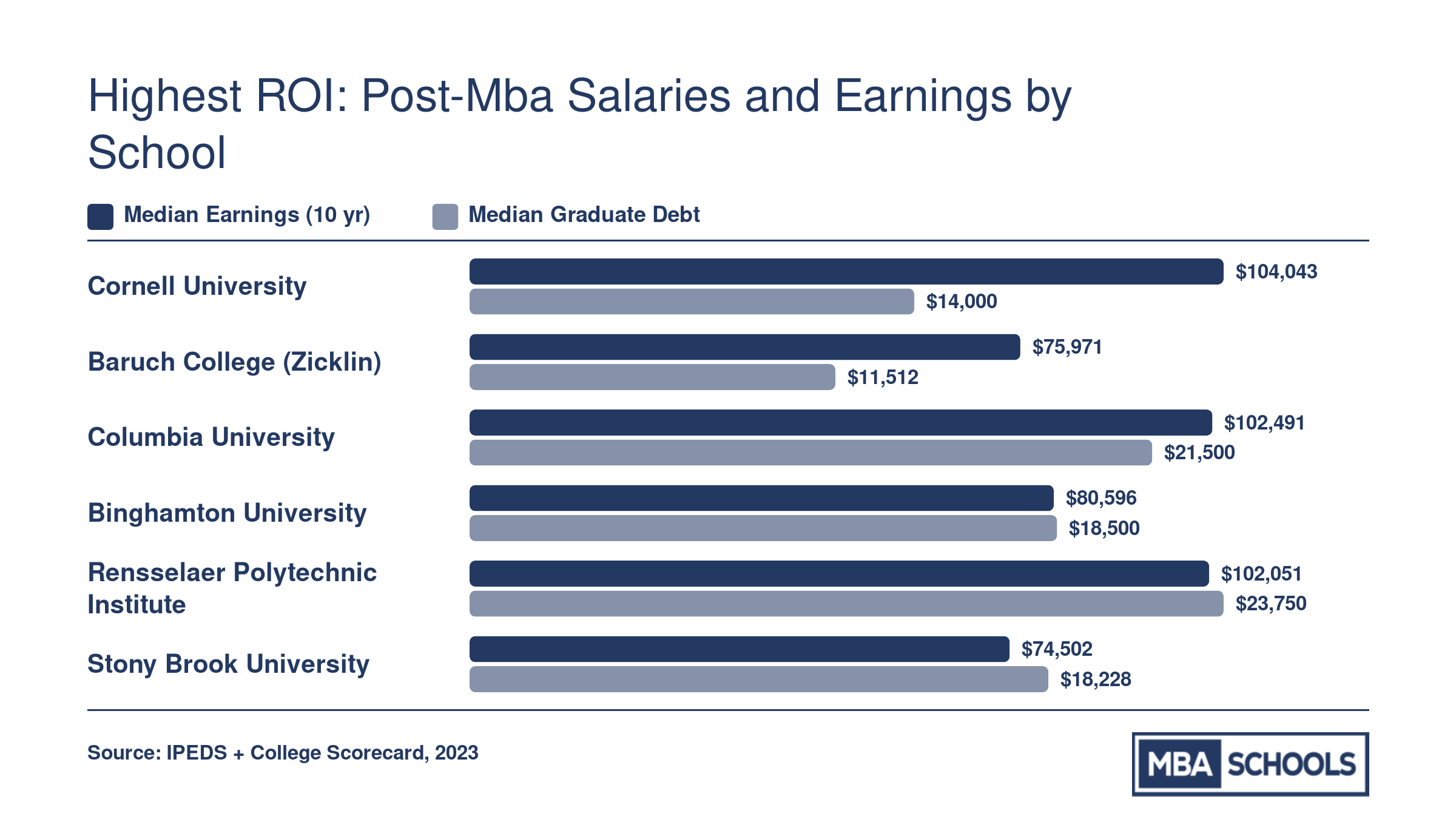
Highest ROI: Post-MBA Salaries and Earnings by School
Return on investment is the metric that separates a smart MBA decision from an expensive credential. To evaluate ROI, compare each school's median earnings ten years after enrollment against the median graduate debt its students carry. A higher earnings-to-debt ratio means you recoup your investment faster and keep more of your salary. Among New York State MBA programs, public universities like Baruch College (Zicklin) deliver standout value because low tuition translates into minimal borrowing, while elite private programs like Cornell and Columbia command higher debt but also produce top-tier earnings.
Best NYC MBA Programs by Career Focus: Finance, Tech & Media
New York City is not just a place to earn an MBA. It is the workplace itself. With more Fortune 500 headquarters than any other U.S. city, a tech sector that rivals the Bay Area in venture capital activity, and the undisputed center of American media, NYC gives MBA students something no other metro can fully replicate: direct, daily access to the industries they want to enter. The key is matching your target career to the program that feeds it.
Finance and Wall Street
If your goal is investment banking, asset management, private equity, or corporate finance, two programs dominate the conversation. Columbia Business School has long been a feeder to Wall Street, with its Executive MBA and full-time programs drawing on deep relationships with firms headquartered minutes from campus. NYU Stern, located in the heart of Manhattan, offers specializations in accounting and finance alongside roughly 20 concentration options, giving students granular control over their curriculum. Stern's proximity to the Financial District and Midtown trading floors creates internship and networking pipelines that are hard to match. For a detailed breakdown of how these two flagships compare, see our NYU Stern vs Columbia MBA ROI analysis.
Baruch College's Zicklin School of Business is an often-overlooked contender. As a public institution with dramatically lower tuition, Zicklin's Executive MBA draws seasoned professionals already embedded in New York's financial services industry, and its alumni network runs deep across the city's banks and consulting firms.
Rensselaer Polytechnic Institute (RPI) also offers a finance concentration within its MBA, with a curriculum that bridges corporate finance and technology management, a combination increasingly valued by fintech employers.
Tech and Data Analytics
New York's tech ecosystem has matured well beyond the "Silicon Alley" label. Companies like Google, Amazon, and Meta maintain large NYC offices, and the city is home to thousands of startups. MBA programs that emphasize analytics and entrepreneurship position graduates for this market.
Cornell University's Two-Year MBA features an entrepreneurship concentration with a dual-campus track that includes time in New York City. Students can participate in real venture capital courses and the eLab startup accelerator. The University of Rochester's Simon Business School similarly offers an entrepreneurship focus, with hands-on vehicles like the Simon Venture Fund and the Ain Center for Entrepreneurship.
NYU Stern rounds out the tech picture with mba specializations that touch data analytics, digital marketing, and e-commerce, all areas where NYC employers are actively hiring MBAs.
Media, Entertainment and Marketing
New York is the global capital of publishing, advertising, and broadcast media. NYU Stern is the clearest fit here, given its location in Greenwich Village and its broad set of marketing-adjacent concentrations. Stern graduates regularly land at media conglomerates, major ad agencies, and entertainment companies headquartered in Midtown.
Columbia Business School also provides strong pathways into media and entertainment through its elective curriculum and the broader Columbia University network, which includes one of the nation's top journalism schools and a thriving film program.
Choosing by Industry, Not Prestige Alone
The practical takeaway: let your target industry guide your shortlist. A career in investment banking points toward Columbia, NYU Stern, or Baruch Zicklin. Aspiring tech founders and product managers should look closely at Cornell and NYU Stern. Media and marketing professionals will find NYU Stern and Columbia best positioned. Cost matters too. Baruch Zicklin offers a fraction of the tuition of its private-school peers, which can dramatically improve your return on investment if you are entering a mid-tier salary band rather than chasing a Wall Street bonus. Graduates who want to explore paths beyond traditional finance and consulting may also want to consider non-traditional MBA career paths.
Part-Time, Executive & Online MBA Options in NYC
Not every MBA candidate can step away from a career for two years. New York City's business schools recognize this reality, which is why several of the area's top programs offer part-time, executive, and online formats designed for working professionals. Understanding the mba application deadlines and structural differences across these formats is essential to planning your next move.
How Application Timelines Differ From Full-Time Programs
One of the most common mistakes prospective students make is assuming that part-time and executive MBA programs follow the same admissions calendar as full-time options. They often do not. Full-time MBA programs at schools like Columbia Business School and NYU Stern typically operate on a traditional fall-entry cycle with two or three application rounds. Part-time and executive programs, by contrast, may accept applications on a rolling basis, use different round structures, or have multiple start dates throughout the year.
Columbia Business School, for example, posts distinct deadlines for its full-time MBA (August 2026 entry), with the first application round closing on September 3, 2025.1 Interviews for that round are scheduled on a rolling basis, and decisions are released by December 15, 2025.1 Incomplete applications roll forward to the next round.1 Executive and part-time options at Columbia and peer institutions typically maintain their own dedicated admissions pages with separate timelines.
When researching programs at NYU Stern, Fordham Gabelli, Baruch Zicklin, or Pace Lubin, look for specific tabs labeled "Part-Time MBA" or "Executive MBA" on each school's admissions site. These pages will outline the rounds, deadlines, and any prerequisites that differ from the full-time track.
Staying on Top of Deadlines
Application rounds for fall entry often open as early as August or September, with first-round deadlines falling in October or November. Later rounds can extend well into the spring, giving candidates more flexibility. However, earlier rounds tend to offer the best odds for scholarships and financial aid.
A few practical steps can keep you on track:
- Bookmark official admissions pages: Sites like columbia.edu and stern.nyu.edu are your primary sources. Program-specific pages are updated annually and should always be your final reference.
- Use aggregator sites for context: Resources like Poets&Quants and Clear Admit publish historical deadline data and can help you anticipate when rounds are likely to open. Treat these as planning tools, not substitutes for official announcements.
- Set calendar reminders early: Block key months (August through November for early rounds, January through April for later rounds) so you have ample time to gather recommendations, finalize essays, and prepare for interviews.
- Verify every detail directly with the school: Deadlines shift from year to year, and even small changes can affect your eligibility. A quick email or phone call to the admissions office can save you from a costly oversight.
Choosing the Right Format
Part-time programs, such as those at NYU Stern and Baruch Zicklin, are structured around evening or weekend classes and typically take two to three years to complete. Executive MBA programs compress coursework into alternating weekends or intensive residency blocks, targeting professionals with significant management experience. Online or hybrid formats, increasingly common across NYC schools, add geographic flexibility while still providing access to the city's professional networks.
Each format comes with its own tuition structure, cohort dynamics, and networking opportunities. Whichever path you choose, the key is to begin your research well before the first deadline so you can apply from a position of strength rather than scrambling to catch up.
NYC MBA Programs Without GMAT Requirements
A growing number of NYC business schools now offer GMAT or GRE waivers, and some have adopted permanent test-optional policies. If you have strong professional credentials but limited time for standardized test prep, these pathways can save months in your application timeline. That said, waiver policies shift frequently, so verifying current requirements directly with each school is essential.
Which NYC Schools Offer GMAT Waivers or Test-Optional Admissions?
Several prominent programs in the city have relaxed their testing requirements in recent years:
- Baruch Zicklin: Zicklin's MBA program has offered GMAT/GRE waivers for applicants who meet specific GPA and work experience thresholds. Candidates with professional certifications such as CPA or CFA may also qualify.
- Pace Lubin: Pace University's Lubin School of Business provides a test waiver option for applicants with qualifying GPAs or significant managerial experience.
- Fordham Gabelli: Fordham has periodically offered GMAT waivers for candidates with demonstrated quantitative ability through coursework, professional certifications, or extensive career accomplishments.
- NYU Stern and Columbia Business School: These elite programs generally still require the GMAT or GRE for their full-time MBA tracks. However, some of their part-time, executive, or specialized programs may have waiver provisions for experienced professionals. Always confirm with the admissions office, as criteria can vary by program format and cohort year.
How to Determine If You Qualify for a Waiver
Do not rely on third-party forums alone. For a broader overview of what schools typically expect, review our guide to mba application requirements. Then follow these steps:
- Visit each school's official MBA admissions page and look for sections labeled "GMAT/GRE Waiver" or "Test-Optional Admissions." These pages typically outline minimum GPA thresholds, required years of professional experience, and accepted certifications.
- Contact admissions offices directly by email or phone. Admissions counselors can clarify whether your specific background (industry, years of leadership, advanced degrees) qualifies you for a waiver. Some schools evaluate waiver requests on a case-by-case basis, so a conversation can reveal flexibility that the website does not spell out.
- Check resources from professional organizations like GMAC, the Forte Foundation, or the Consortium for Graduate Study in Management. These groups sometimes publish updates on admissions trends and testing policies, though you should always cross-reference their information against the school's own site.
Building Your Case Without a Test Score
If a school requires you to formally request a waiver rather than simply opting out, your application needs to demonstrate quantitative readiness through other evidence. Strong performance in undergraduate prerequisites for MBA coursework, professional certifications, or a track record managing budgets and analytics projects all strengthen a waiver petition. You can also reference industry growth data from the U.S. Bureau of Labor Statistics to contextualize the depth of your professional experience, particularly if your career spans high-demand sectors like finance, technology, or healthcare management.
The bottom line: test-optional admissions can remove a real barrier for working professionals, but policies vary by school, program format, and year. Treat any external source as a starting point and always confirm details with the admissions team before finalizing your application strategy.
According to the 2024 GMAC Corporate Recruiters Survey, 89 percent of employers planned to hire MBA graduates, and New York City consistently ranks among the top metro areas for post-MBA hiring demand. For the most current salary projections and regional employment data, check BLS.gov under management occupations filtered by the New York metro area.
Is a New York City MBA Worth It?
An NYC MBA can be one of the highest-returning graduate investments in the country, but the calculus depends on which program you choose, how you finance it, and what you plan to do afterward. Columbia graduates, for example, report median earnings exceeding $102,000 within ten years, while NYU Stern alumni reach roughly $82,500 over the same horizon. Those figures look compelling, yet they must be weighed against tuition that can top $70,000 per year at elite privates and a cost of living that ranks among the highest in the nation. Below is a balanced look at the real trade-offs.
Pros
- Unmatched employer access: New York City is home to the headquarters of major banks, consulting firms, media conglomerates, and a booming tech sector, giving MBA students direct recruiting pipelines.
- Salary premiums are real. Columbia University's median alumni earnings reach approximately $102,500 within a decade, reflecting the city's concentration of high-paying industries.
- STEM-designated MBA options at schools like Columbia Business School (designated since 2019) allow international graduates up to 36 months of Optional Practical Training, a significant career advantage.
- Dense alumni networks in finance, consulting, and tech create mentorship and job referral opportunities that are difficult to replicate in smaller markets.
- Roughly 85% of international MBA graduates from top NYC programs secure U.S. job placements, underscoring strong visa sponsorship support from local employers.
- Public CUNY and SUNY options bring tuition as low as roughly $10,500 to $14,000 per year for in-state residents, making an NYC MBA accessible across a wide budget range.
Cons
- High cost of living in Manhattan and surrounding boroughs can erode salary gains, with housing, transportation, and daily expenses consuming a larger share of post-MBA income.
- Elite private tuition is steep: Columbia's annual tuition exceeds $71,800, and NYU Stern runs above $62,700, meaning total program costs can easily surpass $140,000 before living expenses.
- Intense competition for top positions in finance and consulting means strong credentials alone may not be enough; networking and internship performance carry outsized weight.
- The opportunity cost of stepping out of the workforce for one to two years is amplified in an expensive city, particularly for professionals already earning competitive salaries.
- Median graduate debt at Columbia sits around $21,500 (institutional level), but many full-time MBA students borrow significantly more when factoring in private loans and living costs.
- International students at programs without STEM designation face a tighter 12-month OPT window, limiting their runway to secure employer sponsorship in a competitive market.
Frequently Asked Questions About NYC MBA Programs
Choosing an MBA program in New York City raises plenty of practical questions, from cost and test requirements to career outcomes. Below we answer the most common questions prospective students ask about MBA programs in the NYC metro area, drawing on program data and admissions details covered throughout this guide.
More MBA Programs in the New York City Area
Beyond the top-ranked programs, these additional schools offer strong MBA options across New York state. Explore programs by region to find a fit for your career goals and lifestyle.