
What you’ll learn in this article…
- Philadelphia offers at least six accredited MBA programs, from Wharton's elite full-time track to affordable options at La Salle and Holy Family.
- The region's pharma, healthcare, and financial services sectors create strong post-MBA hiring pipelines, with 88 percent of employers planning to hire MBA graduates.
- Part-time, online, and accelerated formats let working professionals earn a Philadelphia MBA without leaving their current roles.
- GMAT expectations vary widely across Philadelphia programs, so applicants at every score level can find a competitive fit.
Philadelphia is one of a handful of U.S. metros where an Ivy League MBA program, the Wharton School, shares a market with accessible regional options charging a fraction of the cost. Annual MBA tuition across the area ranges from under $16,000 at Holy Family University to nearly $48,000 at Wharton, and median earnings ten years after enrollment vary just as widely.
That spread creates a real decision problem. A working professional weighing a part-time program at Temple Fox or Drexel LeBow against Wharton's full-time cohort is not simply comparing prestige; they are comparing opportunity cost, format flexibility, and access to Philadelphia's pharma, healthcare, and financial services employers. If you are still deciding which programs belong on your shortlist, our tool to compare mba programs can help you evaluate options side by side. With 29 accredited MBA programs across Pennsylvania ranked here on cost, post-graduation earnings, and completion rates, the differences are concrete and measurable.
Philadelphia's Top-Ranked MBA Programs
Pennsylvania is home to a remarkable range of MBA programs, from the globally elite Wharton School to affordable, accelerated options at institutions like Holy Family University. Whether you are targeting a career in pharma, financial services, or healthcare management, the programs below represent some of the strongest options available to Philadelphia-area professionals. Tuition spans from roughly $15,900 per year at the most accessible schools to nearly $48,000 at the top tier, so understanding the trade-offs between cost, format, and long-term earning potential is critical before you commit.
- Published tuition and net price
- Institution-wide graduation rate
- Median alumni earnings
- Program breadth and concentrations
- Format flexibility for professionals
- NCES-IPEDS federal institutional data — nces.ed.gov
- College Scorecard graduate earnings — collegescorecard.ed.gov
- Internal program database
- Independent program research

University of Pennsylvania
The Wharton School at the University of Pennsylvania is consistently ranked among the top MBA programs in the world, placing third globally in the 2026 Financial Times rankings. With published tuition of $47,844 and a net price of $28,699 after aid, the investment is substantial, but the university's overall graduation rate of 96.5% and median earnings of $111,371 at ten years post-enrollment underscore the return. Wharton offers an unusually deep menu of MBA majors, from Finance and Healthcare Management to Business Analytics and Sustainability, plus dual-degree tracks in law, medicine, and social work. Philadelphia students also benefit from the Wharton Venture Lab and cross-registration with Penn Engineering and Penn Carey Law.
MBA, Business Analytics — On-Campus
Accounting, MBA — On-Campus
Entrepreneurship and Innovation — On-Campus
Finance, MBA — On-Campus
Health Care Management, MBA — On-Campus
Marketing, MBA — On-Campus
Business, Energy, Environment and Sustainability, MBA — On-Campus
MBA Program for Executives — Hybrid
Francis J. & William Polk Carey JD/MBA Program — On-Campus
MD/MBA — On-Campus
MSW/MBA — On-Campus
MBA Major in Operations and Information Management, Information Systems — On-Campus
Wharton/MCIT dual degree program — On-Campus

Villanova University
Villanova University's MBA program is ranked among the best business schools in the Philadelphia metro area, with its suburban campus just 15 miles from Center City. Graduate tuition is listed at $22,335 per year, and the university's overall graduation rate is an impressive 91.9%. The Executive MBA is structured as a 19-month, campus-based program with classes every third weekend, making it practical for working professionals who want to maintain full-time employment while building leadership skills alongside a regional executive cohort.
- 19-month campus-based program near Philadelphia
- Classes meet every third weekend for flexibility
- Executive coaching focused on authentic leadership
- Curriculum emphasizes global awareness and sustainability
- Peer learning with regional business leaders
- Professional experience required for admission
Executive MBA — On-Campus

Holy Family University
Holy Family University, located in Northeast Philadelphia, offers one of the most affordable MBA options in the metro area, with graduate tuition at $15,900 per year and a net price of roughly $13,143. The online MBA can be completed in as few as 10 months full-time or five semesters part-time, with rolling admissions and no GMAT or GRE requirement. Concentrations in Healthcare Administration and Information Systems Management align well with Philadelphia's dominant healthcare and technology employers, and eight-week accelerated terms give working professionals maximum scheduling flexibility.
Business Administration, MBA, Healthcare Administration — Online
Business Administration, MBA, Information Systems Management — Online

Philadelphia College of Osteopathic Medicine
Philadelphia College of Osteopathic Medicine (PCOM) partners with Saint Joseph's University to offer an Executive MBA designed specifically for physicians with 10 or more years of clinical experience. The online, healthcare-focused curriculum blends clinical expertise with strategic business knowledge, and PCOM alumni receive discounted tuition. The institution reports median earnings of $138,767 at ten years, reflecting the high-earning physician population the program serves. Program-level earnings and graduation rate data specific to the MBA are not currently reported.
- Online format built for practicing physicians
- Healthcare-focused business curriculum
- Designed for DOs with 10+ years of experience
- Accelerated two-credit course structure
- Discounted tuition for PCOM alumni
- Developed in partnership with Saint Joseph's University
Executive MBA, Healthcare — Online

Carnegie Mellon University
Carnegie Mellon University's Tepper School of Business in Pittsburgh is known for its analytical, technology-driven approach to management education. With a 5:1 student-to-faculty ratio, a university-wide graduation rate of 94.1%, and graduate tuition of $50,975, Tepper attracts quantitatively oriented candidates. MBA students can pursue up to 14 concentration options, including Accounting, Finance, Marketing, Sustainability, and Entrepreneurship, plus dual-degree tracks with law. While the campus is in Pittsburgh rather than Philadelphia, its Pennsylvania roots and strong STEM orientation make it relevant for professionals considering the broader state landscape.
MBA, Accounting — On-Campus
MBA, Finance — On-Campus
MBA, Marketing — On-Campus
MBA Sustainability Concentration — On-Campus
MBA Entrepreneurship Track, High Growth Entrepreneurship — On-Campus
MBA/Juris Doctorate (Law) — On-Campus

Lehigh University
Lehigh University, located about 60 miles north of Philadelphia in Bethlehem, offers a FLEX MBA and a One-Year MBA through its College of Business. Graduate tuition is $28,840, and the university's overall graduation rate is 87.9%. The FLEX MBA's hybrid format blends on-campus and online learning across concentrations such as Supply Chain Management, Business Analytics, Finance, Marketing, International Business, and Project Management. Lehigh also offers an MBA and Engineering dual degree and a 16-month Executive MBA with a global immersion component.
- 16-month accelerated program format
- Monthly weekend in-person sessions
- 48 total graduate credits required
- Global immersion experience included
- Six years of work experience required for admission
- Five curriculum modules with customizable electives
- 45-credit hybrid combining business and engineering
- Concentrations in chemical, civil, and electrical engineering
- Requires two years of professional work experience
- Interactive faculty-led courses in both disciplines
- Integrated capstone project component
- Designed for engineers seeking leadership roles
FLEX MBA, Supply Chain Management — Hybrid
FLEX MBA, Business Analytics — Hybrid
1-MBA, Financial Management — Hybrid
FLEX MBA, International Business — Hybrid
FLEX MBA, Marketing — Hybrid
FLEX MBA, Project Management — Hybrid
FLEX MBA, Finance — Hybrid
Executive MBA — On-Campus
MBA & Engineering (MBA) — Hybrid
One-Year MBA, Marketing — On-Campus

University of Pittsburgh-Pittsburgh
The University of Pittsburgh's Katz Graduate School of Business offers MBA pathways that combine broad business training with deep specialization through dual-degree programs. In-state tuition starts at $27,580 (out-of-state $46,786), with a net price of $30,434, and the university posts an overall graduation rate of 85.5%. Standout options include dual MBA/MS degrees in Supply Chain Management and Finance, an Executive MBA in hybrid format, and joint JD/MBA and MD/MBA tracks. While located in Pittsburgh, Katz's flexible formats and STEM-designated programs may appeal to Pennsylvania professionals comparing options across the state.
- STEM-designated dual MBA and MS in 21 months full-time
- 45 total credit hours with capstone experience
- Part-time pace available over three to four years
- Summer internship integrated into the program
- Seven concentration options across business disciplines
- Electives available at other Pitt professional schools
- Dual MBA and MS Finance in 21 months full-time
- 45 total credit hours with capstone required
- Deep specialization paired with broad business foundation
- Part-time completion in three to four years
- Summer internship experience included
- Seven concentration areas to choose from
- 19-month hybrid program format
- 45 credits with 3.0 GPA requirement
- One weekend per month on campus
- Designed for experienced professionals
- Blends in-person and online learning
- Flexible schedule for working executives
- Four-year dual JD and MBA degree
- Admission to both law and business schools required
- LSAT and GMAT scores needed for application
- Full-time enrollment required throughout
- Financial aid available with structured tuition formula
- Advanced standing credits reduce total coursework
- Joint MD/MBA with focus on leadership skills
- 12 shared credits between programs
- In-person learning at Pitt's medical campus
- Entrepreneurship training integrated into curriculum
- Combines clinical expertise with business acumen
- Campus-based in Pittsburgh
- Four-year dual JD and MBA degree
- Admission to both law and business schools required
- LSAT and GMAT scores needed for application
- Full-time enrollment required throughout
- Financial aid available with structured tuition formula
- Advanced standing credits reduce total coursework
- Four-year dual JD and MBA degree
- Admission to both law and business schools required
- LSAT and GMAT scores needed for application
- Full-time enrollment required throughout
- Financial aid available with structured tuition formula
- Advanced standing credits reduce total coursework
- Dual MSW/MBA with community organization focus
- Prepares for leadership in nonprofit and public sectors
- Social entrepreneurship course included
- Field practicum integrated into program
- GMAT or GRE and 3.0 GPA required for admission
- Dual-degree credits shared across programs
- STEM-designated dual degree in 21 months full-time
- Hybrid, in-person, and online format options
- Capstone experience and summer internship included
- Part-time options available for working professionals
- Bachelor's degree and GMAT/GRE required
- Financial aid available
Dual-degree MBA / Supply Chain Management, MS — On-Campus
Dual Degree MBA / MS Finance, Finance — On-Campus
Executive MBA — Hybrid
Law and Business Administration, JD/MBA — On-Campus
MD/MBA — On-Campus
Law and Business Administration, JD/MBA, Katz Graduate School of Business — On-Campus
Law and Business Administration, JD/MBA, Carnegie Mellon University Tepper School of Business — On-Campus
Master of Social Work/Master of Business Administration, Community Organization and Social Action (COSA) — On-Campus
MBA/MS in Management Information Systems — On-Campus

Saint Francis University
Saint Francis University in Loretto, Pennsylvania, takes an unconventional approach by pairing its MBA with a cybersecurity-focused undergraduate pathway. Graduate tuition is $21,940 per year with a net price of $23,526, and the university's overall graduation rate is 74.4%. The accelerated MBA option allows undergraduate students to earn nine graduate credits before completing their bachelor's degree, with no GMAT required. While the rural campus is far from Philadelphia, the program's affordable pricing and cybersecurity specialization may interest professionals considering Pennsylvania-wide options.
- 128-credit program typically completed in four years
- Accelerated MBA allows nine graduate credits during undergrad
- No GMAT required for MBA admission
- Tracks in Blockchain, Penetration Testing, Digital Forensics
- Hands-on labs with industry certification preparation
- Prepares for government, healthcare, and private sector roles
Cybersecurity Administration (Accelerated MBA) B.S. — On-Campus

Duquesne University
Duquesne University in Pittsburgh offers a JD/MBA joint degree through its School of Law and Palumbo-Donahue School of Business. Graduate tuition is $27,612, and the university's overall graduation rate is 77.5%. The four-year dual program allows students to earn both degrees simultaneously, with some courses counting toward each credential. The LSAT may substitute for the GMAT or GRE, and both full-time and part-time enrollment paths are available. Median earnings at ten years for the institution are $74,742.
- Four-year dual JD and MBA degree program
- LSAT may replace GMAT or GRE requirement
- Full-time and part-time enrollment options
- Some courses count toward both degrees
- Law tuition rate applies when enrolled in law courses
- Requires acceptance to both law and business programs
Juris Doctor/MBA — On-Campus

Pennsylvania State University
Pennsylvania State University's Smeal College of Business offers an Executive MBA that completes in 17 months through a hybrid format blending in-person and online sessions. In-state tuition begins at $26,034 (out-of-state $45,574), and the university's overall graduation rate is 86.1%. The program emphasizes executive leadership, strategic management, and global business perspectives. Penn State also offers joint JD/MBA and MD/MBA tracks. While the main campus is in University Park, the hybrid EMBA format can be accessible to professionals across Pennsylvania.
- 17-month hybrid program with leadership focus
- 40 to 46 credits including core and elective courses
- Global business and ethical leadership emphasis
- Competitive admissions evaluating professional achievement
- Flexible blend of in-person and online sessions
- Strategic management concentration available
- Joint degree with Penn State Law and Smeal College
- Six semesters at law school, two at Smeal
- Separate admissions processes for each program
- Dual advisors guide tailored program of study
- Campus-based format at University Park
- Financial aid available across both schools
- Five-year combined MD and MBA degree
- Medical training at Penn State Hershey campus
- MBA coursework through Smeal College of Business
- Hybrid format with flexible enrollment options
- Separate application processes for each program
- Clinical and business training integrated
Executive MBA, Executive Leadership and Strategy — Hybrid
JD/Master of Business Administration (MBA) — On-Campus
MD/MBA Program — Hybrid
Philadelphia MBA Comparison Table: Tuition, Format, and Earnings at a Glance
The table below compares MBA programs across Pennsylvania, sorted by in-state tuition from lowest to highest so cost-conscious readers can quickly identify affordable options. Details such as GMAT score expectations, accreditation status, and program duration are covered in later sections of this guide. Please note that the net price shown is an institution-wide average and does not reflect MBA-specific costs, scholarships, or financial aid packages.
| School | City | In-State Tuition | Out-of-State Tuition | Avg. Net Price (Institution-Wide) | Format | Median Earnings (1 Yr Post-Grad) | Median Earnings (4 Yr Post-Grad) |
|---|---|---|---|---|---|---|---|
| Westminster College | New Wilmington, PA | $9,000 | $9,000 | $19,859 | Online | Not yet reported | Not yet reported |
| Lancaster Bible College | Lancaster, PA | $11,160 | $11,160 | $25,480 | Online | Not yet reported | Not yet reported |
| Indiana University of Pennsylvania | Indiana, PA | $12,672 | $18,261 | $16,804 | Hybrid | Not yet reported | Not yet reported |
| Slippery Rock University of Pennsylvania | Slippery Rock, PA | $12,720 | $18,287 | $19,608 | Online | Not yet reported | Not yet reported |
| Rosemont College | Rosemont, PA | $12,780 | $12,780 | $20,150 | Online | Not yet reported | Not yet reported |
| Marywood University | Scranton, PA | $12,951 | $12,951 | $23,388 | Online | Not yet reported | Not yet reported |
| Messiah University | Mechanicsburg, PA | $14,040 | $14,040 | $26,502 | Online | Not yet reported | Not yet reported |
| Juniata College | Huntingdon, PA | $14,700 | $14,700 | $23,988 | Online | Not yet reported | Not yet reported |
| Gwynedd Mercy University | Gwynedd Valley, PA | $15,804 | $15,804 | $27,483 | Online | Not yet reported | Not yet reported |
| Holy Family University | Philadelphia, PA | $15,900 | $15,900 | $13,143 | Online | Not yet reported | Not yet reported |
| Saint Francis University | Loretto, PA | $21,940 | $21,940 | $23,526 | Campus | Not yet reported | Not yet reported |
| Temple University (Fox School of Business) | Philadelphia, PA | $22,818 | $29,924 | $28,198 | Hybrid | Not yet reported | Not yet reported |
| Pennsylvania State University, Penn State Scranton | Dunmore, PA | $25,234 | $32,774 | $17,910 | Campus | Not yet reported | Not yet reported |
| Widener University | Chester, PA | $28,004 | $28,004 | $25,759 | Hybrid | Not yet reported | Not yet reported |
| La Salle University | Philadelphia, PA | $29,220 | $29,220 | $19,409 | Online | Not yet reported | Not yet reported |
Questions to Ask Yourself
MBA Career Outcomes and Salaries in Philadelphia
Philadelphia's economy rewards MBA holders with compensation that consistently outpaces regional averages. The city's concentration of Fortune 500 headquarters, major health systems, and a growing fintech corridor means graduates step into roles where advanced business training commands a premium. Understanding what those salaries actually look like, and which industries drive the strongest outcomes, is essential before committing to a program.
Management Salaries in the Philadelphia Metro Area
According to Bureau of Labor Statistics data for May 2024, the mean annual wage across all occupations in the Philadelphia-Camden-Wilmington metropolitan area is approximately $69,620, translating to a mean hourly wage of about $33.47.1 That figure already edges above the national mean hourly wage of $32.66.1 The gap widens dramatically when you isolate management occupations, the category most relevant to MBA graduates. Management roles in the Philadelphia metro carry a mean annual wage of roughly $148,660, more than double the regional all-occupations average.1
Three job titles deserve particular attention for MBA candidates:
- Financial Managers: These roles anchor Philadelphia's banking and insurance sectors, which have deep roots in the region. Compensation data from the BLS confirms that financial managers in the metro area rank among the highest-paid management positions.2
- Marketing Managers: With healthcare, consumer goods, and technology firms all competing for marketing leadership, this role remains one of the most common landing spots for MBA graduates who specialize in marketing or brand strategy.3
- General and Operations Managers: The broadest of the three categories, this title captures the cross-functional leaders that nearly every industry needs. Philadelphia's diverse economy, spanning logistics, education, government, and professional services, creates steady demand.4
Program-specific placement data from schools like Wharton, Temple Fox, Drexel LeBow, and Saint Joseph's Haub can sharpen these numbers further. Each school publishes annual employment reports detailing median starting salaries, signing bonuses, and industry placement rates for recent graduates. Reviewing those reports side by side gives you a realistic picture of where each program's alumni land.
How to Benchmark Your Expected ROI
Raw salary figures tell only part of the story. A disciplined approach to evaluating career outcomes includes several additional steps:
- Compare pre- and post-MBA compensation: Track the salary lift you can realistically expect. Many schools report median pre-enrollment salaries alongside post-graduation figures, making the calculation straightforward.
- Factor in industry concentration: Philadelphia's strengths in pharmaceuticals, healthcare administration, and financial services mean that MBA graduates targeting those sectors often see faster salary growth than peers in less regionally concentrated industries.
- Use multiple data sources: Cross-reference school-reported outcomes with salary benchmarks from professional associations such as the American Marketing Association or the Financial Management Association. Platforms like LinkedIn Salary and Glassdoor can also provide Philadelphia-specific ranges for MBA-level titles.
- Consult regional workforce reports: Organizations like the Chamber of Commerce for Greater Philadelphia and local industry groups periodically publish workforce development data that aggregates compensation across sectors, offering another useful reference point.
Why Philadelphia Stands Out for Post-MBA Careers
The Philadelphia metro area supports roughly 3.14 million jobs, making it one of the largest employment markets on the East Coast.5 That scale matters because it provides MBA graduates with optionality: you are not locked into a single dominant employer or industry the way you might be in a smaller metro. Exploring common mba career paths can help you identify which sectors align with your goals before choosing a program. The region's proximity to New York and Washington, D.C. further expands your network and interview pipeline without requiring relocation.
Management compensation in Philadelphia also compares favorably to the cost of living, which remains meaningfully lower than New York City or the San Francisco Bay Area. A mean management salary near $148,660 stretches further here, improving your real return on tuition investment. For working professionals who are still deciding how to choose an MBA specialization, that combination of strong wages, industry diversity, and relative affordability is difficult to match.
Philadelphia MBA Earnings: 1-Year Vs. 4-Year Post-Graduation
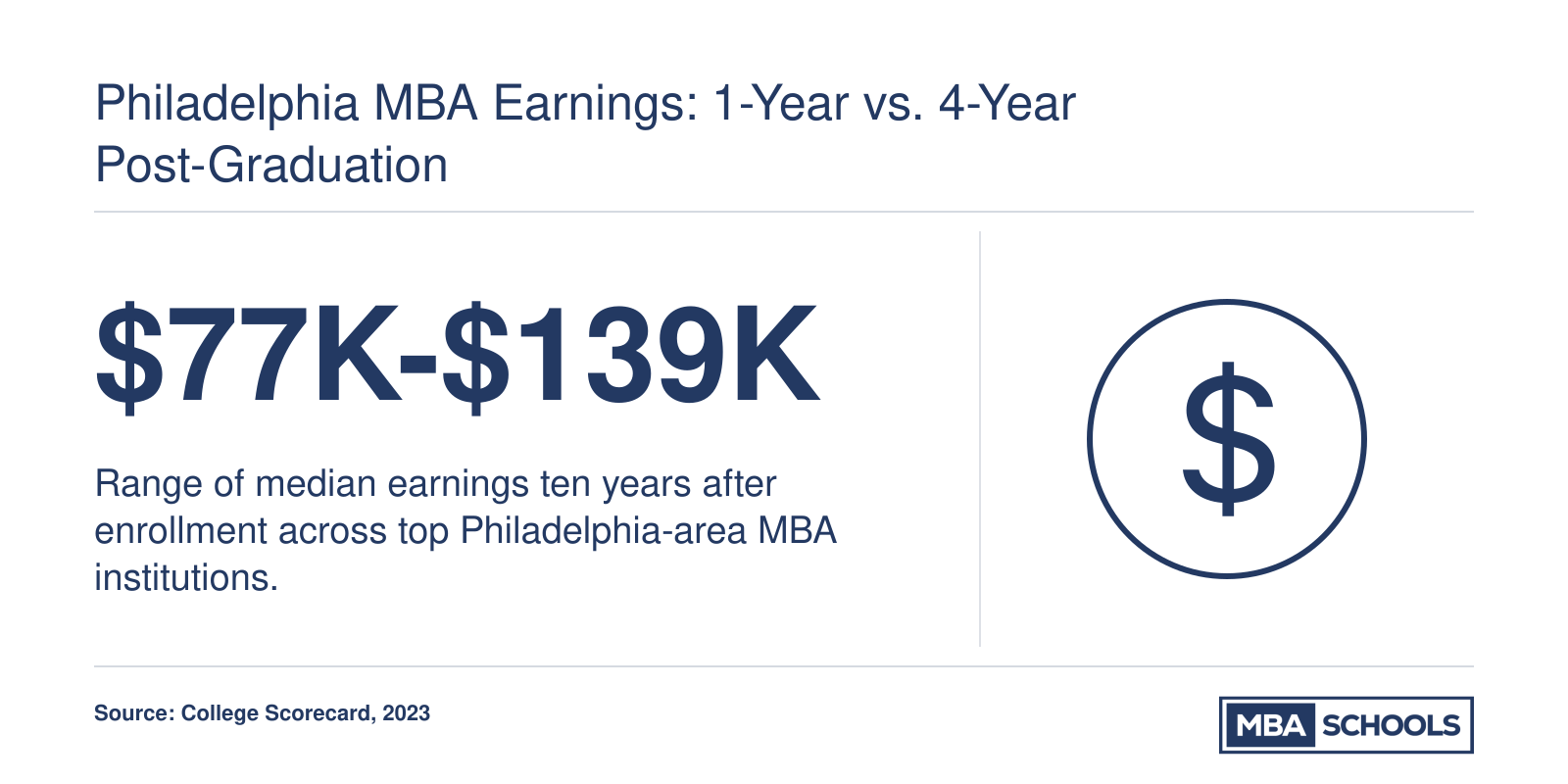
Program-level median earnings at one year and four years after completion are not yet available for the top MBA programs in the Philadelphia area. However, institution-wide median earnings at ten years after enrollment offer a useful benchmark for comparing long-term salary trajectories across these schools.
Admissions Requirements and GMAT Scores for Philadelphia MBA Programs
One of the most common questions prospective students ask is: what GMAT score do I need for MBA programs in Philadelphia? The answer depends entirely on where you apply. Philadelphia's MBA landscape spans from one of the most selective business schools on the planet to accessible regional programs that have dropped standardized testing altogether. Understanding the full range helps you target the right programs and build a realistic application strategy.
GMAT and GRE Score Ranges Across Philadelphia Programs
At the top of the spectrum, the Wharton MBA program Class of 2026 posted an average GMAT of 732, with average GRE scores of 163 quantitative and 162 verbal.1 The school received 7,322 applications for a class of 866 students, yielding an MBA acceptance rate of roughly 11.8%. Wharton continues to require a standardized test score, making it one of the few elite programs that has not adopted a test-optional pathway.3
Moving down the selectivity curve, Temple Fox and Drexel LeBow typically report average GMAT scores in the range of 550 to 640 for their full-time MBA cohorts, though exact figures shift with each entering class. Villanova's MBA program generally attracts applicants scoring in the upper 500s to low 600s on the GMAT, while Saint Joseph's Haub and La Salle tend to draw applicants in the mid-500s range or waive the test entirely for candidates who meet professional experience or GPA thresholds.
Keep in mind that institution-wide acceptance rates published by federal data sources reflect undergraduate and graduate admissions combined, not the MBA program specifically. MBA admissions selectivity can differ significantly from the university-level figure.
Test-Optional and GRE-Accepted Policies
The post-COVID shift toward flexible testing has reshaped admissions across Philadelphia. For a deeper look at standardized testing options, see our guide to mba entrance exams. Several programs now offer test-optional or test-waiver pathways:
- Temple Fox: Offers GMAT/GRE waivers for applicants who meet certain GPA and work experience benchmarks.
- Drexel LeBow: Accepts both the GMAT and GRE and provides test waivers for qualified professionals.
- Saint Joseph's Haub: Test-optional for most MBA formats, particularly part-time and online cohorts.
- La Salle: Waives the GMAT/GRE for candidates meeting minimum GPA and experience criteria.
- Villanova: Accepts the GRE as a GMAT alternative and offers conditional waivers for experienced applicants.
- Wharton: Requires either the GMAT or GRE with no test-optional pathway.
This flexibility has driven rising enrollment among working professionals who may have been out of school for years and prefer to let their career track record speak for itself. Candidates interested in programs that have eliminated testing requirements entirely may also want to explore best MBA programs without GMAT.
GPA, Work Experience, and Emerging Trends
Across the Philadelphia metro, typical GPA expectations range from a 3.0 minimum at regional schools up to the 3.7 average seen at Wharton.1 Most full-time MBA programs expect two to five years of professional experience, while executive formats often require seven or more years.
Notable admissions trends to watch:
- Test-optional enrollment has increased meaningfully at schools like Temple Fox and Drexel LeBow since 2021, with waiver applicants now comprising a substantial share of entering classes.
- Programs are placing greater weight on leadership experience, community involvement, and demonstrated career progression as supplements to, or substitutes for, standardized scores.
- Schools connected to Philadelphia's pharma and healthcare sectors, including Drexel and Saint Joseph's, increasingly value industry-specific experience in admissions review.
For applicants aiming at Wharton, a 730-plus GMAT paired with a 3.6-plus GPA represents the competitive sweet spot. For those targeting Temple, Drexel, Villanova, Saint Joseph's, or La Salle, strong professional experience and a solid undergraduate record can offset a more modest test score, or eliminate the testing requirement entirely. Wherever you fall on that spectrum, Philadelphia has an MBA program calibrated to your profile.
According to GMAC's Corporate Recruiters Survey, 88 percent of employers planned to hire MBA graduates, reflecting strong demand that extends across major metro markets like Philadelphia. For the latest regional hiring data, check resources from GMAC, AACSB, and the Greater Philadelphia Chamber of Commerce.
Online, Part-Time, and Full-Time MBA Options in Philadelphia
One of the most common questions working professionals ask is whether they can earn an MBA in Philadelphia without leaving their job. The answer is a definitive yes. The Philadelphia metro area offers a wide spectrum of program formats, from fully online degrees to immersive full-time experiences, so you can match your MBA to the realities of your career and personal life.
Full-Time Programs for Career Changers
If you can commit to two years of full-time study, programs like the Wharton MBA at the University of Pennsylvania deliver the deepest immersion. Full-time cohorts benefit from structured on-campus recruiting, dedicated career services, and daily interaction with classmates and faculty. The trade-off is opportunity cost: you step away from a paycheck, and tuition at Wharton runs roughly $47,844 per year. For professionals planning a significant industry pivot, particularly into consulting, investment banking, or general management, a full-time format typically provides the strongest recruiting pipeline and alumni network access.
Part-Time and Evening Programs for Working Professionals
Temple University's Fox School of Business, Drexel University's LeBow College, Villanova University, and Saint Joseph's University all offer part-time or evening MBA tracks designed around a working schedule. Villanova's Executive MBA, for example, meets every third weekend over 19 months, with annual tuition around $22,335. Saint Joseph's Haub School of Business runs a hybrid Executive MBA that can be completed in as few as 12 to 16 months at roughly $20,048 per year. If you are weighing whether an executive format is right for you, our guide to best executive mba programs breaks down what to expect. These programs let you apply what you learn on Monday morning and keep earning while you study.
Online and Hybrid Formats
Several Philadelphia-area schools have embraced fully online or hybrid delivery. Holy Family University offers a 100-percent online MBA that can be finished in as little as 10 months, with tuition of approximately $15,900, one of the most affordable options in the region. The Philadelphia College of Osteopathic Medicine (PCOM) runs an online Executive MBA focused on healthcare at about $32,281. If healthcare leadership is your goal, an mba mha dual degree could also be worth exploring. Saint Joseph's hybrid model lets students mix online coursework with periodic in-person sessions, combining flexibility with face-to-face networking.
Hybrid models are becoming increasingly popular because they preserve the convenience of remote learning while still providing structured campus weekends or residencies where you build relationships with peers and faculty.
How Format Affects Cost and Networking
Format choice has real implications beyond scheduling. Online programs in the Philadelphia area tend to carry lower price tags. Holy Family's online MBA at roughly $15,900 stands in stark contrast to Wharton's campus-based tuition near $47,844 per year. However, cost savings come with trade-offs. Full-time, on-campus programs generally offer stronger employer recruiting events, company presentations, and alumni mixers that can be difficult to replicate in a virtual environment. Part-time and hybrid formats strike a middle ground, giving you periodic access to campus resources while keeping your career on track.
When evaluating your options, consider not just what you can afford today but the long-term return on your investment. A lower-cost online program may be the right fit if you plan to stay with your current employer and need the credential to advance. If you are targeting a new industry or relocating into Philadelphia's pharma, healthcare, or financial services sectors, the in-person recruiting access of a full-time or hybrid program could be worth the premium.
MBA Specializations and Philadelphia Industry Connections
Philadelphia's MBA programs offer a wide range of concentrations, but what sets the region apart is how tightly those mba specializations align with the city's dominant industries. Whether you are drawn to pharma, healthcare, or financial services, the Philadelphia metro area provides a direct pipeline from classroom to career.
Available Specializations Across Philadelphia MBA Programs
Across the major business schools in the area, you will find concentrations spanning nearly every functional discipline:
- Finance: Offered at Wharton, Temple Fox, Drexel LeBow, and Villanova, with deep ties to the region's asset management and insurance sectors.
- Healthcare Management: A standout specialization at Wharton, PCOM (which offers a healthcare-focused Executive MBA), Holy Family University, and Saint Joseph's Haub School of Business.
- Business Analytics: Wharton's analytics major emphasizes data-driven decision-making, while Drexel LeBow integrates analytics into several of its MBA tracks.
- Marketing: Available at Temple Fox, Drexel LeBow, and La Salle, often paired with experiential learning projects involving local companies.
- Supply Chain Management: A growing area of focus, especially relevant for graduates entering pharma manufacturing and logistics.
- Entrepreneurship: Temple Fox and Wharton both maintain entrepreneurship centers that connect students with Philadelphia's startup ecosystem.
Pharma and Biotech: A Regional Powerhouse
Philadelphia sits at the heart of one of the country's densest pharma and biotech corridors. Companies like GSK, Merck, AstraZeneca, and Johnson & Johnson all maintain significant operations in the metro area. Wharton reports that GSK typically hires five to ten MBA graduates per year, while AstraZeneca draws two to five graduates annually from Philadelphia-area schools.1 Temple Fox places roughly 15 percent of its graduates into pharma roles, a figure that climbs to around 30 percent when combined with finance-sector placements.2 For professionals looking to break into the life sciences industry, a Philadelphia MBA offers proximity and recruiting relationships that are difficult to replicate elsewhere.
Financial Services and Corporate Recruiting
The region's financial services footprint is equally impressive. Vanguard, headquartered in suburban Malvern, is one of the largest employers of MBA talent in the area. Lincoln Financial maintains strong ties to Temple Fox, where Fox graduates represent approximately 20 percent of its professional workforce.2 Comcast NBCUniversal, based in Center City, recruits across strategy, marketing, and finance roles from multiple Philadelphia programs. Wharton alone attracts more than 300 employers to campus each recruiting cycle, including global firms like BCG, Bain, and Microsoft alongside these regional anchors.13
Healthcare Systems and Local Employer Pipelines
Beyond pharma, Philadelphia's concentration of major health systems creates demand for MBA-trained administrators and strategists. Penn Medicine, Jefferson Health, and Children's Hospital of Philadelphia all recruit locally for operations, finance, and leadership development roles. Programs with healthcare management concentrations, including PCOM's Executive MBA and Holy Family's healthcare administration track, are designed with these employers in mind.
Where Wharton Fits, and Where Other Programs Shine
If you are wondering what the most prestigious school in Philadelphia is, the answer is straightforward: the Wharton School at the University of Pennsylvania. Wharton is consistently recognized among the top business schools globally and is frequently included in discussions of the elite "M7" MBA programs, a group that also includes Harvard, Stanford GSB, Columbia, Chicago Booth, MIT Sloan, and Northwestern Kellogg. You can explore how Wharton stacks up against peer institutions in our Wharton vs Columbia MBA comparison. Its finance and consulting placement rates are unmatched in the region, with 10 to 15 percent of recent graduates entering finance roles at top-tier firms.1
That said, Wharton is not the only path to strong outcomes in the Philadelphia market. Temple Fox and Drexel LeBow place graduates into regional pharma, financial services, and healthcare organizations at a high rate, often with employer partnerships that Wharton's more globally oriented graduates may bypass. Villanova's MBA program, with its strong alumni network across the Main Line and the broader Philadelphia suburbs, is particularly well positioned for mid-career professionals in corporate leadership. For regional employment, these programs offer a combination of relevant specializations, employer access, and competitive tuition that makes them a smart investment for working professionals.
How to Choose the Right Philadelphia MBA for Your Career
With at least six strong MBA programs in the Philadelphia metro area, the right choice depends less on prestige alone and more on how well a program fits your career trajectory, lifestyle, and financial reality. Use the five-step framework below to narrow your options with confidence.
Step 1: Define Your Career Goal and Target Industry
Start with the end in mind. Are you pivoting into a new industry, accelerating within your current field, or launching a business? Philadelphia's economy is anchored by pharma, healthcare, and financial services, and each MBA program in the region connects differently to those sectors. If you want to break into consulting or investment banking, a full-time program at the Wharton School at the University of Pennsylvania offers unmatched recruiting pipelines. If your goal is to move into healthcare leadership while staying employed, programs like Temple Fox's healthcare MBA concentration or the Executive MBA at Philadelphia College of Osteopathic Medicine (PCOM) may align more naturally.
Step 2: Match the Format to Your Life Situation
Philadelphia's MBA landscape spans full-time, part-time, online, and hybrid formats. Career switchers who can commit two years of focused study often benefit most from a full-time program at Wharton or Temple Fox, where immersive recruiting cycles and internships accelerate the transition. Working professionals juggling job responsibilities should look at part-time options at Drexel LeBow or Villanova, both of which offer evening and weekend schedules designed around corporate calendars. Budget-conscious candidates or those outside the metro area may find La Salle University's more affordable tuition or online-friendly formats a practical fit. If you are still weighing factors to consider when choosing an MBA program, our decision guide can help you structure the process.
Step 3: Compare ROI, Not Just Sticker Price
Tuition is only half the equation. What matters is the gap between what you pay and what you earn afterward. Among Philadelphia-area programs with available data, the Wharton MBA stands out: institutional-level median earnings ten years after enrollment reach roughly $111,000, against a median graduate debt of about $15,700, yielding an earnings-to-debt ratio above 7 to 1. Thomas Jefferson University also delivers strong value, with a lower tuition baseline and a favorable earnings-to-debt profile. Always request each school's net price estimate, which accounts for scholarships and grants, before comparing bottom lines.
Step 4: Evaluate Specialization Alignment
Philadelphia programs differentiate themselves through concentrations. Wharton's business analytics and finance tracks serve data-driven and Wall Street-oriented careers. Drexel LeBow is known for its focus on analytics and technology management. Villanova emphasizes ethics-grounded general management, while Saint Joseph's Haub School offers pharmaceutical and food marketing specializations that plug directly into the region's life sciences corridor. Choose a program whose elective menu and faculty expertise map to the specific skills your target employers value.
Step 5: Weigh Network Strength Against Affordability
An MBA's long-term value often lives in its alumni network. Wharton's global alumni base of more than 100,000 opens doors across industries worldwide, but that reach comes at a premium price. If you plan to build your career primarily in the Philadelphia region, the dense local networks at Temple Fox, Drexel LeBow, and Villanova can be equally powerful for job referrals and mentorship at a fraction of the cost. Understanding the importance of alumni network in choosing MBA programs can help you weigh whether the incremental access of a top-tier program justifies the incremental investment for the career path you have in mind.
Your Concrete Next Step
Narrowing your list to two or three programs is only the beginning. Visit each campus, attend an admissions information session, and speak with current students or recent alumni in your target industry. Most importantly, request net price estimates from every school on your shortlist so you can compare actual out-of-pocket costs side by side. The best MBA for your career is the one that delivers the strongest return on your specific goals, not someone else's.
Frequently Asked Questions About Philadelphia MBA Programs
Choosing an MBA program in Philadelphia raises plenty of practical questions, from salary expectations to admissions requirements. Below, we answer the most common questions prospective students ask about MBA programs in the Philadelphia metro area, drawing on the latest available data and program details.
Additional MBA Programs to Consider in Pennsylvania
Beyond the top-rated programs, many other Pennsylvania schools offer strong MBA options with unique specializations and flexible formats. Whether you are drawn to healthcare management, supply chain, or online learning, this directory can help you explore further. Click through to request information from any program that fits your goals.