What you’ll learn in this article…
- Harvard Business School and MIT Sloan accept fewer than 15 percent of applicants and lead Boston in post-MBA earnings.
- Boston is the global headquarters for both Bain and Company and Boston Consulting Group, fueling unmatched consulting recruitment.
- Affordable options like UMass and Salem State deliver accredited MBAs at a fraction of the cost of elite programs.
- Programs at BU Questrom, Babson Olin, and Northeastern offer flexible part-time, hybrid, and online MBA formats for working professionals.
Seven of the most competitive MBA programs in the United States sit within 15 miles of downtown Boston, anchored by Harvard Business School and MIT Sloan, where median earnings ten years after enrollment exceed $100,000 and $140,000 respectively. That elite tier, however, is only part of the story. Programs at BU Questrom, Boston College Carroll, Babson, Northeastern, and Brandeis International Business School offer strong placement into the region's consulting, biotech, finance, and healthcare sectors, often at significantly lower tuition.
The real tension for working professionals is not whether Boston has a good MBA program. It is whether the program that fits your budget, schedule, and career goals also delivers measurable salary lift. Annual tuition across the metro ranges from under $20,000 at public institutions like UMass Boston to over $67,000 at the private flagships, and ROI varies just as widely. Boston's density of MBB consulting headquarters, hospital networks, and venture-backed startups compresses the gap between classroom and career, but only if you match the right program to the right industry pipeline. If you are weighing Boston against other major metro areas, our ability to compare mba programs side by side can sharpen that decision.
Best MBA Programs in Boston: 2026 Rankings
The Boston metro area is home to some of the most respected MBA programs in the world, spanning elite research universities, STEM-focused business schools, and affordable public options. Our 2026 rankings weigh institutional net price, graduation rates, long-term earnings outcomes, and program breadth to help working professionals find the right fit. Graduation rates cited below reflect institution-wide figures rather than MBA-specific completion data, and program-level post-graduation earnings are not yet available for the schools listed here; where we report median earnings, those figures represent all graduates of the institution ten years after enrollment.
- Institutional net price after aid
- Institution-wide graduation rate
- Median earnings ten years out
- Program format and concentration breadth
- Graduate debt at completion
- Internal program database
- Independent program research
- College Scorecard graduate earnings — collegescorecard.ed.gov
- NCES-IPEDS federal institutional data — nces.ed.gov

Massachusetts Institute of Technology
MIT Sloan is a global powerhouse for MBA candidates drawn to finance, entrepreneurship, and technology. With an institution-wide net price of roughly $20,111 and a 96.4% graduation rate, MIT pairs exceptionally strong outcomes (median earnings of $143,372 at ten years) with action-learning pedagogy set in the heart of Kendall Square's innovation corridor. The school's Finance Track, Executive MBA, and STEM designations give students multiple pathways, while a 3:1 student-to-faculty ratio ensures close mentorship from world-class researchers.
- Campus-based program at MIT Sloan in Cambridge
- Concentrations span corporate finance, fintech, and impact investing
- Finance Research Practicum with industry practitioners
- Annual Buffett trek to Berkshire Hathaway headquarters
- New York Banking Day experience for first-year MBAs
- Forté Foundation sponsor supporting women in finance
- Action learning via Global Entrepreneurship Lab projects
- 20-month executive format with 26 weekend sessions
- Four immersive executive learning modules
- Cross-registration privileges with Harvard University
- Action Learning experiences embedded in curriculum
- Global strategy and innovative leadership focus
- Campus-based delivery designed for senior professionals
- Access to MIT's full faculty and research ecosystem
MBA with Finance Track, Finance — On-Campus
MIT Executive MBA — On-Campus

Harvard University
Harvard Business School remains the benchmark for MBA education, known for its case-method pedagogy and vast alumni network. The university posts a 97.6% graduation rate, the highest on this list, with an institution-wide net price near $19,066 and median ten-year earnings of $101,817 across all graduates. Harvard's joint-degree offerings, including a JD/MBA and an MD-MBA, let candidates customize a rigorous management education with complementary professional credentials, all within walking distance of Boston's financial and healthcare hubs.
- Four-year dual JD and MBA awarded upon completion
- Requires separate admission to Harvard Law and HBS
- Boston Immersion Week with local firms like Bain Capital
- Financial aid available across both schools
- Campus-based program with full access to HBS resources
- Prepares graduates for corporate leadership and legal strategy
- Five-year integrated MD and MBA curriculum
- Scholarly project and dedicated management block required
- Mass General Brigham rotations for in-state physicians
- Separate admissions to Harvard Medical School and HBS
- Combines rigorous medical and managerial training
- Designed for future healthcare executives and innovators
Joint Degree Program in Law and Business — On-Campus
MD-MBA Program — On-Campus

Bentley University
Bentley University in Waltham brings a business-only institutional focus that few competitors can match, offering a STEM-designated MBA with concentrations in business analytics, finance, healthcare management, and accounting. With 45-plus graduate career events per year and hands-on learning in high-tech labs, Bentley blends analytics rigor with strong career support. The institution-wide graduation rate stands at 86.8%, and ten-year median earnings reach $120,959.
- STEM designation qualifies international grads for extended OPT
- Four technology-driven concentration options available
- Business Analytics concentration with 12 total courses
- Hands-on learning in Bentley's high-tech analytics labs
- 45+ graduate career events held annually on campus
- Campus-based delivery in Waltham, near Route 128 corridor
- STEM designation qualifies international grads for extended OPT
- Four technology-driven concentration options available
- Business Analytics concentration with 12 total courses
- Hands-on learning in Bentley's high-tech analytics labs
- 45+ graduate career events held annually on campus
- Campus-based delivery in Waltham, near Route 128 corridor
- STEM designation qualifies international grads for extended OPT
- Four technology-driven concentration options available
- Business Analytics concentration with 12 total courses
- Hands-on learning in Bentley's high-tech analytics labs
- 45+ graduate career events held annually on campus
- Campus-based delivery in Waltham, near Route 128 corridor
STEM MBA, Business Analytics — On-Campus
MBA, Accounting — On-Campus
MBA, Strategic Healthcare Management — Hybrid

Boston College
Boston College's Carroll School of Management offers MBA pathways rooted in a Jesuit mission of service and leadership. Dual-degree options pair the MBA with a JD or MSW, giving students rare interdisciplinary depth. The university posts a 90.8% graduation rate and median ten-year earnings of $103,937, with a net price of approximately $41,704. Carroll's Chestnut Hill campus provides easy access to Boston's nonprofit, legal, and healthcare sectors.
- 10-course program with 6 core and 4 elective courses
- Hybrid format with online and evening campus classes
- Approved by the Department of Homeland Security
- Stackable credential pathway toward MBA (launched Spring 2026)
- Covers cyber risk management and policy development
- Accessible to mid-career professionals and recent graduates
- Four-year program awarding both JD and MBA degrees
- Separate admission required to BC Law and Carroll School
- Ideal for careers in corporate law and business strategy
- Campus-based delivery in Chestnut Hill, MA
- Financial aid considerations apply across both schools
- Massachusetts Bar prep integration via BC Law clinics
- Combines social work and business management training
- Partnership between Carroll School and BC School of Social Work
- Designed for leadership roles in social service organizations
- Campus-based program with community-focused projects
- Separate admission to both schools required
- Boston Nonprofit Accelerator partnerships with local organizations
Master of Science in Cybersecurity Policy and Governance — Hybrid
Dual J.D./M.B.A. — On-Campus
MSW/MBA Dual Degree — On-Campus

University of Massachusetts Chan Medical School
UMass Chan Medical School in Worcester fills a distinctive niche: dual MBA/MD programs with concentrations in health care, finance, and managerial leadership. Its hybrid format combines online flexibility with on-campus immersions, and an in-state priority cohort reserves seats for Massachusetts-licensed healthcare professionals. In-state tuition starts near $28,393, making it one of the more affordable paths for physicians seeking business acumen. Detailed net price and earnings data are not yet reported for this institution.
- Hybrid format blending online coursework and campus sessions
- Health Care, Finance, and Managerial Leadership concentrations
- Automatic GMAT waiver for MA-licensed healthcare professionals
- In-state priority cohort with subsidized tuition options
- New Biotechnology Finance track funded by Mass Life Sciences Grant
- Worcester-to-Boston shuttle supports hybrid learning schedule
Dual Degree MBA Program, Health Care — Hybrid

Brandeis University
Brandeis University's International Business School and Heller School together offer MBA concentrations in data analytics, marketing, nonprofit management, and an Executive MBA for Physicians. The STEM-designated data analytics track qualifies international graduates for 36 months of practical training. With a net price near $35,736 and an 86% graduation rate, Brandeis appeals to mission-driven professionals who want rigorous quantitative skills paired with a social-impact orientation.
- Data Analytics concentration with STEM designation
- Marketing concentration with field project and analytics focus
- Graduates placed at firms like Apple, Amazon, and Google
- 18 credit hours for Data Analytics; 16 for Marketing
- Campus-based delivery in Waltham, near Route 128
- 36-month practical training eligibility for international graduates
- Data Analytics concentration with STEM designation
- Marketing concentration with field project and analytics focus
- Graduates placed at firms like Apple, Amazon, and Google
- 18 credit hours for Data Analytics; 16 for Marketing
- Campus-based delivery in Waltham, near Route 128
- 36-month practical training eligibility for international graduates
- Data Analytics concentration with STEM designation
- Marketing concentration with field project and analytics focus
- Graduates placed at firms like Apple, Amazon, and Google
- 18 credit hours for Data Analytics; 16 for Marketing
- Campus-based delivery in Waltham, near Route 128
- 36-month practical training eligibility for international graduates
- Data Analytics concentration with STEM designation
- Marketing concentration with field project and analytics focus
- Graduates placed at firms like Apple, Amazon, and Google
- 18 credit hours for Data Analytics; 16 for Marketing
- Campus-based delivery in Waltham, near Route 128
- 36-month practical training eligibility for international graduates
MBA, Data Analytics — On-Campus
Social Impact MBA, Nonprofit Management — On-Campus
Master of Business Administration (MBA), Marketing — On-Campus
Executive MBA for Physicians — Hybrid

University of Massachusetts-Amherst
UMass Amherst's Isenberg School of Management delivers one of the strongest public MBA values in the Northeast, with an in-state net price near $22,383 and both on-campus and fully online formats. Concentrations span finance, marketing, healthcare administration, and entrepreneurship, plus a distinctive MBA/MS in Sport Management dual degree. The institution's 83.3% graduation rate and $71,631 median ten-year earnings reflect its broad undergraduate population, while Isenberg's MBA program has earned top-ranked public online MBA recognition.
- Two-year, full-time dual degree in business and sport management
- Six-credit sport industry internship between Year 1 and Year 2
- Active, experiential learning approach with industry-experienced faculty
- Access to Isenberg's significant alumni network
- Campus-based delivery in Amherst, MA
- No thesis or capstone required for completion
- Concentrations in asset management, alternative investments, and real estate
- Available in both on-campus and online formats
- Nine elective credit hours in finance coursework
- Multiple start dates: fall, spring, and summer
- Financial aid available with priority-deadline fee reimbursement
- New England residents eligible for in-state tuition via NEBHE
- Concentrations in asset management, alternative investments, and real estate
- Available in both on-campus and online formats
- Nine elective credit hours in finance coursework
- Multiple start dates: fall, spring, and summer
- Financial aid available with priority-deadline fee reimbursement
- New England residents eligible for in-state tuition via NEBHE
- Concentrations in asset management, alternative investments, and real estate
- Available in both on-campus and online formats
- Nine elective credit hours in finance coursework
- Multiple start dates: fall, spring, and summer
- Financial aid available with priority-deadline fee reimbursement
- New England residents eligible for in-state tuition via NEBHE
- Concentrations in asset management, alternative investments, and real estate
- Available in both on-campus and online formats
- Nine elective credit hours in finance coursework
- Multiple start dates: fall, spring, and summer
- Financial aid available with priority-deadline fee reimbursement
- New England residents eligible for in-state tuition via NEBHE
- Concentrations in asset management, alternative investments, and real estate
- Available in both on-campus and online formats
- Nine elective credit hours in finance coursework
- Multiple start dates: fall, spring, and summer
- Financial aid available with priority-deadline fee reimbursement
- New England residents eligible for in-state tuition via NEBHE
Master of Business Administration / Master of Science in Sport Management — On-Campus
MBA with a Focus in Finance, Asset Management, Alternative Investments, Real Estate — On-Campus
MBA, Healthcare Administration — Online
MBA, Marketing — Online
MBA, Management & Entrepreneurship — On-Campus
MBA, Marketing — On-Campus

Boston University
Boston University's Questrom School of Business sits at the center of the city's healthcare, consulting, and technology industries. Its Health Sector Management MBA leverages the Longwood Medical Area, while a STEM-eligible Management Science major appeals to data-oriented candidates. With a net price of about $24,402 and an 88.7% graduation rate, Questrom combines an urban campus experience with strong career placement. Ten-year median earnings for BU graduates reach $83,238 institution-wide.
- Campus-based MBA specializing in health sector management
- Leverages Boston's Longwood Medical Area healthcare hub
- 25% of seats reserved for Massachusetts hospital employees
- 400-hour internship embedded in dual MD-MBA option
- Prepares graduates for leadership in healthcare organizations
- Customized treks to Boston-area hospitals and biotech firms
- Campus-based MBA specializing in health sector management
- Leverages Boston's Longwood Medical Area healthcare hub
- 25% of seats reserved for Massachusetts hospital employees
- 400-hour internship embedded in dual MD-MBA option
- Prepares graduates for leadership in healthcare organizations
- Customized treks to Boston-area hospitals and biotech firms
- Management Science major with STEM designation
- 15 elective credits allow deep specialization
- No quantitative background required for Management Science
- Foundational business modeling coursework included
- International students eligible for OPT extension
- Combines with Social Impact or Digital Technology dual options
Health Sector Management MBA — On-Campus
MBA, Management Science — On-Campus
Health Sector MBA+ Doctor of Medicine, Health Sector Management — On-Campus

University of Massachusetts-Boston
UMass Boston provides one of the most accessible MBA pathways in the metro area, with an institution-wide net price of approximately $17,707 and AACSB accreditation. The program requires no GRE or GMAT, offers online, in-person, and hybrid formats, and can be completed in as little as one year. A concentration in Information Systems positions graduates for Boston's thriving tech hiring market. The institution-wide graduation rate of 49.4% reflects its open-access mission serving a diverse commuter student body.
- AACSB-accredited with no GRE or GMAT required
- Flexible online, in-person, and hybrid delivery formats
- Completable in as little as one year
- Concentration available in Information Systems
- 12 courses with no prerequisite coursework
- Priority admission for UMass system undergraduates
- Affordable tuition with variety of financial aid resources
Business Administration (MBA), Information Systems — On-Campus

Fitchburg State University
Fitchburg State University offers the most affordable MBA on this list, with total program tuition of $13,080 regardless of residency. Its fully online, IACBE-accredited MBA spans seven concentrations including business analytics, accounting, finance, healthcare management, human resources, marketing, and management. The accelerated 12-month format uses seven-week course terms and requires no GMAT, making it a practical choice for working professionals seeking a quick, budget-friendly credential. The institution-wide graduation rate is 55.1%, and ten-year median earnings are $53,874.
- Fully online with asynchronous classes and 7-week terms
- 30 credits across 10 courses; completable in 12 months
- Total tuition of $13,080 at $436 per credit
- No GMAT required; 2.8 GPA minimum for admission
- IACBE accredited with Tableau data visualization training
- Four start dates per year with dual concentration option
- Online 30-credit program with capstone requirement
- Prepares graduates for CPA licensure in Massachusetts
- Locked tuition rate of $13,080 for all students
- Forensic accounting career track available
- Taught by same faculty as on-campus program
- Dual concentration options to broaden expertise
- Online delivery with accelerated 7-week course terms
- 30 credits; completable in 12 months full-time
- Total tuition $13,080 with no GMAT required
- Capstone project focused on financial leadership
- Financial aid available with $50 application fee
- Same flat tuition for in-state and out-of-state students
- Fully online IACBE-accredited healthcare MBA
- 30 credits at $436 per credit; 12-month completion
- 20% projected job growth in healthcare management
- Dual concentration options for broader specialization
- No thesis or capstone required
- Four annual start dates with locked tuition rate
- Online MBA with HR management specialization
- 12-month program at $13,080 total tuition
- No entrance exam or GMAT required for admission
- Accelerated 7-week asynchronous course format
- Dual concentration option to pair HR with another focus
- Financial aid available; same tuition for all students
- Fully online with no campus visits required
- 30 credits completable in 12 months at $436 per credit
- Faculty with real-world marketing industry experience
- Dual concentration options available
- Four start dates annually with rolling admissions
- IACBE accredited with locked flat tuition rate
- Fully online with asynchronous classes and 7-week terms
- 30 credits across 10 courses; completable in 12 months
- Total tuition of $13,080 at $436 per credit
- No GMAT required; 2.8 GPA minimum for admission
- IACBE accredited with Tableau data visualization training
- Four start dates per year with dual concentration option
Master of Business Administration in Business Analytics Management — Online
Master of Business Administration in Accounting — Online
Master of Business Administration in Finance — Online
Master of Business Administration in Healthcare Management — Online
Master of Business Administration in Human Resources Management — Online
Master of Business Administration in Marketing — Online
Master of Business Administration in Management — Online
MBA Program Comparison Table: Tuition, Format, and Outcomes
The table below provides a side-by-side comparison of MBA programs across Massachusetts, including graduate tuition (which reflects degree-level pricing rather than undergraduate rates), program delivery format, median graduate debt, median earnings ten years after enrollment, and institutional graduation rate. Tuition figures shown are annual graduate tuition as reported to federal databases. Where a school charges the same tuition regardless of residency, a single figure is listed. Note that program-level earnings after graduation are not yet available for these MBA programs, so we have included institution-wide median earnings at ten years as a proxy for long-term earning power. Programs marked as 'online' or 'hybrid' offer flexible scheduling beyond the traditional campus experience, which is particularly valuable for working professionals weighing part-time or remote study.
| School | Annual Graduate Tuition (In-State) | Annual Graduate Tuition (Out-of-State) | Format | Median Graduate Debt | Median Earnings (10 Yr) | Graduation Rate |
|---|---|---|---|---|---|---|
| MIT (Sloan) | $62,396 | $62,396 | Campus | $14,768 | $143,372 | 96.4% |
| Harvard University (HBS) | $57,248 | $57,248 | Campus | $14,000 | $101,817 | 97.6% |
| Bentley University | $46,920 | $46,920 | Campus | $25,023 | $120,959 | 86.8% |
| Boston College (Carroll) | $37,520 | $37,520 | Hybrid | $19,000 | $103,937 | 90.8% |
| Brandeis University (IBS) | $60,153 | $60,153 | Campus | $25,648 | $77,231 | 86.0% |
| UMass Amherst (Isenberg) | $17,410 | $35,726 | Campus | $22,763 | $71,631 | 83.3% |
| Boston University (Questrom) | $67,626 | $67,626 | Campus | $23,250 | $83,238 | 88.7% |
| UMass Boston | $20,456 | $39,352 | Campus / Hybrid / Online | $21,974 | $65,865 | 49.4% |
| Northeastern University (D'Amore-McKim) | $26,020 | $26,020 | Campus | $24,250 | $92,538 | N/A |
| Suffolk University (Sawyer) | $38,448 | $38,448 | Campus | $26,889 | $67,506 | 60.9% |
| Hult International Business School | $55,570 | $55,570 | Campus | N/A | N/A | 66.7% |
| UMass Dartmouth (Charlton) | $17,269 | $30,589 | Campus | $25,000 | $68,804 | 52.1% |
| Assumption University | $15,470 | $15,470 | Online | $27,000 | $74,895 | 75.2% |
| Fitchburg State University | $6,246 | $6,246 | Online | $24,239 | $53,874 | 55.1% |
| Emmanuel College | $14,400 | $14,400 | Online | $27,000 | $68,245 | 67.5% |
| Western New England University | $18,210 | $18,210 | Campus / Online | $25,500 | $73,157 | 64.0% |
| Salem State University | $9,360 | $11,069 | Campus / Hybrid / Online | $25,000 | $56,662 | 49.8% |
| Endicott College | $15,534 | $15,534 | Online | $27,000 | $58,336 | 75.6% |
| Bay Path University | $15,162 | $15,162 | Online | $24,901 | $55,383 | 43.9% |
| Nichols College | $1,200 | $1,200 | Online | $27,000 | $58,063 | 62.6% |
| Lasell University | $12,150 | $12,150 | Hybrid / Online | $26,000 | $49,705 | 58.6% |
| Cambridge College | $11,763 | $11,763 | Online | $21,791 | $45,998 | 11.1% |
| Springfield College | $33,722 | $33,722 | Online | $26,250 | $48,036 | 74.2% |
| Elms College | $17,670 | $17,670 | Campus | $25,000 | $51,540 | 68.1% |
| Berklee College of Music | $51,431 | $51,431 | Online | $25,000 | $33,647 | 67.3% |
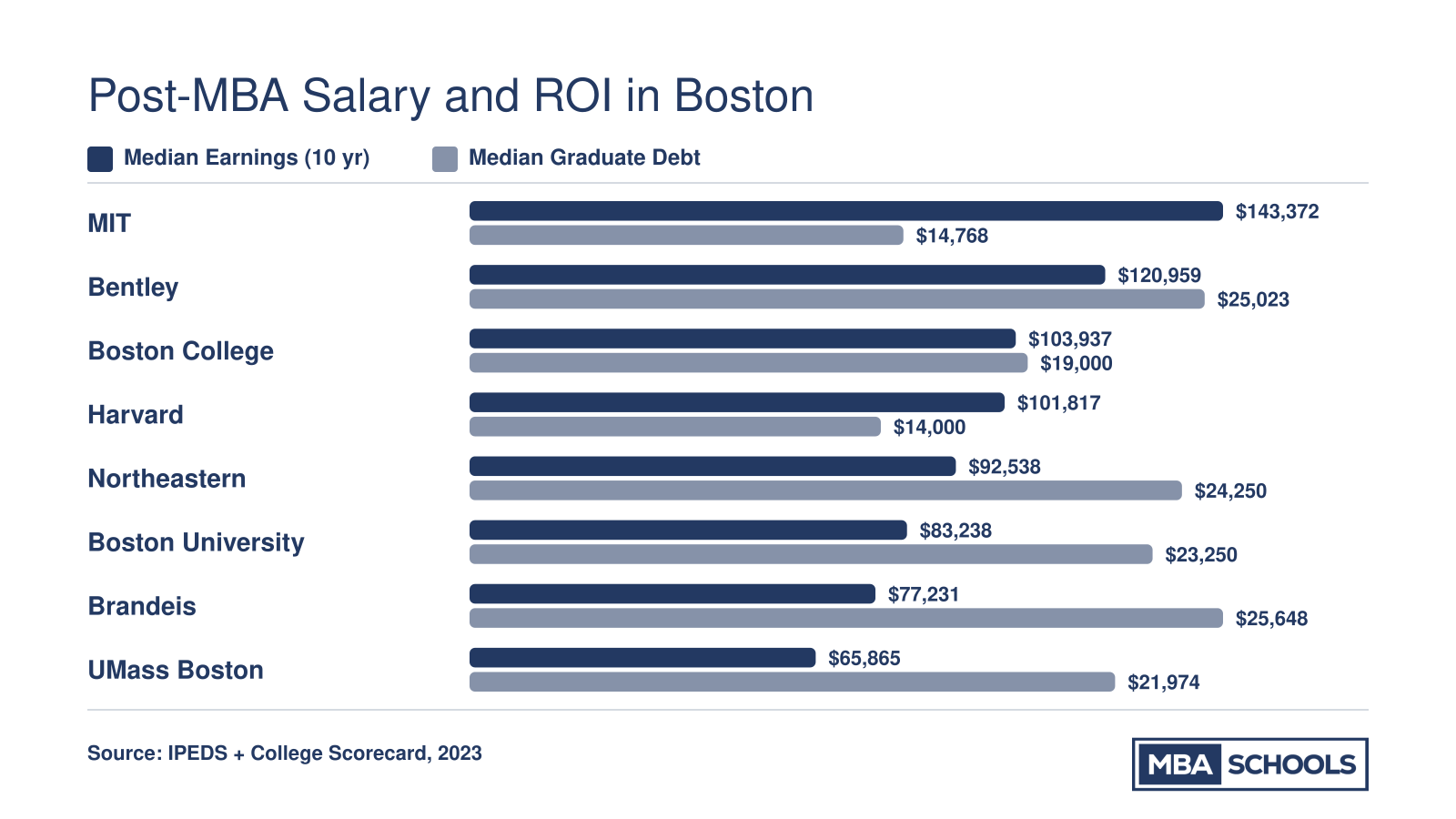
Post-MBA Salary and ROI in Boston
Return on investment is arguably the most important metric when choosing an MBA program. The chart below compares median earnings ten years after enrollment against median graduate debt at completion for top Massachusetts business schools. MIT and Harvard stand out with the highest earnings-to-debt ratios, while public options like UMass Boston deliver solid returns at a fraction of the borrowing burden. Program-level earnings shortly after MBA completion are not yet available for most of these schools, so the institution-wide figures below offer the best available proxy for long-term financial outcomes.
Questions to Ask Yourself
Most Affordable MBA Programs in Boston
Boston's reputation for world-class MBA programs often comes with an equally famous price tag. Yet several Massachusetts institutions deliver accredited MBA degrees at a fraction of the cost charged by the region's marquee schools. If you are asking, "What is the cheapest MBA program in Boston?" the answer depends on whether you define "Boston" strictly or include the wider Massachusetts metro area, but the options below represent the most affordable tier in our rankings.
The Most Budget-Friendly MBA Programs in Massachusetts
The following schools stand out for their low net prices. Net price reflects the institution-wide average cost after grants and scholarships, so individual MBA students may pay more or less depending on their financial aid package.
- Fitchburg State University: With an effective net price of roughly $14,262 and a total program tuition advertised at $13,080 for its online MBA, Fitchburg State is the least expensive option in our data set. The 30-credit program can be completed in as little as 12 months, charges $436 per credit, and requires no entrance exam.
- Bay Path University: A private institution in Longmeadow with a comparable net price of about $14,271. Bay Path offers a 30-credit online MBA with concentrations including cybersecurity, making it a strong pick for professionals pivoting into tech-adjacent roles.
- Salem State University: A public university on Boston's North Shore, Salem State carries a net price near $15,996. Its MBA features evening and weekend courses, hybrid and online options, and a minimum of 36 credits, meaning working professionals can earn the degree without leaving their jobs.
- Elms College: Located in Chicopee, this private college has a net price of approximately $17,545 and offers IACBE-accredited MBA concentrations in areas like accounting. Small class sizes and faculty with practitioner experience are hallmarks of the program.
- University of Massachusetts Boston: The only school on this list located in Boston proper, UMass Boston has a net price around $17,707 and holds AACSB accreditation. It offers flexible online, in-person, and hybrid formats, and does not require the GMAT or GRE for admission.
Public vs. Private: Understanding the Tuition Gap
Three of the five most affordable options listed above are public institutions (Fitchburg State, Salem State, and UMass Boston), which benefit from state subsidies that keep sticker prices lower for in-state residents. Private schools like Bay Path and Elms College have higher published tuition rates but often close the gap through institutional aid, resulting in comparable net prices. For a broader look at tuition benchmarks, see our guide on how much an online MBA costs. Keep in mind that net price figures represent institution-wide averages across all programs and student profiles. Your actual MBA cost may differ, so always request a personalized financial estimate from the admissions office.
Do Affordable Programs Deliver Competitive Outcomes?
Program-level earnings data for these MBA programs are not yet available in federal reporting, so we cannot cite specific one-year or two-year post-graduation salary figures. However, institution-wide median earnings ten years after enrollment range from about $51,500 at Elms College to nearly $65,900 at UMass Boston. While those figures cover all graduates, not just MBA holders, they suggest that affordable Massachusetts schools can produce solid long-term earning trajectories. UMass Boston, in particular, stands out for combining low cost with a location in the heart of Boston's job market. For context on what MBA graduates across the country typically earn, our overview of MBA career paths and salaries offers useful benchmarks.
Cost-Cutting Strategies Worth Considering
Beyond choosing a lower-tuition school, the format you pick can meaningfully reduce your total outlay.
- Part-time enrollment lets you keep your current salary and benefits while spreading tuition payments over a longer period.
- Online programs eliminate commuting costs and, in several cases, charge the same rate regardless of residency, as Fitchburg State does.
- Accelerated tracks shorten time to completion, limiting the opportunity cost of foregone income or career momentum.
Several of these programs also waive standardized test requirements, a growing trend you can explore further in our roundup of best MBA programs without GMAT. An affordable MBA does not have to mean a lesser education. Many of these schools carry respected accreditations, offer flexible scheduling for working professionals, and sit within reach of the same Massachusetts employer ecosystem that draws candidates to higher-priced institutions. The key is matching your career goals and budget to the program that delivers the best return on your investment.
Full-Time Vs. Part-Time Vs. Online MBA Options in Boston
Boston's MBA landscape offers remarkable flexibility. Whether you want to immerse yourself in a two-year, full-time cohort or earn your degree around a demanding work schedule, the region's schools have a format to match. Since 2020, hybrid and online options have expanded significantly, with several Boston-area institutions now offering both on-campus and remote pathways. Understanding how each format differs across key dimensions will help you invest wisely.
| Dimension | Full-Time MBA | Part-Time MBA | Online MBA |
|---|---|---|---|
| Typical time commitment | 2 years of full-time study (40+ hours per week including classes, team projects, and recruiting activities) | 2.5 to 3.5 years, with evening or weekend classes designed for working professionals | 1 to 2 years depending on pace; asynchronous coursework allows maximum scheduling flexibility |
| Networking and recruiting access | Strongest access to on-campus recruiting, career fairs, and employer info sessions. Schools like Harvard Business School, MIT Sloan, and Boston University Questrom channel consulting, finance, and biotech recruiters directly through full-time pipelines. | Solid peer networking with fellow working professionals; access to career services varies by school. Boston College Carroll and Northeastern D'Amore-McKim offer evening cohorts that tap into the local industry ecosystem. | More limited in-person networking, though programs increasingly include virtual networking events and optional campus residencies. Schools like UMass Boston and Fitchburg State build community through synchronous online sessions. |
| Tuition range (Boston area) | Roughly $57,000 to $68,000 per year at top programs such as MIT Sloan (about $62,400/year) and Boston University Questrom (about $67,600/year). Two-year totals can exceed $120,000. | Similar per-credit rates to full-time programs, but spread over more semesters. Suffolk University and Babson Olin offer part-time tracks at competitive price points. Total cost depends on pace. | Often the most affordable option. Fitchburg State offers an online MBA for about $13,080 total. Emmanuel College charges roughly $14,400, and Assumption University is approximately $15,470, making these among the cheapest MBA programs in Boston and across Massachusetts. |
| Employer perception | Highest prestige, especially from elite programs. Top-tier employers in consulting, investment banking, and biotech actively recruit from full-time cohorts at Harvard, MIT Sloan, and Babson. | Well regarded by employers, particularly for professionals who continue working while studying. Demonstrates time management and commitment to career growth. | Acceptance has grown substantially since 2020. AACSB-accredited online programs from recognized institutions carry strong credibility, though some traditional recruiters still favor in-person formats. |
| Best for career switchers? | Yes. Full-time programs dominate recruiting pipelines for career changers. The structured internship between first and second year is a critical bridge into new industries like healthcare, biotech, or consulting. | Better suited for professionals seeking advancement within their current field or company. Limited access to structured internship recruiting. | Best for professionals looking to add credentials or pivot within a familiar industry. Less structured career-switching support, but the ability to keep your salary offsets lost income risk. |
| Boston schools offering this format | Harvard Business School, MIT Sloan, BU Questrom, Northeastern D'Amore-McKim, Brandeis International Business School, Bentley University, Hult International Business School | BU Questrom, Northeastern D'Amore-McKim, Boston College Carroll, Suffolk University, Babson Olin, Salem State University | Fitchburg State University, Emmanuel College, Assumption University, Cambridge College, Nichols College, Endicott College, Bay Path University |
Boston's Industry Ecosystem: Why an MBA Here Matters
Boston is not just a college town with a prestigious academic pedigree. It is one of the most concentrated MBA hiring markets in the world, with four dominant industries actively competing for business school talent. When you earn your MBA in Boston, you are not simply getting a degree. You are stepping into an ecosystem where global employers recruit on campus, sponsor internships, and build direct pipelines from the classroom to the C-suite.
The city's seven major MBA programs (Harvard Business School, MIT Sloan, BU Questrom, Babson Olin, BC Carroll, Northeastern University MBA, and Brandeis International Business School) each tap into this ecosystem in distinct ways, but they all benefit from a shared geographic advantage that few other metro areas can match.
Healthcare and Biotech: A World-Leading Cluster
Greater Boston is home to one of the densest life sciences corridors on the planet. Major employers such as Moderna, Vertex Pharmaceuticals, Biogen, Takeda, Novartis, and athenahealth all recruit MBA graduates from local programs.1 The Kendall Square area alone houses hundreds of biotech startups alongside legacy hospital systems like Mass General Brigham. For MBA students interested in healthcare strategy, product commercialization, or biopharma operations, no other city offers the same depth of opportunity.
Finance and Asset Management
Boston has long been a powerhouse in investment management. Fidelity Investments, State Street, Bain Capital, Wellington Management, and a growing number of private equity firms (including TA Realty, Actis, 1823 Partners, and 1745 Ventures) all maintain significant operations in the metro area.1 JP Morgan also recruits heavily from Boston MBA programs. This concentration gives students direct access to roles in portfolio management, corporate finance, and private equity without needing to relocate to New York.
Consulting: The Global Capital
Both Boston Consulting Group and Bain & Company were founded in Boston, and both still maintain their global headquarters here. McKinsey operates a major office in the city as well. This makes Boston arguably the consulting capital of the world. MBA students benefit from deep alumni networks at these firms, on-campus case competitions, and recruiting relationships that are decades old. At MIT Sloan alone, 26 top hiring firms recruited from the most recent class, and 40 percent of graduates accepted offers at these leading organizations.1
Tech and Innovation
Boston's tech sector continues to expand rapidly, with more than 9,500 tech-related MBA job postings appearing in the metro area in recent searches.2 HubSpot, headquartered in Cambridge, is a major recruiter, alongside Amazon and Google, which maintain growing Boston offices. DraftKings, Wayfair, and a wave of earlier-stage startups round out the landscape. MIT Sloan's most recent employment data shows that 30 startups recruited directly from the program, and 11 percent of the graduating class launched their own ventures.1
Proximity Creates a Recruiting Advantage
What makes Boston's ecosystem especially powerful for MBA students is proximity. When your campus is a short train ride from a consulting headquarters, a biotech hub, and a financial district, recruiting becomes embedded in daily life rather than confined to a few fly-out weekends. Companies host info sessions, sponsor capstone projects, and fill internship roles locally, which means Boston MBA students often build employer relationships months before formal recruiting begins.
MIT Sloan's most recent employment report illustrates this dynamic clearly: 270 companies recruited from a single class, including 88 employers that were new to the program.1 The offer rate for students who participated in facilitated recruiting reached 94 percent. These numbers reflect what happens when a world-class MBA program sits in the middle of a world-class hiring market.
If you are weighing where to pursue your MBA, the question is not just which school fits your profile. It is which city gives you the broadest access to the careers for MBA graduates you want. For healthcare, biotech, consulting, finance, and tech, Boston consistently ranks at or near the top of that list.
Boston is the only city in the world that serves as the founding city and current global headquarters for two of the three MBB consulting firms: Boston Consulting Group and Bain & Company. That distinction makes the Boston metro area a uniquely powerful launchpad for MBA graduates pursuing careers in management consulting.
Best Boston MBA Programs for International Students
Boston's concentration of globally recognized business schools, combined with a thriving job market in consulting, biotech, healthcare, and finance, makes it one of the most attractive MBA destinations for international professionals. Several programs actively recruit diverse cohorts, and key immigration-friendly policies can extend your time in the U.S. workforce well beyond graduation.
STEM Designation and Work Authorization
One of the most consequential factors for international applicants is whether an MBA program carries a STEM designation. Graduates of STEM-designated programs qualify for up to 36 months of post-graduation work authorization through Optional Practical Training (OPT), compared to 12 months for non-STEM programs.1 That additional runway is often the difference between landing a long-term role in the U.S. and having to leave before you gain meaningful traction.
Several top Boston MBA programs hold STEM designations, including Harvard Business School2, Boston University Questrom1, Boston College Carroll3, and Babson Olin.4 Be sure to verify which specific concentrations or tracks carry the designation, as policies can vary by enrollment year. Northeastern D'Amore-McKim's full-time MBA does not currently carry a STEM designation5, which is worth factoring into your decision if extended OPT eligibility is a priority.
Most of these programs also support Curricular Practical Training (CPT), which allows international students to complete paid internships during the program. Internship experience is critical for building a U.S. professional network and converting summer offers into full-time roles.
International Enrollment at Top Programs
Boston's leading MBA programs enroll significant international cohorts, which fosters a genuinely global classroom experience:
- MIT Sloan: Roughly 40 to 45 percent of the MBA class identifies as international.
- Harvard Business School: Approximately 37 percent of the class comes from outside the United States.
- Babson Olin: International students make up an estimated 35 to 40 percent of the MBA cohort.
- BU Questrom: Around 30 to 35 percent of MBA students are international.
These figures reflect recent class profiles, though exact percentages shift year to year. High international enrollment typically signals robust institutional support, including dedicated visa advising, career coaching tailored to sponsored roles, and alumni networks that span multiple continents. For a broader look at Massachusetts MBA programs, many of the same support structures extend across the state's business schools.
Is 40 Too Old for the Harvard MBA?
Harvard's most recent class profile reports an average age of 27, with a typical range of 24 to 34.7 Applicants over 35 or approaching 40 are not common, and admission at that stage is rare rather than routine. That said, age alone is not a disqualifier. What matters most is whether your career trajectory, leadership impact, and goals align with what the program is looking for. If you are an older applicant, focus your narrative on what you will contribute to the classroom and why the MBA is the right next step now, not five years ago.
For experienced professionals who feel the timing or fit is not right for HBS, programs like MIT Sloan's Executive MBA or Babson's flexible formats may offer a stronger match. Our MBA FAQ covers additional questions about age, work experience, and admissions expectations.
Is an MBA from Boston University Worth It?
This is a question that comes up frequently, and the short answer is yes. BU Questrom holds AACSB accreditation, carries a STEM designation, and maintains strong ties with regional employers across financial services, healthcare, and technology. Its location in the heart of Boston gives students direct access to the city's recruiting ecosystem. Post-MBA earnings are competitive, particularly for graduates entering the Northeast job market, and the program's part-time and online options provide flexibility for professionals who cannot step away from work entirely. For international students specifically, Questrom's combination of STEM-eligible OPT, solid employer connections, and a sizable international cohort makes it a practical and respected choice.
How to Choose the Right Boston MBA Program
With seven major programs clustered within a few miles of each other, Boston gives you more high-caliber MBA options per square mile than almost any city in the world. That density is a gift, but it also means you need a clear decision framework to avoid analysis paralysis. Start with these five factors.
Define Your Career Goal First
Are you switching careers or accelerating in your current field? This single question narrows your list faster than anything else. Career switchers benefit most from full-time programs that offer structured on-campus recruiting, employer presentations, and dedicated career coaching. Schools like Harvard Business School and MIT Sloan run extensive recruiting pipelines with consulting firms, investment banks, and tech companies that specifically target full-time MBA candidates. If you are already on a trajectory you like and want to move up faster, a part-time or online format lets you keep earning while you study, and your employer may even foot part of the bill. For a deeper walkthrough, see our guide on how to choose the right MBA program for your career goals.
Set a Realistic Budget
Total cost of attendance varies dramatically across Boston programs, from roughly $60,000 at more affordable options to well over $200,000 at elite schools when you factor in living expenses and forgone income. Think beyond sticker price. Consider scholarships, employer sponsorship, and projected salary gains. A program that costs twice as much but doubles your earning power in three years may actually deliver better value than the cheapest option.
Match the Format to Your Life
Full-time, part-time, hybrid, and online formats each serve different circumstances.
- Full-time: Best for career changers who can commit two years and want immersive recruiting access.
- Part-time or evening: Ideal for working professionals who need income continuity and employer tuition support.
- Online or hybrid: Suited to those with unpredictable schedules or who live outside the immediate metro area.
Target the Right Industry Ecosystem
Boston's MBA programs tap into distinct industry strengths. If healthcare or biotech is your goal, proximity to the Longwood Medical Area, Kendall Square, and the hundreds of life sciences firms along Route 128 matters. Finance candidates may lean toward programs with strong Wall Street and asset management pipelines. Consulting recruiters, particularly from Bain, BCG, and McKinsey, visit nearly every top Boston campus, but the depth of alumni networks in those firms varies by school. Understanding the importance of alumni network in choosing MBA programs can help you make a sharper comparison. Align your program choice with the industry where you want to land.
Verify Accreditation and Visit in Person
AACSB accreditation benefits extend well beyond prestige: the designation affects employer perceptions, credit transferability, and eligibility for certain scholarships. All seven major Boston-area MBA programs hold AACSB status, but if you are considering a lesser-known program, confirm accreditation before applying.
Finally, take advantage of Boston's compact geography. You can realistically visit three or four campuses in a single day, attending info sessions and walking through facilities back to back. No other MBA market makes comparison shopping this convenient. Sitting in on a class, speaking with current students, and feeling the culture of a program will tell you things no website can.
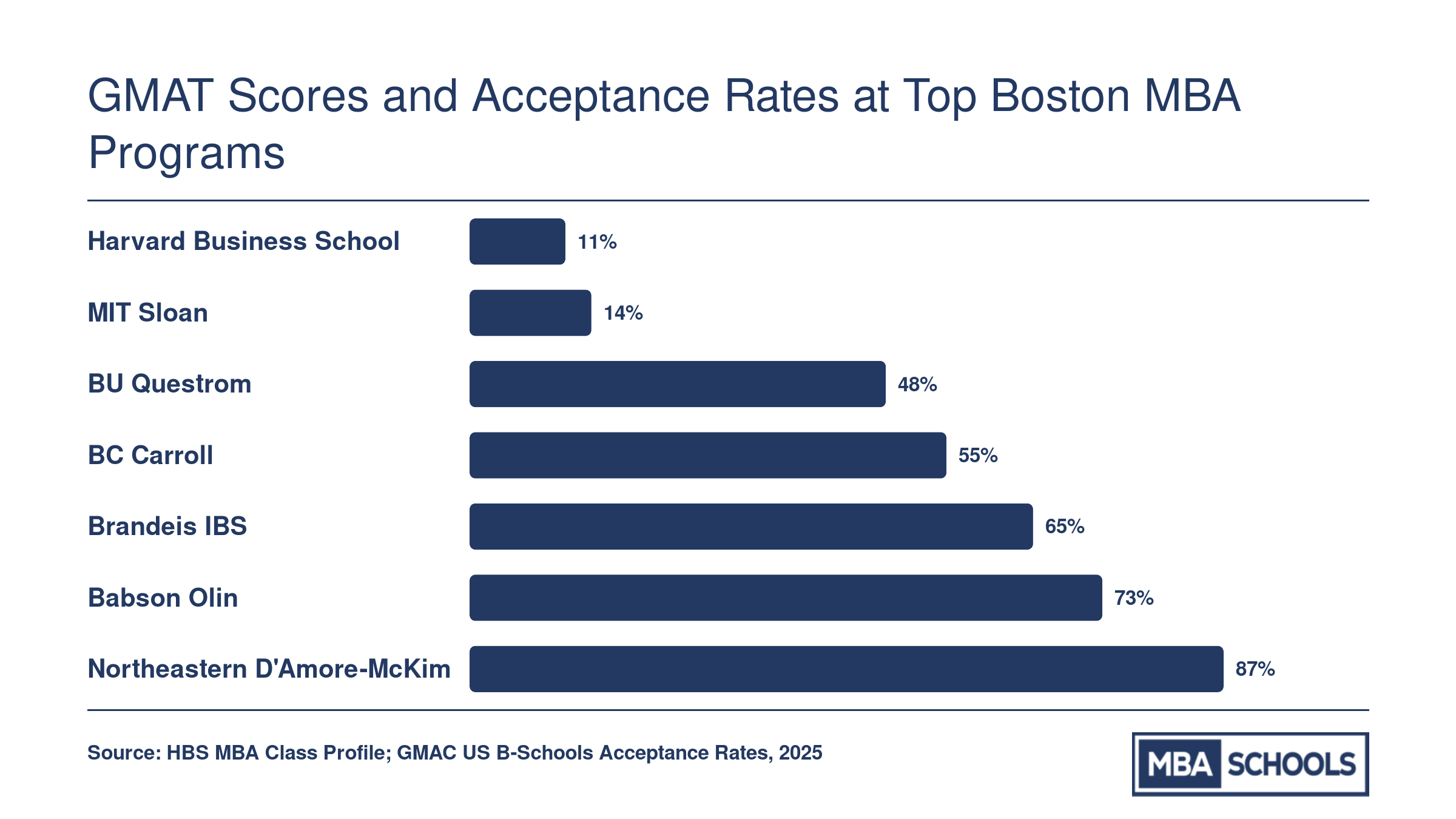
GMAT Scores and Acceptance Rates at Top Boston MBA Programs
Admissions selectivity varies widely across Boston's MBA landscape. Harvard Business School and MIT Sloan accept fewer than 15% of applicants, while programs like BU Questrom, BC Carroll, Babson Olin, and Northeastern D'Amore-McKim offer significantly higher acceptance rates for qualified candidates. It is also worth noting that several Boston-area programs now offer test-optional admissions or accept the Executive Assessment, giving experienced professionals additional flexibility.
Frequently Asked Questions About Boston MBA Programs
Boston's MBA landscape draws thousands of applicants each year, and working professionals often share the same core questions about cost, outcomes, and fit. Below we address the most common concerns using publicly available data and program details from the schools covered in this guide.
Additional MBA Programs in the Boston Area
Beyond the top-ranked programs, Boston and Massachusetts offer many other MBA options worth exploring. Below is a directory of additional accredited programs, organized by region.